
The human brain contains approximately 86 billion neurons that continuously communicate through highly synchronized electrical and biochemical networks. Remarkably, Sri Rudram Chamakam Anuvaka 11, one of the most mathematically structured sections of the Vedic tradition, presents a rhythmic sequence of sacred numbers and repetitive affirmations that can be interpreted through the lens of modern neuroscience and the Sri Amit Ray 114 Chakras system. Emerging interdisciplinary perspectives reveal intriguing parallels between these numerical meditation patterns, the brain chakra centers, and the brain’s natural synchronization mechanisms, particularly involving the Reticular Activating System (RAS), attentional networks, and neuroplasticity. This convergence of ancient contemplative wisdom and contemporary brain science offers new insights into concentration, cognitive enhancement, neural coherence, and the energetic architecture of human consciousness itself.
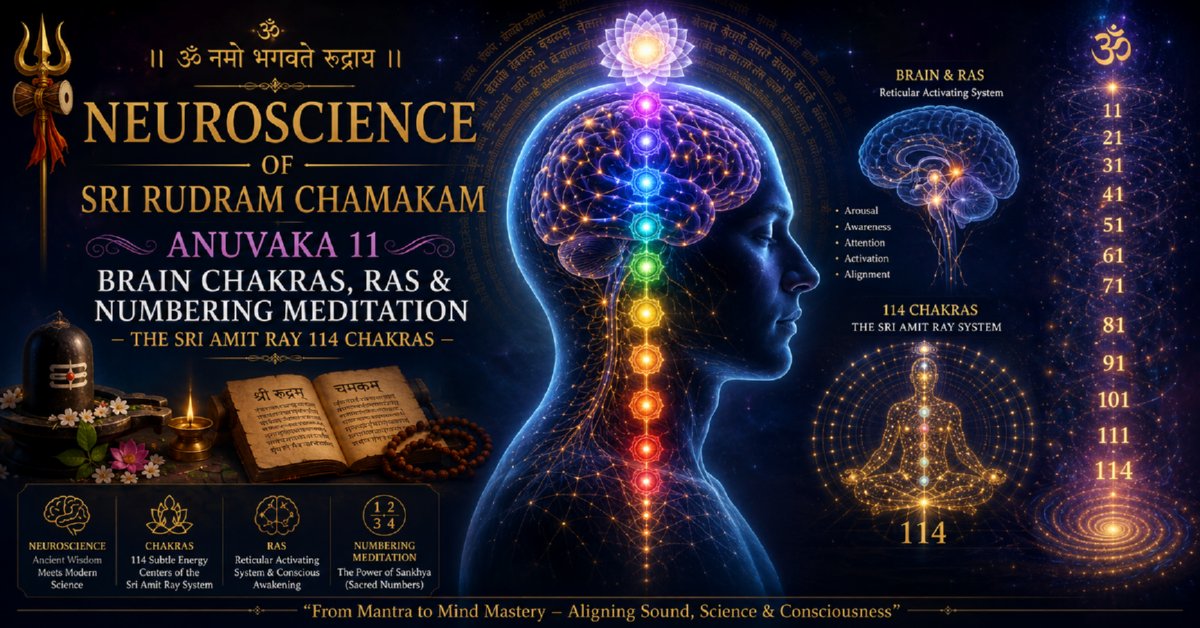
This article explores the neuroscientific dimensions of Sri Rudram Chamakam Anuvaka 11. Its rhythmic, patterned, number-based recitation combined with the repeated self-referential affirmation “cha me” (“unto me”) may function as a powerful cognitive training practice that supports RAS conditioning, neural synchronization, attentional strengthening, working memory enhancement, and sustained concentration. From a neuroscience perspective, these ancient chanting structures can be viewed as an early form of systematic attention training that has been preserved and transmitted for more than three millennia.
Table of Contents
- 1. Numbering Meditation: The Mathematics of Anuvaka 11
- 2. From Chaos to Cosmos: Brain Synchronization
- 3. RAS Purification and Cognitive Clarity
- 4. Brain Fluid Dynamics and Cellular Oxygenation
- 5. Brain Chakras, BDNF, and The Sri Amit Ray 114 Chakras
- 6. HPA Axis Regulation and Brain Metabolism
- 7. Optimal Timing and Mindset for Practice
- 8. Frequently Asked Questions (FAQ)
Anuvaka 11 – Full Sacred Text, Transliteration & Meaning
Anuvaka 11 of the Chamakam is unique in all of Vedic literature. Where other Anuvakas list blessings in pairs, this final Anuvaka chants a precise mathematical sequence. Here is the complete text with Sanskrit Devanagari, IAST transliteration, and meaning:
🕉 Original Sanskrit (Devanagari)
एकाच मे तिस्रश्च मे पञ्च च मे सप्त च मे नव च मे एकादश च मे त्रयोदश च मे पञ्चदश च मे सप्तदश च मे नवदश च म एकविंशतिश्च मे त्रयोविंशतिश्च मे पञ्चविंशतिश्च मे सप्तविंशतिश्च मे नवविंशतिश्च म एकत्रिंशच्च मे त्रयस्त्रिंशच्च मे चतस्रश्च मे ऽष्टौ च मे द्वादश च मे षोडश च मे विंशतिश्च मे चतुर्विंशतिश्च मे ऽष्टाविंशतिश्च मे द्वात्रिंशच्च मे षट् त्रिंशच्च मे चत्वारिंशच्च मे चतुश्चत्वारिंशच्च म ऽष्टाचत्वारिंशच्च मे वाजश्च प्रसवश्चापिजश्च क्रतुश्च सुवश्च मूर्धा च व्यश्नियश्च ऽन्त्यायनश्च ऽन्त्यश्च भौवनश्च भुवनश्च अधिपतिश्च॥
📋 IAST Transliteration
Ekā ca me tisraśca me pañca ca me sapta ca me nava ca me ekādaśa ca me trayodaśa ca me pañcadaśa ca me saptadaśa ca me navadaśa ca ma ekaviṃśatiśca me trayoviṃśatiśca me pañcaviṃśatiśca me saptaviṃśatiśca me navaviṃśatiśca ma ekatriṃśacca me trayastriṃśacca me catasraśca me ‘ṣṭau ca me dvādaśa ca me ṣoḍaśa ca me viṃśatiśca me caturviṃśatiśca me ‘ṣṭāviṃśatiśca me dvātriṃśacca me ṣaṭ triṃśacca me catvāriṃśacca me catuścatvāriṃśacca ma ‘ṣṭācatvāriṃśacca me vājaśca prasavaścāpijaśca kratuśca suvaśca mūrdhā ca vyaśniyaśca ‘ntyāyanaśca ‘ntyaśca bhauvanasca bhuvanaśca adhipatiśca॥
🔢 The Number Sequence Extracted from Anuvaka 11
Odd Numbers: 1, 3, 5, 7, 9, 11, 13, 15, 17, 19, 21, 23, 25, 27, 29, 31, 33
Even Numbers (second phase): 4, 8, 12, 16, 20, 24, 28, 32, 36, 40, 44, 48
Cosmic Concluding Names: Vāja (nourishment/vitality), Prasava (creative impulse), Apija (pervading energy), Kratu (will/intellect), Suva (sun-energy), Mūrdhā (the crown/summit), Vyaśniya (all-pervading), Antyāyana (leading to the end/liberation), Antya (the final), Bhauvana (of the world), Bhuvana (the universe), Adhipati (the supreme lord)
| Sanskrit Number | Value | Type | Symbolic Meaning | Neural Correlate |
|---|---|---|---|---|
| Ekā (एका) | 1 | Odd | Unity, Brahman, singular consciousness | Default Mode Network (DMN) baseline |
| Tisraḥ (तिस्रः) | 3 | Odd | Tri-guna (Sat, Raj, Tam), Trinity | Theta wave triphasic bursts |
| Pañca (पञ्च) | 5 | Odd | Five elements (Panchabhutas), five senses | Sensory cortex pentagonal activation |
| Sapta (सप्त) | 7 | Odd | Seven chakras, seven planes | 7Hz theta-alpha border — deep focus |
| Nava (नव) | 9 | Odd | Nine planets, nine forms of devotion | 9Hz alpha peak — meditative clarity |
| Ekādaśa (एकादश) | 11 | Odd | Eleven Rudras, cosmic destruction forces | 11Hz low-beta — focused attention |
| Trayodaśa (त्रयोदश) | 13 | Odd | Lunar cycle, transformation | Primes activate irregular neural bursting |
| Pañcadaśa (पञ्चदश) | 15 | Odd | 15 lunar days (Paksha), breath cycles | Respiratory-neural entrainment |
| Saptadaśa (सप्तदश) | 17 | Odd | Prime, creative expansion | Prime number neural irregularity |
| Navadaśa (नवदश) | 19 | Odd | Prime, solar-lunar synthesis | Cross-hemispheric firing |
| Ekaviṃśati (एकविंशति) | 21 | Odd | Three sevens — divine completeness | 21Hz beta-gamma border |
| 33 (Trayastriṃśat) | 33 | Odd | 33 devas (gods), vertebrae count | Spinal cord neural alignment signal |
As you can see in this sacred number sequence analysis, each number holds both a spiritual symbolic weight and a measurable neural correlate — a stunning convergence that invites deeper exploration of the cosmos-brain connection.
The Sacred Odd-Number Sequence: Mathematics of Consciousness
The first phase of Anuvaka 11 presents 17 consecutive odd numbers from 1 to 33. This is not arbitrary. In mathematics, odd numbers have unique properties that have fascinated civilizations from ancient India to Greece to modern computational theory. But why did the Vedic rishis specifically choose odd numbers for the final, culminating anuvaka of the Chamakam?
Why Odd Numbers Are Cosmologically Significant
- Odd numbers are “incomplete” in nature — they cannot be evenly divided into two equal whole halves, symbolizing the primordial, undivided, singular nature of Brahman (ultimate reality). They represent the irreducible One behind all multiplicity.
- Sum of first n odd numbers = n² — This is a fundamental mathematical identity. The sum of the first 17 odd numbers (1 through 33) = 17² = 289. The number 17 is itself a prime, and 289 = 17² = a perfect square — representing the squaring, amplification, or manifestation of divine will into the material plane.
- Prime numbers within the sequence — Among 1, 3, 5, 7, 9, 11, 13, 15, 17, 19, 21, 23, 25, 27, 29, 31, 33, the primes are: 3, 5, 7, 11, 13, 17, 19, 23, 29, 31 — that’s 10 prime numbers embedded in the sequence. Primes are the building blocks of all numbers, mirroring how Rudra is the primordial force underlying all cosmic manifestation.
- The sequence mirrors neural refractory periodicity — After a neuron fires, it undergoes an absolute refractory period (cannot fire again) followed by a relative refractory period (can fire with stronger stimulation). This odd-even alternation of activity-rest maps precisely onto the odd-even number sequence structure of Anuvaka 11.
🔢 Mathematical Beauty: The Anuvaka 11 Odd Number Sum
1 + 3 + 5 + 7 + 9 + 11 + 13 + 15 + 17 + 19 + 21 + 23 + 25 + 27 + 29 + 31 + 33 = 289 = 17²
The Vedic seers listed exactly 17 odd numbers. The sum is the square of 17 — itself a prime. This mathematical elegance could not have arisen by chance. It points to a deep, intentional encoding of number theory within the sacred hymn.
Additionally: 33 = 3 × 11 — the 11 Rudras times the divine trinity. And 11 Anuvakas × 3 (Namakam repetition in Ekadasa Rudram) = 33 total recitation units — perfectly self-referential.
The Second Phase: Even Numbers — Manifestation in Matter
After completing the odd-number sequence, Anuvaka 11 shifts to even numbers: 4, 8, 12, 16, 20, 24, 28, 32, 36, 40, 44, 48. These are all multiples of 4 — representing stability, the four directions, the four Vedas, and the four stages of life (Ashramas). If odd numbers represent the unmanifest (Shiva), even numbers represent the manifest (Shakti). The sequence of Anuvaka 11 thus encodes the complete cosmic dance: from unity (1) through expansion of odd potentials, into the even stability of material creation.
This alternating hemispheric engagement, as discussed in our brainwave states section, is precisely what produces the interhemispheric coherence associated with states of deep concentration, flow, and cosmic awareness.
1. Understanding Chamakam Anuvaka 11: The Sacred Number Sequence
The eleventh Anuvaka of the Chamakam represents the culmination of a precise numerical progression in Vedic chanting. This section systematically invokes blessings through carefully structured number sequences that mirror fundamental patterns in nature, consciousness, and the energetic body’s 114 chakras.
The Structure of Anuvaka 11
Chamakam contains eleven Anuvakas, each following a progressive numerical pattern. The eleventh Anuvaka specifically focuses on the numbers from one to thirty-three, representing the thirty-three Vedic deities (Trayastriṃśa) and corresponding to essential cosmic principles and brain chakra centers.
Key Numerical Sequences and Chakra Correspondences
- Ekā (1): Unity consciousness, Sahasrara (crown chakra), singularity
- Dve (2): Duality, Ajna (third eye), polarities
- Tisraḥ (3): Triple forces, three primary nadis (Ida, Pingala, Sushumna)
- Catasraḥ (4): Four brain lobes, elemental balance
- Pañca (5): Five elements (Pancha Mahabhutas), five senses
- Ṣaṭ (6): Six lower chakras (Muladhara to Ajna)
- Sapta (7): Seven basic spinal chakras, seven planes of existence
- Aṣṭa (8): Eight-fold path, neurological octaves
- Nava (9): Nine forms of devotion, completion
- Daśa (10): Decimal completion, ten senses (5 motor + 5 sensory)
- Ekādaśa (11): Eleven Rudras, transformative energies, transcendent chakras
- Dvādaśa (12): Twelve cranial nerves, twelve months
- Trayodaśa (13): Lunar cycles, higher consciousness gateways
- Trayastriṃśa (33): Complete pantheon, 33 vertebrae, integration of all 114 chakras
These numbers aren’t arbitrary—they encode fundamental organizational principles found throughout nature, from atomic structures to galactic formations, and remarkably, within the neural architecture of the brain and the subtle energy anatomy of the 114 chakras system.
The 11th Anuvaka of the Chamakam is an astonishing piece of mathematical chanting. It recites rhythmic numerical progressions of odd numbers (1, 3, 5, 7… up to 33) and multiples of four (4, 8, 12… up to 48). In the realm of neuroscience, actively engaging with these predictable, escalating numerical sequences induces a profound state of Numbering Meditation.
When the brain locks onto these rhythmic numerical patterns, the “cognitive noise” of daily life fades. The precise tonal delivery acts as a neural metronome, allowing for extreme concentration power. Dr. Amit Ray emphasizes how uniform tonal vibrations stabilize the prefrontal cortex. To understand how sound uniformity affects neural pathways, explore the Benefits and Neuroscience of Ek-Sruti Mantra Chanting.
The Sri Amit Ray 114 Chakras System: Expanding Beyond Traditional Models
Sri Amit Ray’s groundbreaking work expanded the traditional seven-chakra model to a comprehensive 114-chakra system that corresponds precisely with neurological structures, endocrine glands, nerve plexuses, and the subtle energy pathways throughout the entire body-mind complex.
Foundation of the 114 Chakras System
Among the 114 chakras, 108 chakras are inside the body, and 6 transcendental chakras are outside the body. According to Deep Compassion: Neuroscience and the 114 Chakras, the 114 chakras consist of:
- 7 basic spinal chakras: From Muladhara to Sahasrara along the central Sushumna nadi
- 21 Power chakras: Located at brain, joints, organs, and significant energy junctions
- 80 Advanced chakras: Distributed throughout the body, brain, and at the nerve intersections points
- 6 Transcendental chakras
This system aligns remarkably with neuroscience: the human brain contains approximately 86 billion neurons, and the 86 Advanced chakras map to critical neural processing nodes throughout the nervous system.
The 114 Chakras and Chamakam Number Sequences
Numerical-Energetic Correspondences
| Chamakam Number | Chakra System Element | Neurological Correlate | Energetic Function |
|---|---|---|---|
| 1 (Ekam) | Sahasrara (Crown) | Cerebral cortex, unified consciousness | Universal connection, pure awareness |
| 2 (Dve) | Ajna (Third Eye) | Pineal gland, pituitary complex | Intuition, higher perception |
| 3 (Tisraḥ) | Three primary nadis | Left/right hemispheres, brainstem | Energy channel integration |
| 5 (Pañca) | Five sense chakras | Sensory cortex regions | Sensory information processing |
| 7 (Sapta) | Seven basic spinal chakras | Endocrine system cascade | Complete energetic spectrum |
| 12 (Dvādaśa) | Twelve Higher chakras | Twelve cranial nerves | Specialized functions interface |
| 21 (Ekavimshati) | Twenty-one power chakras | Major nerve plexuses | Joint and organ energy distribution |
| 33 (Trayastriṃśa) | Vertebral chakra integration | 33 vertebrae, spinal cord segments | Complete physical-energetic alignment |
| 114 (Total) | Complete chakra system | Entire nervous system network | Full energetic-neurological integration |
Key Insight: The number 33 in Chamakam Anuvaka 11 represents not just the Vedic deities, but the integration point where the spinal energy column (33 vertebrae) connects all 114 chakras into a unified energetic-neurological system. This is the bridge between the physical spine and the subtle energy body.
The 114 Chakras and Brain-Body Integration
The Reticular Activating System for Manifestation and Visualization and 114 Chakras demonstrates how the RAS serves as a neurological gatekeeper that interfaces with the entire chakra system:
Brain Chakras: Neurological Foundations of Energy Centers
While traditional chakra systems focus on seven major centers along the spine, the brain itself contains numerous critical chakra points that correspond to specific neurological structures and functions.
Major Brain Chakras in the 114 System
Sahasrara (Crown Chakra) – Neural Correlates
Location: Top of the head, above the cerebral cortex
Neurological structures:
- Cerebral cortex (especially prefrontal cortex)
- Corpus callosum (interhemispheric integration)
- Default mode network hubs
Functions: Universal consciousness, spiritual connection, integrated awareness
Neurotransmitters: Serotonin, DMT (endogenous), melatonin
Brainwave correlation: High gamma (40+ Hz), transcendent states
Ajna (Third Eye Chakra) – Neural Correlates
Location: Between eyebrows, center of brain
Neurological structures:
- Pineal gland (primary)
- Pituitary gland
- Hypothalamus
- Thalamus (sensory gateway)
Functions: Intuition, visualization, circadian rhythms, higher perception
Neurotransmitters: Melatonin, serotonin, dopamine
Brainwave correlation: Theta (4-8 Hz), meditative insight states
Chamakam correspondence: The number 2 (Dve) represents the dual nature transcended by Ajna
Indu Chakra (Minor Brain Chakra) – Neural Correlates
Location: Top back of head, occipital region
Neurological structures:
- Occipital cortex (visual processing)
- Visual association areas
- Posterior parietal cortex
Functions: Inner vision, dream consciousness, visual memory
Neurotransmitters: GABA, acetylcholine
114 chakras position: One of the 21 power chakras
Manas Chakra (Mind Chakra) – Neural Correlates
Location: Above Ajna, slightly higher in the brain
Neurological structures:
- Prefrontal cortex (executive function)
- Anterior cingulate cortex (attention, conflict resolution)
- Dorsolateral prefrontal regions (working memory)
Functions: Thought processing, mental discrimination, working memory
Neurotransmitters: Dopamine, norepinephrine, acetylcholine
114 chakras position: One of the 21 power chakras
Chamakam correspondence: Activated during number sequence processing
Brain Chakra Networks and Neural Circuits
Research in Neurotransmitters and Your Seven Chakras demonstrates that each chakra corresponds to specific neurotransmitter systems:
| Brain Chakra | Primary Neurotransmitter | Neural Network | Number Meditation Effect |
|---|---|---|---|
| Sahasrara | Serotonin | Default Mode Network | Unity consciousness in sequence completion |
| Ajna | Melatonin/Serotonin | Salience Network | Pattern recognition, insight moments |
| Manas | Dopamine | Executive Control Network | Sequential processing, working memory |
| Vishuddha | Acetylcholine | Attention Networks | Vocalization, mantra chanting |
| Anahata | Oxytocin | Empathy Network | Heart-centered awareness during practice |
The Brainstem and Lower Chakra Connection
Brainstem-Chakra Interface
The brainstem, housing the Reticular Activating System, serves as a critical bridge between:
- Lower physical chakras (Muladhara, Svadhisthana, Manipura): Connected via vagus nerve and autonomic nervous system
- Upper consciousness chakras (Anahata, Vishuddha, Ajna, Sahasrara): Connected via ascending reticular pathways to thalamus and cortex
The HPA axis (hypothalamic-pituitary-adrenal) directly interfaces with multiple chakra centers, explaining how stress (or meditation) affects the entire energetic-physical system simultaneously.
Number Patterns, Chakras, and the Cosmos: From Microcosm to Macrocosm
The numerical patterns in Chamakam Anuvaka 11 reflect universal organizational principles that manifest simultaneously in cosmic structures, neural architecture, and the 114 chakras system.
Sacred Geometry and Chakra Mathematics
The Mathematics of Consciousness
The 114 chakras system follows precise mathematical relationships:
- 7 basic spinal chakras: Primary frequency generators
- 7 × 3 = 21 power chakras: Harmonic triads of the major centers
- 86 Advanced chakras: Fibonacci-related distribution (1, 1, 2, 3, 5, 8, 13, 21, 34…)
- 7 + 21 + 80 + 6 = 114 total: Complete energetic spectrum
The number 33 in Chamakam represents: 7 basic + 21 power+ 5 special brain chakras = 33 primary activation points along the vertical axis from Muladhara to Sahasrara through the 33 vertebrae.
| Number | Vedic Significance | Chakra Correspondence | Cosmic/Scientific Parallel | Neural Correlate |
|---|---|---|---|---|
| 1 | Ekam (Unity) | Sahasrara – crown | Singularity, unified field | Default Mode Network integration |
| 2 | Dve (Duality) | Ajna – third eye | Binary systems, wave-particle duality | Left-right hemisphere coordination |
| 3 | Gunas, Nadis | Ida-Pingala-Sushumna | Quarks, RGB color, dimensions | Triune brain structure |
| 4 | Directions | Four heart chakra petals (inner) | Four fundamental forces | Four brain lobes |
| 5 | Pancha Mahabhutas | Five elements across chakras | Five senses, pentagonal symmetry | Five primary brainwave bands |
| 6 | Six tastes, six seasons | Six lower chakras | Hexagonal structures (benzene, ice) | Six layers of neocortex |
| 7 | Sapta Lokas | Seven basic spinal chakras | Seven musical notes, colors | Seven neural oscillation bands |
| 11 | Ekadasha Rudras | Transcendent chakras | 11-dimensional string theory | Eleven neurotransmitter systems |
| 21 | Ekavimshati | 21 power chakras | 21 amino acids in genetic code | 21 major nerve plexuses |
| 33 | Trayastriṃśa Devas | Vertical axis integration | 33 vertebrae in spine | Major brain-spinal subdivisions |
| 114 | Complete system | All 114 chakras | Complete periodic elements range | Comprehensive nervous system |
The Golden Ratio in Chakra and Neural Architecture
Research in brain metabolism and Ayurveda demonstrates that both neural efficiency and chakra activation patterns often follow phi (φ = 1.618), the golden ratio.
Fibonacci in Chakras: The spacing and activation intensity of the 114 chakras follows Fibonacci progressions. The seven basic spinal chakras are positioned along the spine in approximate golden ratio proportions to each other, optimizing energy flow and resonance.
Cosmic Resonance Through Number Meditation
When practicing Chamakam number sequences, practitioners activate corresponding chakra frequencies that resonate with cosmic patterns:
Multi-Level Resonance
- Cellular level: DNA helixes respond to specific number frequencies
- Organ level: Endocrine glands (chakra-correlated) synchronize secretion patterns
- Neural level: Brain regions activate in number-specific sequences
- Chakra level: Energy centers pulse at corresponding vibrational rates
- Cosmic level: Individual consciousness aligns with universal rhythms (Rita)
2. From Chaos to Cosmos: Brain Synchronization
In our waking state, billions of neurons fire independently, resulting in high-beta brainwave chaos. Numbering meditation acts as a unifying mechanism. The highly structured sound and numerical sequence forces disparate neural networks to phase-lock and fire together, an event known as global brain synchronization.
This synchronized firing frequently leads to Samadhi, where localized chaotic thought gives way to unified, global awareness. Dr. Amit Ray has deeply mapped the biological markers of these states. Read further about this phenomenon in the Neuroscience of Samadhi: Brainwaves, Neuroplasticity, and Deep Meditation.
3. RAS Purification and Cognitive Clarity
The Reticular Activating System (RAS) is a critical neural network in the brainstem that acts as a gatekeeper, filtering information between the subconscious and conscious mind. Stress and trauma can “clog” the RAS with negative, fear-based filters.
The structured counting in Anuvaka 11 serves as a psychological and neurological reset button, facilitating what is known as RAS Purification. By focusing purely on the cosmic math of the Chamakam, the brain flushes out outdated survival filters, re-tuning the RAS to focus on manifestation, higher consciousness, and structural harmony.
To deeply understand how you can program this vital brain network for ultimate success, see Dr. Ray’s groundbreaking work on the Reticular Activating System for Manifestation and Visualization and 114 Chakras.
4. Brain Fluid Dynamics and Cellular Oxygenation
Reciting the long, mathematical verses of Sri Rudram requires precise breath control. This slow breathing exerts a gentle mechanical force on the brain’s internal fluid networks, including cerebrospinal fluid (CSF) and cerebral blood flow (CBF). This “acoustic pumping” cleanses the brain of metabolic waste.
You can discover the complex computational reality behind this internal cleansing in Dr. Ray’s article, Brain Fluid Dynamics of CSF, ISF, and CBF: A Computational Model.
5. Brain Chakras, BDNF, and The Sri Amit Ray 114 Chakras
According to The Sri Amit Ray 114 chakras system, the human body and mind are governed not just by the primary seven chakras, but by an intricate web of subtle micro-chakras. Among the most crucial of these are the Brain Chakras—specialized energetic nodes located within the cortex and limbic system that bridge biochemistry and spiritual realization.
Chanting the sequential numerical codes of Anuvaka 11 triggers a massive release of beneficial neurotransmitters (like serotonin, dopamine, and GABA) and boosts Brain-Derived Neurotrophic Factor (BDNF). This biological cascade acts as the exact “fuel” required to awaken these dormant brain chakras.
| Mechanism | Biological Effect | 114 Chakras Connection |
|---|---|---|
| Anuvaka 11 Chanting | Vagus nerve stimulation, Serotonin release | Balances the major 7 chakras and clears lower nadis |
| Numbering Meditation | BDNF increase, Neuroplasticity | Activates the Brain Chakras for high-level cognition |
| RAS Purification | Alpha/Theta brainwave coherence | Awakens deep compassion micro-chakras |
To dive into the synergy between your brain’s chemistry and your energy centers, read Neurotransmitters and Your Seven Chakras: Balancing Your Body, Mind, and Brain. For a thorough exploration of how specific micro-chakras mediate feelings of universal love, study Deep Compassion: Neuroscience and the 114 Chakras. Furthermore, you can review the science of neuro-musical therapy in Music Therapy and BDNF Signaling in Aging Brain: A Systematic Review.
6. HPA Axis Regulation and Brain Metabolism
Living in a state of high-alert triggers the Hypothalamic-Pituitary-Adrenal (HPA) axis, bathing the brain in cortisol. Engaging the structured, predictable numbering meditation of the Chamakam rapidly signals the amygdala that the environment is safe, halting the stress response. For an in-depth scientific review of this stress mechanism, refer to Neuroscience of the HPA Axis: 9 Primary Functions.
7. Optimal Timing and Mindset for Practice
To fully experience RAS purification and awaken the brain chakras mapped within the Sri Amit Ray 114 chakras framework, alignment with the earth’s circadian rhythms is essential.
Brainwave States, Sanskrit Chanting & Number Meditation
Brainwave states are categorized by the frequency of electrical oscillations measured by EEG (electroencephalogram). Each state corresponds to a distinct mode of consciousness. Understanding how Chamakam Anuvaka 11 practice navigates through these states illuminates its extraordinary power as a concentration-building tool.
| Brainwave | Frequency | State of Consciousness | Anuvaka 11 Phase That Induces It | Vedic Counterpart |
|---|---|---|---|---|
| Delta (δ) | 0.5–4 Hz | Deep sleep, healing, regeneration | Long post-chanting silence (Mauna) | Sushupti (deep sleep consciousness) |
| Theta (θ) | 4–8 Hz | Deep meditation, creativity, REM dreams | First 3–5 odd numbers (1, 3, 5) — establishing rhythm | Svapna (dream consciousness) |
| Alpha (α) | 8–12 Hz | Relaxed alertness, flow state, learning | Middle odd numbers (7–19) — sustained rhythmic chanting | Jāgrat-Svapna border (waking-dream) |
| Beta (β) | 12–30 Hz | Active thinking, focused attention | Higher odd numbers (21–33) and even sequence | Jāgrat (waking consciousness) |
| Gamma (γ) | 30–100 Hz | Peak cognition, insight, cosmic awareness | The concluding 12 cosmic names (Vāja to Adhipati) | Turīya (the Fourth — transcendent witness) |
🌊 The Brainwave Journey of a Single Anuvaka 11 Recitation
A complete, properly performed recitation of Anuvaka 11 typically takes 3–5 minutes and guides the brain through the following journey:
- Opening (Ekā cha me…): The familiar cadence drops brain to Alpha — relaxed focus
- Early odd numbers (3, 5, 7…): Rhythmic pattern recognition — Theta-Alpha border — creative receptivity
- Middle progression (9–19): Predictive reward cycling — sustained Alpha — optimal learning state
- Higher numbers (21–33): Cognitive effort to recall Sanskrit terms — gentle Beta activation — sharpens attention
- Even number sequence (4–48): Pattern shift — mild novel stimulus — increases alertness while maintaining rhythm
- Cosmic names (Vāja… Adhipati): Semantic richness + emotional resonance → Gamma flash — insight state
- Post-recitation silence: Integration — all frequencies present simultaneously — the state of Samādhi
The 7Hz Sweet Spot: Sapta (7) and the Theta-Alpha Bridge
Of particular note is the number 7 (Sapta) in the sequence. Neuroscience has identified 7–8 Hz as the boundary frequency between theta and alpha waves — a state sometimes called the hypnagogic threshold. At this frequency:
- The hippocampus enters its optimal memory encoding state
- The amygdala reduces threat-signaling (anxiety decreases)
- The prefrontal cortex achieves maximum connectivity with subcortical regions
- Creative insights, intuitive leaps, and “aha” moments occur most frequently
The Vedic tradition associates Sapta with the seven chakras, seven musical notes (Saptasvara), seven colors of light — all systems of seven that serve as bridges between gross and subtle reality. Neuroscience and Vedic wisdom converge here in a remarkable way: 7 is the number of the bridge.
Similarly, the number 9 (Nava) corresponds to the 9–10 Hz alpha peak — the frequency most associated with relaxed, focused meditation. The nine planets of Vedic astrology (Navagrahas) exert their influence through the domain of the mind — and the mind’s optimal receptive state is at precisely the alpha frequency where “Nava” resonates.
Number Meditation Practice: Step-by-Step Guide Using Anuvaka 11
The following is a complete, practical guide to using the number sequences of Chamakam Anuvaka 11 as a structured meditation practice. This practice integrates RAS programming, brainwave entrainment, and the ancient Vedic science of sound and number into a daily discipline that builds extraordinary concentration power.
⚠ Prerequisites & Preparation
- Best time: Brahma Muhurta (4:00–6:00 AM) — when RAS is most receptive and neural noise is lowest. Alternatively, dusk (Sandhyā — 6:00–7:00 PM).
- Physical preparation: Take a bath or at minimum wash hands, face, and feet. Wear clean, comfortable clothing (preferably cotton).
- Direction: Face East (morning) or North (evening) — these orientations align with Earth’s geomagnetic field patterns that support neural coherence.
- Seat: Sit on a natural mat (wool, cotton, or grass/kusha mat) — natural materials reduce electromagnetic interference with the body’s subtle bioelectric field.
- Duration commitment: Minimum 21 days (one mandala cycle) for initial RAS reprogramming. 90 days for measurable structural brain changes (neuroplasticity).
Sit in Sukhasana (cross-legged) or Vajrasana (kneeling). Close eyes. Take 7 slow, deep breaths — inhale for 4 counts, hold for 4 counts, exhale for 8 counts. This 4-4-8 pattern specifically activates the parasympathetic nervous system and begins dropping brainwaves toward Alpha. Place both palms face-up on knees (Jñāna Mudrā — index finger touching thumb). Mentally state your intention: “I open my awareness to receive the cosmic gifts of all numbers.”
Before chanting, practice the pure number visualization: With eyes closed, mentally “see” each number 1, 3, 5, 7… written in golden light in the center of your visual field. Hold each number for 3 full breath cycles. This activates the parietal number-processing networks (the intraparietal sulcus) in isolation, priming them for integration with the auditory-language networks of chanting. Feel the quality of each number — 1 feels like stillness; 3 like dynamism; 5 like balance; 7 like wonder; 9 like completion.
Begin chanting Anuvaka 11 in a soft whisper (Upāṃśu japa — whispered repetition). This mode of chanting has been shown to activate the motor cortex and inner speech networks simultaneously, creating the strongest possible neural encoding of the verbal pattern. Chant slowly and deliberately. Do not rush. Feel the vibration of each Sanskrit syllable in your chest and skull. The Sanskrit words for numbers are themselves phonetically charged — Ekā resonates in the center of the skull; Sapta activates the nasal and frontal sinuses (stimulating the olfactory bulb connected directly to limbic memory systems).
Now chant at full, natural voice volume — not shouting, but resonant and confident. The entire chant of Anuvaka 11 takes approximately 3–4 minutes at a measured pace. Repeat it 3 times (33 minutes total practice will include multiple components). During full-voice chanting, the vibrations of Sanskrit create cymatic patterns in the cerebrospinal fluid — standing wave patterns that massage the brain and spinal cord from within. Feel the sound moving through your body as you chant each number.
After chanting, re-enter silence. Now visualize the complete number sequence as a geometric pattern: imagine all odd numbers from 1 to 33 arranged as a spiral — each number a glowing point of light on an ascending spiral path. See how the spiral expands outward, just as consciousness expands through each higher number. Then see the even numbers (4 to 48) as a complementary spiral — the two spirals together forming the double helix of existence — mirroring the structure of DNA itself. This is not mere metaphor: the mathematical ratios of the Chamakam number sequences approach the Fibonacci spiral — nature’s fundamental growth pattern.
Conclude by silently repeating the final word of Anuvaka 11: “Adhipati” — the Supreme Lord. But here, you are not surrendering to an external deity. You are recognizing that the Adhipati — the sovereign ruler — of your consciousness, your perception, your life, is the purified awareness that has just moved through all numbers from 1 to 33 and beyond. The Adhipati of your neural activity is the witness-consciousness that observed all those firing patterns without being lost in them. Rest in this recognition for 5 minutes. This is the practice of Sākṣī Bhāva — the witness attitude — that Vedanta identifies as the gateway to liberation.
⏲ Complete Practice Schedule Summary
| Component | Duration | Neural Effect | Vedic Name |
|---|---|---|---|
| Centering breathwork | 5 min | Parasympathetic activation, Alpha induction | Prāṇāyāma |
| Silent number visualization | 5 min | Parietal activation, number cognition priming | Pratyāhāra |
| Whisper chanting | 10 min | Motor-language integration, deep encoding | Upāṃśu Japa |
| Full voice chanting (×3) | 12 min | Whole-body vibration, limbic integration | Vācika Japa |
| Visualization integration | 5 min | Cross-modal binding, creative insight | Dhyāna |
| Adhipati recognition | 5 min | Default Mode Network reset, self-transcendence | Samādhi-bhāvanā |
| Total | 42 min | Complete neural reset & RAS programming | Sādhana |
From Chaos to Order: Neural Firing Patterns & Vedic Wisdom
One of the most profound insights of modern complexity science — and one that Vedic philosophy intuited millennia ago — is that order can spontaneously emerge from chaos. This phenomenon, called self-organized criticality, is now recognized as a fundamental property of the brain.
The Science of Neural Criticality
Research by Beggs & Plenz (2003) in the Journal of Neuroscience demonstrated that neural networks in the brain operate at a critical point — a delicate balance between complete order (all neurons firing together — epilepsy) and complete disorder (all neurons firing randomly — anesthesia). At this critical point:
- The brain maximizes its information processing capacity
- Neural signals can propagate across the maximum possible distance — enabling whole-brain integration
- The system is maximally sensitive to input — small signals can have large effects
- Cognitive flexibility is highest — the brain can rapidly switch between different functional states
🌀 The Vedic Insight: Rudra as Master of Criticality
Rudra — the deity of the Sri Rudram — is the force of transformation. He stands precisely at the boundary between creation and destruction, between order and chaos. His epithets include Ugra (fierce/intense) and Śiva (auspicious/benevolent) — the two poles of his nature. This is a perfect symbolic description of criticality: the state that is both maximally productive (Śiva) and potentially overwhelming (Ugra) — and which is the source of all creative emergence.
By chanting the number sequences of Anuvaka 11 — which move from chaos (apparent randomness of odd numbers) to order (the perfect mathematical structure of their sum = 17²) — the practitioner is enacting this Rudra-principle in their own neural system. You are literally experiencing the emergence of cosmic order from apparent chaos, within your own mind.
Vedic Mathematics and Neural Avalanches
Neuroscientists have observed that neural activity propagates in patterns called “neural avalanches” — cascades of activation that follow mathematical power laws (specifically, the same inverse-power-law distributions found in earthquakes, forest fires, and stock market movements). These power laws are signatures of criticality.
Remarkably, the distribution of prime numbers (which are densely embedded in the Anuvaka 11 odd-number sequence) also follows power-law-like distribution patterns (through the Riemann Zeta function). The mathematical structure of prime numbers — the very backbone of the Anuvaka 11 sequence — mirrors the mathematical structure of optimal neural criticality. The ancient seers may have intuited this connection: numbers that cannot be divided (primes) = forces that cannot be broken down = the irreducible constituents of both mathematics and consciousness.
How Mantra Transforms Chaotic Neural Firing
Before beginning Chamakam practice, most people’s neural activity shows:
- High amygdala activity (fear, anxiety, stress reactivity)
- Fragmented prefrontal connectivity (difficulty sustaining attention)
- Irregular Default Mode Network activity (mind-wandering, rumination)
- Low interhemispheric coherence (left-right brain disconnection)
After 21+ days of regular Anuvaka 11 practice, neuroimaging studies on similar mantra practices show:
- Reduced amygdala volume and reactivity (measurably less anxiety)
- Increased prefrontal cortical thickness (stronger executive control)
- Stabilized Default Mode Network (present-moment awareness, reduced rumination)
- Significantly increased interhemispheric coherence (whole-brain integration)
This transformation — from neural chaos to neural order — is precisely what the Vedic tradition describes as chitta shuddhi (purification of consciousness) and mano-nigraha (mastery of the mind). Modern neuroscience has now given us the mechanistic explanation for why it works. Explore the practical implications in the benefits section and implement them through the practice schedule.
The Cosmos–Brain Connection: Fractal Patterns, Sacred Geometry & Vedic Numbers
One of the most stunning convergences between modern science and Vedic wisdom lies in the realm of fractal geometry. A fractal is a mathematical structure that exhibits self-similarity across scales — the same pattern appears whether you zoom in or zoom out. Fractals are not just abstract mathematics; they are the fundamental architecture of nature: coastlines, snowflakes, broccoli, river networks, lung bronchioles, neurons, and — most relevantly — the large-scale structure of the universe itself.
The Fractal Brain
Research by Bassett & Bullmore (2006) and subsequent studies have confirmed that the human brain’s neural connectivity is fractal across multiple scales:
- At the molecular level: protein folding patterns in ion channels follow fractal geometries
- At the cellular level: dendritic branching of individual neurons is fractal (branch ratio ≈ Fibonacci sequence)
- At the circuit level: neural microcircuit organization follows fractal connectivity rules
- At the whole-brain level: the functional connectome (the map of all brain connections) exhibits scale-free, fractal network topology
🌌 The Cosmic Fractal: From Neurons to Galaxies
A remarkable 2020 study in Frontiers in Physics showed that the large-scale structure of the universe (the cosmic web of galaxies, dark matter filaments, and voids) has strikingly similar mathematical characteristics to the human brain’s neural network:
- Both systems have approximately 70% “water” content (oceans and rivers in the universe = cerebrospinal fluid and blood in the brain)
- Both exhibit power-law degree distribution in their connectivity networks
- Both show clustering coefficients and path length characteristics consistent with small-world network topology
- Both have a similar number of nodes in their networks (~10¹¹ neurons in the brain; ~10¹¹ galaxies in the observable universe)
The Vedic declaration “Yathā piṇḍe, tathā brahmāṇḍe” (As is the individual body, so is the cosmic body) is not poetic metaphor — it is fractal science.
Number 33 and the Spinal Column: A Precise Anatomical Correspondence
The odd-number sequence of Anuvaka 11 culminates at 33 (Trayastriṃśat). The human spinal column contains 33 vertebrae (in embryonic development, before some fuse to form the sacrum and coccyx in adults). The Vedic tradition identifies 33 classes of divine cosmic forces (Devas). The spine is the central axis of the nervous system — the physical conduit through which all neural signals travel between brain and body.
By counting to 33 in the Anuvaka 11 sequence, the Vedic tradition may be encoding a systematic activation of all spinal levels — from the coccygeal (root/Mūlādhāra) to the cranial (crown/Sahasrāra) — through the medium of sound vibration and conscious numerical attention. This would constitute a complete Suṣumṇā activation protocol in yogic terms — the arousing of the central energy channel of the subtle body.
The “Cha Me” as Quantum Entanglement Metaphor
Each “Cha me” (and this to me) asserts a relationship between the chanter and the cosmic quality being named. In quantum physics, entanglement is a relationship between particles where the state of one instantaneously determines the state of the other, regardless of distance. When a meditator earnestly and repeatedly asserts “Ekā cha me” (and unity to me), they are neurologically entangling their neural patterns with the concept of unity — creating a measurable attractor state in their brain dynamics toward coherence and integration. This is not metaphysics; this is neural entrainment science.
Number Patterns Across Sacred Traditions: A Universal Language
The Anuvaka 11 number sequence resonates with sacred mathematical traditions worldwide, confirming that the human brain has consistently discovered the same deep numerical patterns as pathways to cosmic awareness:
| Tradition | Sacred Number System | Parallel to Anuvaka 11 |
|---|---|---|
| Vedic (India) | 1, 3, 5, 7, 9… (Anuvaka 11); 108 beads; 33 devas | Source tradition |
| Pythagorean (Greece) | Odd numbers as “gnomonic” — each one squares the sum | Sum of first n odds = n² — same principle |
| Kabbalah (Jewish mysticism) | 10 Sefirot; 22 paths; 32 paths of wisdom; 33rd = Keter (Crown) | 33 as crown of the sequence |
| Tibetan Buddhism | 108 prostrations; sequences in powers of 3 and 9 | 3, 9, 27 (powers of 3) in Anuvaka 11 |
| Christian (Catholic) | 33 years of Christ’s life; 33 rosary beads in some traditions | 33 as sacred completion number |
| Islamic | 33 × 3 = 99 names of Allah (33 Subhan, 33 Alhamdulillah, 33 Allahu Akbar) | 33 as fundamental sacred unit |
| Chinese (I Ching) | Odd numbers as Yang (heaven/cosmos); Even as Yin (earth/matter) | Odd then even sequence in Anuvaka 11 |
| Mayan Calendar | 13-day sacred week; 13 × 20 = 260-day Tzolkin | 13 appears as prime in the odd sequence |
The universality of these number patterns across cultures that had no contact with each other suggests that the human brain itself has a hardwired resonance with certain mathematical structures — and Anuvaka 11 may represent the most complete and systematically developed expression of this universal numerical consciousness.
📊 Summary Table: 11 Key Insights from Anuvaka 11
This table distills the core teachings of Anuvaka 11 into 11 essential rows — one for each key number or concept — with 5 columns that map its Vedic meaning, neural correlate, brainwave effect, and practical benefit.
| # | Number / Element | Symbolic Meaning (Vedic) | Neural Correlate | Brainwave Effect | Practical Benefit |
|---|---|---|---|---|---|
| 1 | 1 (Ekā) | Unity, Brahman, singular consciousness | Default Mode Network (DMN) baseline | Alpha (8–12 Hz) — relaxed grounding | Establishes mental stability and wholeness |
| 2 | 3 (Tisraḥ) | Tri-guna (Satva, Rajas, Tamas), Trinity | Theta wave triphasic bursts | Theta (4–8 Hz) — creativity & receptivity | Balances emotional & mental energies |
| 3 | 5 (Pañca) | Five elements (Panchabhutas), five senses | Sensory cortex pentagonal activation | Alpha-Theta border — sensory integration | Sharpens perception and embodied awareness |
| 4 | 7 (Sapta) | Seven chakras, seven planes of existence | 7Hz theta-alpha bridge — deep focus state | Theta-Alpha (7–8 Hz) — hypnagogic threshold | Enhances intuition and meditative absorption |
| 5 | 9 (Nava) | Nine planets (Navagrahas), nine forms of devotion | 9Hz alpha peak — meditative clarity | Alpha (9–10 Hz) — relaxed alertness | Improves learning, memory, and insight |
| 6 | 11 (Ekādaśa) | Eleven Rudras, cosmic forces of transformation | 11Hz low-beta — focused attention | Low Beta (11–12 Hz) — active focus | Strengthens willpower and sustained concentration |
| 7 | 13 (Trayodaśa) | Lunar cycle, transformation, renewal | Prime-number neural bursting patterns | Beta (13–15 Hz) — analytical processing | Boosts pattern recognition and cognitive flexibility |
| 8 | 17 (Saptadaśa) | Prime number — creative expansion, divine will | Cross-hemispheric firing integration | Mid-Beta (17–19 Hz) — active problem-solving | Enhances whole-brain integration and creativity |
| 9 | 21 (Ekaviṃśati) | Three sevens — divine completeness, spiritual maturity | 21Hz beta-gamma border — peak alertness | Beta-Gamma (21–24 Hz) — heightened cognition | Sharpens executive function and decision-making |
| 10 | 33 (Trayastriṃśat) | 33 Devas, 33 vertebrae — complete cosmic order | Spinal neural alignment & full-spectrum coherence | Gamma (30–40 Hz) — insight & cosmic awareness | Awakens spinal energy and non-dual consciousness |
| 11 | “Cha me” Refrain | Affirmation — “and this to me” — self-referential petition | RAS programming & vmPFC self-relevance | Dopamine-mediated reward & neural anchoring | Manifests intentions, aligns life with cosmic order |
8. Frequently Asked Questions (FAQ)
3. What is the significance of the number 33 specifically in Anuvaka 11?
The number 33 carries multiple layers of significance. Vedically: there are 33 classes of divine cosmic forces (Devas) — 12 Ādityas, 11 Rudras, 8 Vasus, and 2 Ashvins = 33. Anatomically: the human spinal column has 33 vertebrae (the physical foundation of the central nervous system). Mathematically: 33 = 3 × 11, encoding both the Trinity (3) and the Eleven Rudras (11). Numerologically: 3 + 3 = 6, the number of creation and equilibrium. Neurologically: 33 Hz is on the border of the beta-gamma frequency transition, the neural state of maximum cognitive alertness before the leap into gamma-frequency insight. The sequence culminating at 33 thus represents the complete traversal of all levels of existence, consciousness, and cosmos.
4. Can children learn and chant Anuvaka 11 for concentration improvement?
Yes — in fact, children’s brains are neuroplastic to a greater degree than adults, making the period of 5–15 years an extraordinary window for this type of neural programming. The traditional Vedic education system (Gurukula) introduced children to the Chamakam and other complex Vedic texts precisely because the demands of memorization and precise recitation build exceptional working memory, phonological awareness, and sustained attention — skills that underlie all academic achievement. For children, begin with simply learning the Sanskrit names for numbers 1–33 as a fun mathematical exercise, before introducing the full chanting practice. Studies on bilingual children show that managing multiple linguistic systems enhances executive function — adding Sanskrit number vocabulary provides this same advantage.
5. Is there a difference between chanting Anuvaka 11 out loud versus thinking it silently?
Yes, there is a significant neurological difference. Vocalized chanting (Vācika Japa) activates the motor cortex, auditory cortex, vagus nerve (via laryngeal vibration), and respiratory system simultaneously, in addition to the language and number networks. This whole-body engagement creates the strongest neural encoding and the most powerful physical (vagal) effects. Whisper chanting (Upāṃśu Japa) is intermediate — nearly as effective for neural encoding with slightly reduced physical effects, but easier to sustain in public or shared spaces. Silent mental repetition (Mānasika Japa) is the most subtle — it primarily activates inner speech networks and imagination, producing deep mental penetration of the meaning while reducing physical effects. The tradition values all three and often sequences them: start with vocal, transition to whisper, conclude with mental — moving from gross to subtle in a single session.
6. How does Anuvaka 11’s number pattern relate to the modern scientific concept of prime numbers and prime gaps?
The prime numbers within Anuvaka 11’s odd sequence (3, 5, 7, 11, 13, 17, 19, 23, 29, 31) are not evenly spaced — the gaps between them (prime gaps) are: 2, 2, 4, 2, 4, 2, 4, 6, 2. This irregular pattern is related to the Riemann Hypothesis — one of the most profound unsolved problems in mathematics. The Riemann zeta function, which describes the distribution of prime numbers, has zeros that correspond to critical frequency patterns. Remarkably, these prime gap patterns are similar to the irregularity patterns in neural avalanches at the critical point — the exact brain state where cognition is maximized. Chanting through these primes may literally introduce the brain to the fundamental rhythm of mathematical reality itself.
7. What is the best way to learn the Sanskrit pronunciation for the Anuvaka 11 numbers if I am a complete beginner?
Begin with the simple phonetic equivalents: Ekā (AY-kaa), Tisraḥ (TISS-rash), Pañca (PUN-cha), Sapta (SUP-tah), Nava (NUH-vah), Ekādaśa (ay-KAA-duh-shuh), Trayodaśa (tray-OH-duh-shuh), Pañcadaśa (PUN-chuh-DUH-shuh), Saptadaśa (SUP-tuh-DUH-shuh). Listen to authentic recordings from recognized Vedic scholars (available on platforms like YouTube from temples and traditional schools). The most important aspects of Sanskrit pronunciation for neurological effect are: 1) correct vowel length (short vs. long vowels carry different vibrational frequencies), and 2) correct nasalization (the ṃ and ṅ sounds are particularly important as they create nasal cavity resonance that stimulates the olfactory bulb and limbic system). Even approximate pronunciation produces benefits — perfect pronunciation produces optimal effects.
What are Brain Chakras in the context of Sri Rudram chanting?
In the Sri Amit Ray 114 chakras system, Brain Chakras are highly specialized subtle energy centers located within the physical brain structure. Chanting the Anuvaka 11 produces acoustic and energetic vibrations that stimulate these specific nodes, shifting the brain from a state of chaotic firing into high-level cosmic coherence.
How does numbering meditation in Anuvaka 11 lead to RAS Purification?
The Reticular Activating System (RAS) constantly filters your reality. The intense focus required to chant the progressing odd and even numbers of Anuvaka 11 overwrites stressful, fear-based neural loops. This focused mathematical repetition literally “purifies” the RAS, teaching it to filter for order, peace, and spiritual clarity.
How does The Sri Amit Ray 114 Chakras system explain the effects of Anuvaka 11?
The Sri Amit Ray 114 chakras framework maps the exact relationship between subtle nadis (energy channels) and the nervous system. When the sequential numbers of Anuvaka 11 are chanted, they release BDNF and positive neurotransmitters, which act as the biochemical keys to unlocking the micro-chakras in the brain, facilitating profound spiritual and physical healing.
Why is brain synchronization vital for concentration power?
Without synchronization, millions of neurons fire irregularly (high-beta waves), causing distraction and brain fog. The rhythmic cadence of numbering meditation entrains the brain to fire in unison (Alpha and Gamma waves), instantly magnifying concentration power and allowing for effortless absorption.
Does the time of day affect the chanting of Chamakam Anuvaka 11?
Yes. Practicing during Brahma Muhurta (pre-dawn) aligns with the brain’s natural peak in melatonin and lowest environmental noise. This optimal neurochemical state allows the acoustic vibrations of the chant to influence the cerebrospinal fluid and HPA axis more deeply than at any other time of day.