
Hindu divine genealogy is not one single family tree. It is a network of cosmic origins, divine manifestations, marriages, sages, Prajapatis, Devas, Asuras, Nagas, royal dynasties and theological relationships preserved in the Vedas, Upanishadic thought, Ramayana, Mahabharata and especially the Puranic traditions.
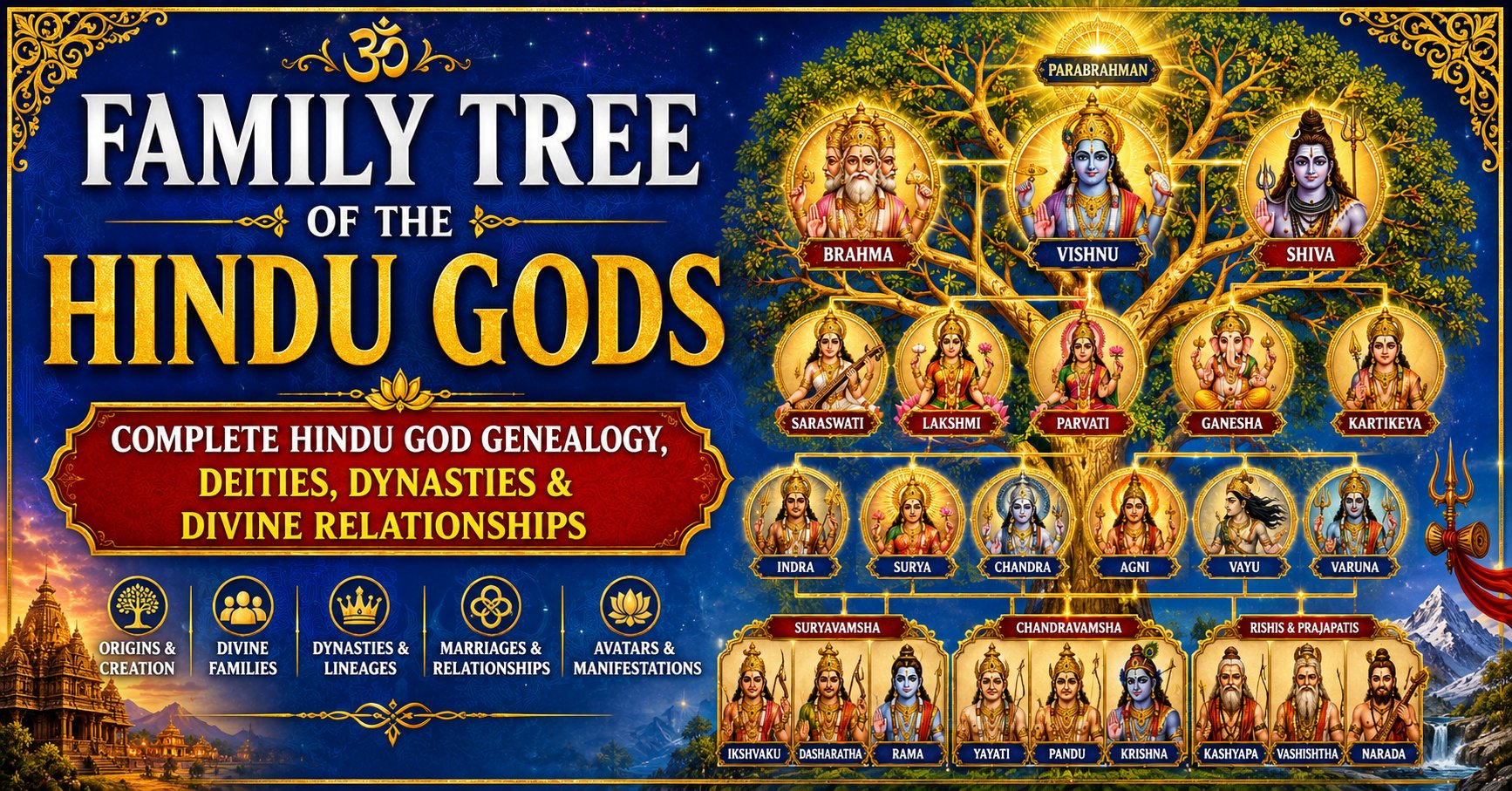
Quick answer: If you are looking for the “Hindu gods family tree,” the most useful starting point is not a simple grandfather → father → son chart. Hindu traditions use several different kinds of relationships: cosmic origin, manifestation, parentage, marriage, lineage, avatar and spiritual identity. A Puranic genealogy can therefore place apparently different divine groups inside one extended cosmic network.
Contents
- How to Understand a Hindu Gods Family Tree
- Master Family Tree
- Cosmic Origins: Brahman, Prakriti, Purusha and Creation
- Brahma, Vishnu and Shiva: The Trimurti
- Brahma’s Creation and the Prajapatis
- Daksha and His Daughters
- Kashyapa: The Great Branching Ancestor
- Aditi, the Adityas and the Devas
- Diti, Danu and the Asura Lineages
- Vinata, Kadru, Garuda and the Nagas
- Surya and the Solar Dynasty
- Chandra and the Lunar Dynasty
- Shiva, Parvati and the Shiva Family
- Vishnu, Lakshmi and the Avatara Tradition
- Shakti and the Divine Feminine
- Rama’s Family and Solar Lineage
- Krishna’s Family and Yadu Lineage
- Major Divine Families at a Glance
- Important Caveats: Why Sources Differ
- Frequently Asked Questions
- Sources and Further Reading
1. How to Understand a Hindu Gods Family Tree
The phrase “family tree of Hindu gods” is convenient for modern readers, but it can be misleading. Hindu sacred literature does not provide a single universally authoritative genealogy comparable to a modern family register.
Different texts and traditions organize divine relationships differently. The Vishnu Purana, for example, presents detailed genealogies of Prajapatis, sages, Devas, and royal dynasties. The Bhagavata Purana gives extensive accounts of creation and the descendants of Kashyapa. The Ramayana emphasizes the Solar Dynasty surrounding Rama, while the Mahabharata and Harivamsha preserve extensive Lunar and Yadu genealogies.
Seven relationship types
| Relationship | Meaning | Example |
|---|---|---|
| Cosmic origin | A theological account of how reality or creation unfolds. | Brahman, Prakriti, Purusha and cosmic creation. |
| Genealogical parentage | Parent-child relationships in mythic/Puranic narratives. | Kashyapa and Aditi → Adityas. |
| Marriage | Divine consort relationships. | Shiva–Parvati; Vishnu–Lakshmi. |
| Manifestation | One divine reality appearing in another form. | Vishnu’s avataras. |
| Dynasty | A royal lineage descending from an ancestral figure. | Ikshvaku → Solar Dynasty. |
| Class/group lineage | A common ancestral branch produces a class of beings. | Adityas, Daityas, Danavas, Nagas. |
| Theological identity | Traditions may identify different divine names/forms as expressions of one Supreme Reality. | Different interpretations of Vishnu, Shiva, Devi and Brahman. |
2. Master Family Tree of the Hindu Gods
The following is a simplified synthesis designed for orientation. It combines major Puranic genealogical branches while avoiding the false impression that every tradition uses one identical tree.
SUPREME REALITY / BRAHMAN
│
├── COSMIC POWER (Brahma, Vishnu, Shiva) / SHAKTI / PRAKRITI
│   │
│   ├── Divine Feminine traditions
│   │   ├── Devi / Mahashakti
│   │   ├── Durga
│   │   ├── Kali
│   │   ├── Parvati
│   │   ├── Lakshmi
│   │   └── Sarasvati
│   │
│   └── Cosmic manifestation
│
├── BRAHMA
│   │
│   ├── Sarasvati (consort in widely known traditions)
│   │
│   └── Prajapatis / mind-born or otherwise manifested progenitors
│       ├── Marichi
│       │   └── Kashyapa
│       │       ├── Aditi → Adityas / Devas
│       │       │          └── Vivasvat / Surya → Vaivasvata Manu
│       │       │                            └── Ikshvaku → Solar Dynasty → Rama
│       │       ├── Diti → Daityas
│       │       │          ├── Hiranyakashipu
│       │       │          │      └── Prahlada
│       │       │          └── other Daitya branches
│       │       ├── Danu → Danavas
│       │       ├── Vinata → Garuda, Aruna
│       │       ├── Kadru → Nagas
│       │       └── other wives/branches → many classes of beings
│       │
│       └── Other Prajapati/sage branches
│
├── VISHNU / NARAYANA
│   │
│   ├── Lakshmi / Shri
│   │
│   └── Avatar traditions
│       ├── Matsya
│       ├── Kurma
│       ├── Varaha
│       ├── Narasimha
│       ├── Vamana
│       ├── Parashurama
│       ├── Rama
│       ├── Krishna
│       ├── Buddha (in traditions that include him)
│       └── Kalki
│
└── SHIVA / RUDRA
    │
    ├── Parvati / Uma / Shakti
    │   ├── Ganesha
    │   └── Kartikeya / Skanda / Murugan
    ├── Parvati
    │   ├── Lakshmi
    │   └── Saraswati
    │
    └── Shiva's many forms and Rudra traditions
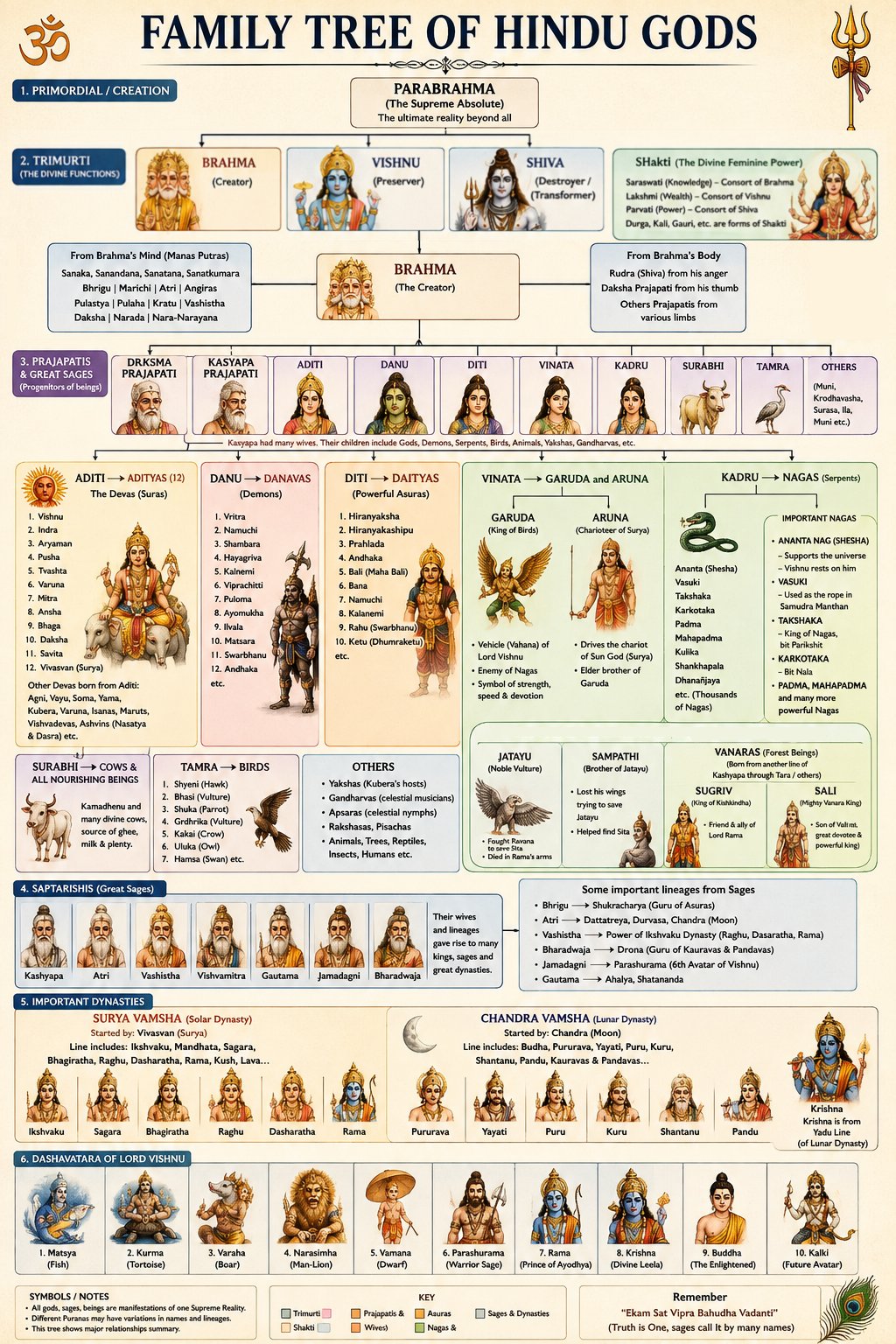
3. Cosmic Origins: Brahman, Prakriti, Purusha and Creation
At the philosophical level, the word Brahman refers to ultimate reality in several Vedantic traditions. It should not automatically be equated with Brahma, the creator deity. The similarity of the English spellings often causes confusion.
| Term | Meaning / Role | Genealogical status |
|---|---|---|
| Brahman | Ultimate reality in Vedantic philosophy; interpretations vary among schools. | Not normally a “parent” in an ordinary biological sense. |
| Brahma | Creator deity in Puranic cosmology. | Participates in creation genealogies. |
| Prakriti | Primordial nature/material principle in Samkhya and related frameworks. | Cosmological principle, not simply a family member. |
| Purusha | Conscious principle in Samkhya; meanings vary by text and school. | Philosophical/cosmological category. |
| Shakti | Divine power/energy; especially central in Shakta traditions. | May be understood as inseparable divine power rather than a genealogical child. |
Because Hindu traditions operate simultaneously through philosophy, mythology, ritual and theology, a “family tree” must keep these levels separate.
4. Brahma, Vishnu and Shiva: The Trimurti
The Trimurti is a well-known Puranic conceptual grouping of Brahma, Vishnu and Shiva. They are commonly associated with creation, preservation and dissolution/transformation. However, the theological meaning of the Trimurti varies, and not every Hindu tradition treats these three deities as equal members of one divine “nuclear family.”
| Deity | Common association | Major consort | Important family/manifestation connections |
|---|---|---|---|
| Brahma | Creation | Sarasvati in widely known traditions | Prajapatis and creation lineages |
| Vishnu | Preservation / cosmic order | Lakshmi / Shri | Avataras such as Rama and Krishna |
| Shiva | Dissolution, transformation, asceticism | Parvati / Uma | Ganesha and Kartikeya/Skanda |
In Vaishnava traditions, Vishnu or Narayana may be understood as Supreme; in Shaiva traditions, Shiva may occupy that position; in Shakta traditions, Devi/Shakti may be Supreme. Smarta traditions can emphasize multiple deities as manifestations of one ultimate reality. Therefore, a good family-tree article should present these perspectives without declaring one sectarian interpretation to be the only Hindu answer.
5. Brahma’s Creation and the Prajapatis
Puranic literature describes Brahma as a creator figure and gives multiple accounts of the emergence of sages and Prajapatis. A Prajapati is broadly a progenitor or lord of creatures. Different texts preserve different lists and mechanisms of creation.
Important Prajapati and sage names
| Name | Role in major genealogical traditions |
|---|---|
| Marichi | A major Prajapati; father of Kashyapa in prominent Puranic genealogies. |
| Atri | One of the celebrated sages and a major lineage ancestor. |
| Angiras | Ancient sage and progenitor figure with extensive Vedic/Puranic associations. |
| Pulastya | Important Prajapati/sage; connected with the lineage of Vishrava and, in turn, Ravana in Puranic genealogy. |
| Pulaha | One of the Prajapati/sage figures. |
| Kratu | One of the traditional progenitor sages. |
| Vasishtha | Major Vedic sage and royal priest in epic traditions. |
| Daksha | Major progenitor figure whose daughters branch into many divine and non-human lineages. |
| Bhrigu | Ancient sage associated with important Brahminical and Puranic genealogies. |
These sages should not be imagined merely as ordinary human ancestors. In Puranic cosmology they can function as cosmic progenitors, sages, divine beings and lineage founders.
6. Daksha and His Daughters: One of the Most Important Branching Points
Daksha is central to the Puranic family-tree concept. The traditions give him daughters who marry major progenitor figures, especially Kashyapa. Through these marriages, the genealogy branches into Devas, Daityas, Danavas, Nagas, birds and other beings.
The Vishnu Purana gives a list of thirteen daughters of Daksha married to Kashyapa: Aditi, Diti, Danu, Arishta, Surasa, Surabhi, Vinata, Tamra, Krodhavasha, Ida, Khasa, Kadru and Muni. Lists vary among texts. Vishnu Purana, Book I, Chapter XV.
| Daksha’s daughter | Associated spouse in the Vishnu Purana genealogy | Major descendants/associations |
|---|---|---|
| Aditi | Kashyapa | Adityas / Devas |
| Diti | Kashyapa | Daityas |
| Danu | Kashyapa | Danavas |
| Vinata | Kashyapa | Garuda and Aruna traditions |
| Kadru | Kashyapa | Nagas |
| Surabhi | Kashyapa | Cows and related beings in Puranic accounts |
| Tamra | Kashyapa | Bird lineages in Puranic traditions |
| Surasa | Kashyapa | Serpent/other beings depending on text and tradition |
| Krodhavasha | Kashyapa | Various fierce/non-human beings |
7. Kashyapa: The Great Branching Ancestor
Kashyapa is one of the most important names in Hindu genealogical literature. The Vishnu Purana describes him as the son of Marichi and gives him marriages to daughters of Daksha. Through different wives, he becomes an ancestor of multiple classes of beings.
The result is a genealogical “hub”:
MARICHI
  │
  └── KASHYAPA
      │
      ├── Aditi ──► Adityas / Devas
      │
      ├── Diti ──► Daityas
      │
      ├── Danu ──► Danavas
      │
      ├── Vinata ──► Garuda and Aruna
      │
      ├── Kadru ──► Nagas
      │
      ├── Surabhi ──► cattle/divine animal traditions
      │
      ├── Tamra ──► bird lineages
      │
      └── other wives ──► numerous classes of beings
This structure is one of the strongest reasons a Hindu “god family tree” becomes much larger than the familiar list of Brahma, Vishnu, Shiva, Lakshmi, Sarasvati and Parvati.
8. Aditi, the Adityas and the Devas
Aditi is a major mother figure in Vedic and Puranic traditions. The Vishnu Purana states that the twelve Adityas were born from Kashyapa and Aditi and lists their names as Vishnu, Shakra, Aryaman, Dhuti, Tvastri, Pushan, Vivasvat, Savitri, Mitra, Varuna, Ansha and Bhaga. Vishnu Purana, Book I, Chapter XV.
| Aditya | General association |
|---|---|
| Vivasvat / Vivasvan | Solar deity; father of Vaivasvata Manu in major genealogies. |
| Varuna | Cosmic order, waters and moral sovereignty in different Vedic traditions. |
| Mitra | Friendship, contracts and social/cosmic order in Vedic tradition. |
| Bhaga | Share, fortune or allotment. |
| Pushan | Protection, paths and pastoral associations. |
| Tvastri | Divine craftsman/artificer in Vedic tradition. |
| Aryaman | Social order, hospitality and kinship associations. |
| Savitri | Solar deity/form associated with stimulation and divine radiance. |
| Shakra | A name/title associated with Indra in the listed genealogy. |
Are all Devas children of Aditi?
No. “Deva” is a broad category, and Hindu texts contain many divine beings whose genealogies are different. Aditi’s sons are specifically the Adityas. Indra, Agni, Vayu, the Ashvins, Rudras, Vasus and other divine groups have their own textual histories and classifications.
9. Diti, Danu and the Asura Lineages
Diti and Danu are major mothers in Puranic genealogy. Their descendants are associated with the Daityas and Danavas, respectively.
Diti → Daityas
The Daitya lineage includes famous figures such as Hiranyakashipu and his son Prahlada. Prahlada is especially important because he becomes a celebrated devotee of Vishnu despite being born in an Asura family.
KASHYAPA + DITI
      │
      ├── DAITYA LINEAGES
      │     │
      │     ├── Hiranyakashipu
      │     │      │
      │     │      └── Prahlada
      │     │
       |     ├──  Raktabija
       |      |
      │     └── other Daityas (Hiranyaksha, Vajranaka, Arunasura, and Surapadman)
      │
      └── (Other traditions preserve additional branches and names)
Danu → Danavas
The Danavas are associated with Danu. The term “Asura” is broader than “Daitya” or “Danava”; therefore, these labels should not always be treated as exact synonyms.
10. Vinata, Kadru, Garuda and the Nagas
The wider Kashyapa genealogy includes famous non-human divine beings.
| Branch | Major figures | Importance |
|---|---|---|
| Vinata | Garuda, Aruna | Garuda becomes the great eagle-like divine being and vehicle of Vishnu; Aruna is associated with the charioteer of Surya. |
| Kadru | Nagas | Associated with serpent beings including Shesha/Ananta and Vasuki in broad traditional genealogical frameworks. |
| Naga traditions | Shesha, Vasuki, Takshaka and others | Important in cosmology, Mahabharata stories and Vishnu/Shiva traditions. |
These relationships show why a complete Hindu family tree cannot stop with the “main gods.” Divine genealogies frequently include animals, celestial beings, sages, kings, serpents and other supernatural classes.
11. Surya and the Solar Dynasty
Surya, or Vivasvan/Vivasvat, is one of the most important solar deities. In Puranic genealogy, Vivasvan is associated with Aditi and Kashyapa. His son Vaivasvata Manu is the Manu of the current manvantara in the traditional cosmological framework.
Surya → Manu → Ikshvaku → Rama
KASHYAPA + ADITI
       │
       └── VIVASVAN / SURYA
              │
              └── VAIVASVATA MANU
                    │
                    ├── IKSHVAKU
                    │     │
                    │     └── SOLAR / IKSHVAKU DYNASTY
                    │            │
                    │            ├── Sagara
                    │            ├── Bhagiratha
                    │            ├── Raghu
                    │            ├── Dasharatha
                    │            └── Rama
                    │
                    └── other sons/branches
The Vishnu Purana, Book IV begins its royal genealogy with Brahma and traces the Solar Dynasty through Manu and his descendants. It explicitly identifies Ikshvaku as one of Vaivasvata Manu’s sons. Vishnu Purana, Book IV, Chapter I.
Bhagavad Gita connection
Bhagavad Gita 4.1 gives a different but complementary kind of lineage: Krishna says the imperishable Yoga was taught to Vivasvan (the Sun-god), then to Manu, and then to Ikshvaku. Bhagavad Gita.
श्रीभगवान् उवाच ।
इमम् विवस्वते योगम् प्रोक्तवान् अहम् अव्ययम् ।
विवस्वान् मनवे प्राह मनुः इक्ष्वाकवे अब्रवीत् ॥ 4.1
12. Chandra and the Lunar Dynasty
The Lunar Dynasty or Chandravamsha is another major royal genealogy. Its mythic ancestry begins with Chandra/Soma and proceeds through Budha, Pururavas and later branches including the Puru and Yadu lines.
CHANDRA / SOMA
      │
      └── BUDHA
            │
            └── PURURAVAS
                  │
                  └── AYUS
                        │
                        └── NAHUSHA
                              │
                              └── YAYATI
                                  │
                                  ├── YADU
                                  │    └── YADAVA / VRISHNI BRANCHES
                                  │          └── KRISHNA
                                  │
                                  └── PURU
                                       └── PURU DYNASTY
                                            └── KURU LINE
                                                 ├── Pandavas
                                                 └── Kauravas
The exact sequence and details vary among texts, especially around Ila, Budha, Pururavas and the branching of the dynasties. The broad distinction remains important: Rama is associated with the Solar Dynasty, while Krishna is associated with the Yadu branch of the Lunar Dynasty.
13. Shiva, Parvati and the Shiva Family
The Shiva family, often called Shiva Parivar, is one of the most recognizable divine families in Hindu devotional culture.
SHIVA / MAHADEVA
      │
      └── PARVATI / UMA / SHAKTI
            │
            ├── GANESHA
            │
            └── KARTIKEYA / SKANDA / MURUGAN
            |
           ├── Lakshmi
           │
           └── Saraswati
Parvati and the Shakti connection
Parvati is understood through several names and theological forms, including Uma, Gauri and Durga in different contexts. In Shakta traditions, Devi/Shakti can be understood not merely as Shiva’s consort but as the Supreme Divine Power itself.
Ganesha
Ganesha is revered as the remover of obstacles, lord of beginnings and patron of wisdom and discernment. The best-known family tradition identifies him with Shiva and Parvati, although the birth narrative varies in detail across texts and regional traditions.
Kartikeya / Skanda / Murugan
Kartikeya is known by names including Skanda, Kumara and Murugan. He is strongly associated with divine warfare, courage and spiritual power. His mythology is especially prominent in South Indian traditions, where Murugan worship is central.
14. Vishnu, Lakshmi and the Avatar Tradition
Vishnu is one of the central deities of Hinduism and the focus of Vaishnava traditions. His consort is commonly identified as Lakshmi or Shri, associated with prosperity, auspiciousness, beauty and abundance.
| Avatar | Major purpose/theme in popular tradition |
|---|---|
| Matsya | Fish form; preservation and rescue during a cosmic deluge narrative. |
| Kurma | Tortoise form; support during the churning of the ocean. |
| Varaha | Boar form; rescue of Earth in the Hiranyaksha narrative. |
| Narasimha | Man-lion form; protection of Prahlada and defeat of Hiranyakashipu. |
| Vamana | Dwarf Brahmin form; encounter with King Bali. |
| Parashurama | Warrior-sage figure. |
| Rama | Ideal king and central hero of the Ramayana. |
| Krishna | Central figure of the Mahabharata and Bhagavad Gita; major object of devotion. |
| Buddha | Included as an avatar in some Vaishnava lists; not included in all traditional lists in the same way. |
| Kalki | Future avatar associated with the end of the Kali Yuga in traditional cosmology. |
The concept of an avatar is crucial because it is a theological relationship, not a normal parent-child relationship. Rama and Krishna are therefore connected to Vishnu in a different sense from Ganesha being connected to Shiva and Parvati.
15. Shakti and the Divine Feminine
A conventional male-centered family tree can badly distort Hindu theology because many traditions place the Divine Feminine at the center.
| Form/name | Common associations | Important note |
|---|---|---|
| Devi | The Goddess / Divine Feminine | Can be a general title or a supreme theological principle. |
| Shakti | Divine power/energy | In Shakta thought, Shakti can be understood as ultimate reality. |
| Durga | Protection, power, victory | Major Goddess of Shakta traditions. |
| Kali | Time, transformation, fierce compassion | Major form of Devi. |
| Lakshmi | Prosperity, abundance, auspiciousness | Widely revered as Vishnu’s consort. |
| Sarasvati | Knowledge, learning, speech, arts | Widely revered as Brahma’s consort in popular tradition. |
| Parvati | Motherhood, power, ascetic devotion | Consort of Shiva; associated with many Goddess forms. |
| Annapurna | Nourishment and food | Important form of the Goddess associated with Parvati/Shakti. |
From a theological perspective, these forms may be interpreted as distinct goddesses, manifestations of one Devi, or different aspects of divine power depending on the tradition.
16. Rama’s Family and the Solar Lineage
Rama is traditionally connected with the Ikshvaku / Solar Dynasty. His immediate family is central to the Ramayana.
DASHARATHA
│
├── KAUSALYA ──► RAMA ──► SITA
│
├── KAIKEYI ──► BHARATA
│
└── SUMITRA ──► LAKSHMANA & SHATRUGHNA

RAMA + SITA
│
├── LAVA
└── KUSHA
The genealogical significance of Rama goes beyond his immediate family. He represents the culmination of a long Solar Dynasty in epic storytelling. Puranic genealogies and the Ramayana preserve overlapping but not always identical king lists.
17. Krishna’s Family and the Yadu Lineage
Krishna is traditionally associated with the Yadu branch of the Lunar Dynasty. His immediate family is extensive and includes Vasudeva, Devaki, Rohini, Balarama and the Yadava/Vrishni community.
YAYATI
  │
  └── YADU
       │
       └── YADU / YADAVA BRANCHES
             │
             └── VRISHNI LINE
                   │
                   └── VASUDEVA
                        ├── DEVAKI ──► KRISHNA
                        └── ROHINI ──► BALARAMA

NANDA + YASHODA
       │
       └── Krishna's foster family in Vrindavana tradition
Krishna’s genealogy demonstrates another important principle: biological, foster, dynastic and theological relationships can all matter simultaneously. His childhood in the household of Nanda and Yashoda is central to devotional traditions even though his birth parents are Vasudeva and Devaki.
18. Major Divine Families at a Glance
| Family/Line | Key members | Type of relationship | Major textual traditions |
|---|---|---|---|
| Shiva Parivar | Shiva, Parvati, Ganesha, Kartikeya | Divine family | Puranic, regional and devotional traditions |
| Vishnu–Lakshmi | Vishnu, Lakshmi, avataras | Consort + manifestation | Vaishnava Puranas, epics, devotional literature |
| Brahma creation line | Brahma, Prajapatis, sages | Creation/progenitor lineage | Puranas |
| Kashyapa family | Kashyapa, Aditi, Diti, Danu, Vinata, Kadru | Genealogical branching | Vishnu Purana, Bhagavata Purana, Mahabharata |
| Aditya branch | Aditi, Vivasvan, Varuna, Mitra and others | Deva lineage | Vedic and Puranic traditions |
| Daitya branch | Diti, Hiranyakashipu, Prahlada | Asura lineage | Puranas, especially Bhagavata traditions |
| Solar Dynasty | Surya/Vivasvan, Manu, Ikshvaku, Rama | Royal/dynastic lineage | Ramayana, Vishnu Purana, other Puranas |
| Lunar/Yadu line | Chandra, Budha, Pururavas, Yayati, Yadu, Krishna | Royal/dynastic lineage | Mahabharata, Harivamsha, Puranas |
19. Why Different Hindu Family Trees Look Different
1. Different Puranas emphasize different genealogies
The Puranas are not a single book. They are a large body of literature containing overlapping narratives, different theological emphases and sometimes different genealogical lists.
2. Names can represent multiple levels
For example, “Vishnu” can mean a specific deity, a cosmic principle, the Supreme Being in a Vaishnava tradition, or a member of a list of Adityas depending on context.
3. A deity can have multiple forms
Rama and Krishna can be presented as avataras of Vishnu, while in particular devotional traditions they can themselves be treated as Supreme.
4. Divine consorts are theological as well as familial
Lakshmi, Sarasvati and Parvati are not merely “wives” in the modern genealogical sense. Their identities can express divine power, knowledge, prosperity, consciousness or Shakti.
5. Regional traditions matter
South Indian Murugan traditions, Bengali Kali traditions, Vaishnava Krishna traditions, Shaiva traditions and Shakta traditions may organize divine relationships differently while remaining recognizably part of the wider Hindu religious world.
20. Frequently Asked Questions (AEO)
Who is the father of the Hindu gods?
There is no single answer because “Hindu gods” is not one genealogical family. At the philosophical level, Brahman is ultimate reality in several Vedantic systems. At the Puranic creation level, Brahma is a creator deity, while figures such as Daksha and Kashyapa serve as important progenitors in particular genealogies.
Are Brahma, Vishnu and Shiva brothers?
No single Hindu scripture establishes a universally accepted literal brother relationship. The Trimurti is a theological grouping, and different traditions explain the relationship between these deities differently.
Who are Kashyapa’s famous children?
Depending on the Puranic genealogy and the wife involved, Kashyapa is associated with the Adityas/Devas, Daityas, Danavas, Garuda, Aruna, Nagas and numerous other classes of beings.
Who is the mother of the Devas?
Aditi is one of the most important maternal figures for the Adityas. The Vishnu Purana describes the twelve Adityas as sons of Kashyapa and Aditi.
Who is the mother of the Asuras?
There is no single mother of every being called an Asura. Diti is associated with the Daityas and Danu with the Danavas in Puranic genealogies. “Asura” is a broader term whose usage changes across texts.
Who are Shiva and Parvati’s children?
Ganesha and Kartikeya/Skanda are the best-known children of Shiva and Parvati in Hindu tradition. Their birth stories have multiple textual and regional versions.
Is Lakshmi Shiva’s wife?
No. In the widely known Vaishnava tradition, Lakshmi is the consort of Vishnu. Parvati/Uma is the principal consort of Shiva in major Shaiva and Puranic traditions.
Is Sarasvati Vishnu’s wife?
In widely known Hindu tradition, Sarasvati is associated with Brahma, while Lakshmi is associated with Vishnu. Different theological and regional traditions can give divine relationships different interpretations.
Are Rama and Krishna brothers?
No. Rama belongs to the Solar Dynasty, while Krishna belongs to the Yadu branch of the Lunar Dynasty. They are connected primarily through Vaishnava theology as avataras/forms of Vishnu, not as biological brothers.
How are Rama and Surya connected?
Rama belongs to the Ikshvaku or Solar Dynasty. Puranic genealogies trace the dynasty through Vaivasvata Manu and Ikshvaku, with Vivasvan/Surya as an earlier ancestral figure.
How are Krishna and Chandra connected?
Krishna is traditionally placed in the Yadu branch of the Lunar Dynasty, whose ancestry is traced through Chandra/Soma and the descendants of Yayati.
What is the biggest family in Hindu mythology?
There is no objective “biggest” family, but the Kashyapa genealogy is one of the most useful hubs for understanding the enormous network of Devas, Daityas, Danavas, Nagas, Garuda and other beings.
Suggested source hierarchy for serious research
- Read the relevant Sanskrit passage where possible.
- Compare at least two Puranic traditions for genealogical claims.
- Compare the Ramayana and Mahabharata/Harivamsha for royal dynasties.
- Use modern encyclopedias and websites as secondary guides, not as the sole authority.
- When traditions disagree, preserve the disagreement rather than forcing one “official” family tree.
Conclusion: The Hindu Gods Family Tree Is a Cosmic Network
The most accurate way to visualize the Hindu gods is as a multi-layered cosmic network rather than a single straight family tree. Brahma’s creation narratives lead to Prajapatis and sages; Daksha’s daughters and Kashyapa create enormous branches; Aditi leads to the Adityas, Diti to the Daityas, Danu to the Danavas, Vinata to Garuda and Aruna, and Kadru to the Nagas. From Vivasvan and Manu comes the Solar Dynasty, culminating in the epic world of Rama. The Lunar tradition leads through Chandra, Yayati and Yadu to Krishna and the Yadava/Vrishni world.
Alongside these genealogies are the divine families of Shiva and Parvati, Vishnu and Lakshmi, Brahma and Sarasvati, and the vast network of Shakti forms. These relationships cannot always be reduced to biology because Hindu theology uses concepts such as avatar, manifestation, Shakti, cosmic function and divine identity.