
The Ganga River, one of the most sacred and ecologically complex river systems in the world, has long intrigued scientists for its unusual ability to resist microbial decay and maintain a degree of self-purification. Among the most compelling scientific explanations for this phenomenon is the presence of bacteriophages—viruses that specifically infect and destroy bacteria. These microscopic entities play a crucial role in shaping microbial ecosystems, controlling pathogenic populations, and potentially offering solutions to modern antimicrobial resistance.
This article provides a comprehensive scientific exploration of bacteriophages in the Ganga River, examining their role in natural self-purification, microbial ecology, and emerging therapeutic applications. It systematically covers key dimensions including Introduction: The Mystery of Ganga’s Self-Purification, Historical Evidence: Ernest Hankin’s 1896 Discovery, Metagenomic Insights: Kanpur vs Farakka Phage Diversity, How Bacteriophages Drive Self-Purification, Phages During Maha Kumbh Mela 2025, Emerging Therapeutic Potential and Phage Therapy, and Frequently Asked Questions, offering an integrated, evidence-based understanding of viral dynamics within one of the world’s most unique river ecosystems.
Key Insight: Bacteriophages in the Ganga act as natural biological regulators, continuously reducing harmful bacterial loads and contributing to the river’s unique resilience.
What Are Bacteriophages?
Bacteriophages, often simply called phages [1], are viruses that infect bacteria with remarkable specificity. Structurally, they consist of genetic material (DNA or RNA) enclosed within a protein capsid. When a phage encounters a suitable bacterial host, it attaches to the cell, injects its genetic material, and hijacks the host’s cellular machinery to replicate itself [2]. This process typically leads to the destruction (lysis) of the bacterial cell, releasing new phage particles into the environment. Due to their specificity, phages can target harmful bacteria without disturbing beneficial microbial communities [4].
In rivers such as the Ganga, phages act as invisible ecological regulators. By infecting and lysing bacteria, they help control microbial overgrowth, influence nutrient cycling, shape community diversity, and sometimes reduce the proliferation of harmful pathogens.
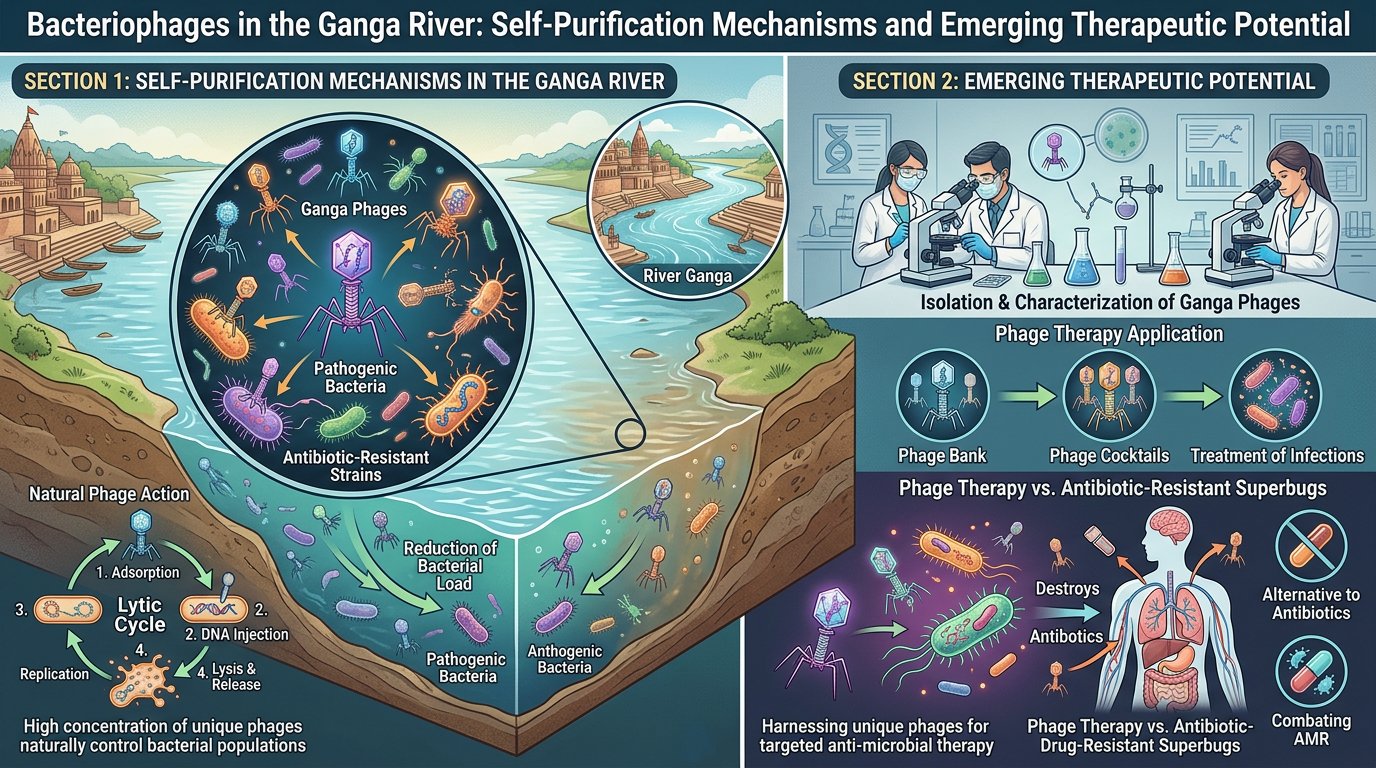
The sacred Ganga River harbors thousands of bacteriophages — viruses that specifically target and destroy harmful bacteria. Despite receiving massive industrial and urban pollution, especially highly polluted places like Kanpur, the river maintains remarkable self-purifying ability largely due to these natural predators. The Ganga River is heavily polluted, with the most critical stretches located in Kanpur, Varanasi, Kannauj, Prayagraj, Gaighat and Darbhanga Ghat of Patna, Farraka, and Babughat Kolkata. The Jajmau, Sarsaiya Ghat, Bhairav Ghat, and Dhobi Ghat of Kanpur are critical.
Metagenomic studies comparing heavily polluted Kanpur stretches with cleaner Farakka sites reveal dynamic phage communities that help sustain the river’s legendary “healing power.” This natural mechanism also showed potential during the massive 2025 Maha Kumbh Mela at Prayagraj.
Today, shotgun metagenomic sequencing allows us to look deeper than ever before—reading the complete genetic library of the Ganges and revealing the millions of microscopic organisms that give the sacred water its life. Scientists are now exploring Ganga-derived phages as eco-friendly alternatives to combat antibiotic-resistant superbugs worldwide.
As the world faces the growing threat of antibiotic resistance, bacteriophages are emerging as promising therapeutic agents. Unlike broad-spectrum antibiotics, phages can target specific bacteria, offering a more precise and potentially effective way to fight stubborn infections, including those caused by multidrug-resistant pathogens.
The Ganga, therefore, is not just a river of heritage and faith — it may also be a source of insight into ecological resilience, microbial balance, and the future of infection treatment.
Table of Contents
- What Are Bacteriophages?
- The Mystery of Ganga’s Self-Purification
- Historical Evidence: Ernest Hankin’s 1896 Discovery
- Metagenomic Insights: Kanpur vs Farakka Phage Diversity
- How Bacteriophages Drive Self-Purification
- Phages During Maha Kumbh Mela 2025
- Emerging Therapeutic Potential and Phage Therapy
- Frequently Asked Questions
Introduction: The Mystery of Ganga’s Self-Purification
The River Ganga, revered for millennia, continues to surprise scientists with its ability to resist putrefaction and maintain relatively lower pathogenic loads despite severe anthropogenic stress. Bacteriophages — viruses that infect and lyse bacteria — play a central role in this natural resilience.
Key Fact: Shotgun metagenomics has confirmed that the Ganga hosts a rich and dynamic virome, with phage families responding to pollution gradients and selectively controlling harmful bacteria such as Pseudomonas, Enterobacter, and coliforms.
Shotgun metagenomics is an untargeted, high-throughput sequencing method that sequences all DNA within an environmental or clinical sample, offering a total view of microbial communities without needing culture. It identifies “who is there” (taxonomic composition) and “what they are doing” (functional potential) by analyzing bacteria, viruses, fungi, and archaea simultaneously.
Mechanisms of Self-Purification
The Ganga River’s self-purification is a multifactorial process involving:
- Bacteriophage activity: Targeted elimination of pathogenic bacteria
- High dissolved oxygen levels: Enhanced microbial degradation
- Sunlight (UV radiation): Natural disinfection
- Continuous flow dynamics: Dilution and dispersion of contaminants
Among these, bacteriophages function as a dynamic biological defense system. They continuously evolve alongside bacterial populations, ensuring sustained ecological balance.
Microbial Ecology and Viral Dynamics
The Ganga represents a complex microbial ecosystem where bacteria, viruses, algae, and protozoa interact in a dynamic equilibrium. Bacteriophages influence:
- Bacterial population control
- Horizontal gene transfer
- Nutrient cycling through bacterial lysis
- Evolutionary pressure on microbial communities
This viral-bacterial interaction is essential for maintaining water quality and preventing the unchecked growth of pathogenic organisms.
Historical Evidence: Ernest Hankin’s 1896 Discovery
In 1896, British bacteriologist Ernest Hankin reported that Ganga water exhibited strong bactericidal activity against Vibrio cholerae. He noted that the effect was destroyed by boiling or filtration but persisted in raw river water. This observation predated the formal discovery of bacteriophages by decades and is now widely regarded as one of the earliest documented accounts of phage activity in a natural environment.
Metagenomic Insights: Kanpur vs Farakka Phage Diversity
A comprehensive metagenomics study analyzed water and sediment samples from heavily polluted sites near Kanpur (receiving effluents from leather, pesticide, paper industries, and urban sewage) and relatively less polluted sites near Farakka.
The results revealed striking differences in viral communities:
| Viral/Phage Family | Kanpur (Polluted) | Farakka (Less Polluted) | Ecological Role |
|---|---|---|---|
| Microviridae (ssDNA phages) | Significantly higher | Lower | Rapid replication in high-organic polluted waters |
| ssDNA viruses | Higher | Lower | Density-dependent control of bacterial blooms |
| Mimiviridae | Higher | Lower | Regulation of eukaryotic microbes |
| Myoviridae (tailed dsDNA phages) | Lower | Significantly higher | Dominant in cleaner stretches; broad host range |
| Unidentified phage families | Lower | Higher | Novel diversity in pristine areas |
Despite massive pollutant inputs at Kanpur, the elevated abundance of certain phages helps prevent unchecked proliferation of pathogenic bacteria, contributing to the river’s overall self-cleansing capacity.
How this works
- When bacterial numbers rise, the phages that infect those bacteria also rise.
- These phages attach to specific bacteria, inject their genetic material, multiply inside them, and then burst the bacterial cells open.
- As a result, they can limit the overgrowth of certain pathogenic bacteria.
Why this matters at Kanpur
Even though the river receives heavy pollutant loads there, the high abundance of certain phages may help stop dangerous bacteria from multiplying without limit. In other words, the river has a kind of biological defense mechanism working within its microbial ecosystem.
The Self-Cleansing Engine: Killing the Winner
In microbial ecology, this is called the “Kill the Winner” dynamic. As soon as one specific type of dangerous bacteria tries to dominate the river (the “winner”), its specific bacteriophage multiplies and wipes it out. The phages act as microscopic regulators. They do not allow any single pathogen to multiply unchecked. This relentless, invisible warfare is the exact biological engine of the river’s legendary “self-purifying” (Brahma Dravya) capacity.
How Bacteriophages Drive Self-Purification Mechanisms
Bacteriophages act as natural predators in a classic “kill-the-winner” ecological dynamic. When bacterial populations surge due to organic pollution, specific lytic phages multiply rapidly inside host cells, causing lysis and releasing new virions that continue the cycle [3].
This density-dependent regulation helps maintain microbial balance, reduces biochemical oxygen demand indirectly, and prevents dominance by opportunistic pathogens. Auxiliary metabolic genes carried by some Ganga phages may also enhance nutrient cycling in the river ecosystem.
Physical factors like dilution during monsoon, UV exposure, and sedimentation complement phage activity, creating a multi-layered self-purification system unique in its robustness.
Bacteriophages and the Maha Kumbh Mela 2025
January–February 2025
Prayagraj (Allahabad), Uttar Pradesh, India
During the historic Maha Kumbh Mela 2025, over 660 million devotees gathered at the confluence of the Ganga, Yamuna, and mythical Saraswati. Despite extreme crowding and potential fecal contamination, reports of large-scale waterborne disease outbreaks remained surprisingly low. Scientists hypothesize that the resident bacteriophage population in Ganga water provided silent, natural protection by targeting common enteropathogens such as Escherichia, Salmonella, Vibrio, and Shigella species.
This event offered a real-world “natural experiment” highlighting the therapeutic-like role of environmental phages in mass gatherings.
Emerging Therapeutic Potential: From River to Phage Therapy
Ganga-derived bacteriophages have shown promising activity against drug-resistant bacteria, including Klebsiella pneumoniae. In laboratory and zebrafish infection models, isolated phages successfully reduced both planktonic growth and biofilms of resistant clinical strains.
These findings open avenues for developing phage cocktails as sustainable alternatives or adjuncts to antibiotics, especially relevant in the era of rising antimicrobial resistance (AMR).
Challenges remain in standardization, regulatory approval, and ensuring safety, but the Ganga’s viral biodiversity represents a valuable natural repository for biotechnological innovation.
Phage Families and Their Roles in Aquatic Microbial Ecology
Note: The family names below follow traditional phage classification commonly used in environmental and water microbiology literature.
| Phage Family | Typical Features | Common Bacterial Hosts | Main Role in Aquatic Ecosystems | Relevance to Ganga Water |
|---|---|---|---|---|
| Myoviridae | dsDNA phages with long contractile tails | Escherichia coli, Vibrio, Pseudomonas, Salmonella | Strongly lytic; rapidly kill bacteria and regulate bacterial blooms | May help suppress pathogenic bacteria in polluted stretches, supporting self-cleansing |
| Siphoviridae | dsDNA phages with long non-contractile tails | Enterococcus, Lactococcus, Streptococcus, Mycobacterium | Often involved in long-term host interactions; can influence microbial diversity and gene exchange | May shape the stability and diversity of river microbial communities |
| Podoviridae | dsDNA phages with short tails | E. coli, Salmonella, Vibrio | Fast infection cycles; important in bacterial turnover and nutrient recycling | Can contribute to rapid control of specific bacterial populations in water |
| Microviridae | Small ssDNA phages, no tail | Mainly enteric bacteria and related microbes | Common in aquatic environments; influence microbial population dynamics | Often detected in metagenomic studies and may serve as markers of microbial activity |
| Inoviridae | Filamentous ssDNA phages | Pseudomonas, Vibrio, Neisseria | Usually do not lyse hosts immediately; can alter virulence, biofilm formation, and host behavior | May affect biofilms and bacterial adaptation in river sediments and polluted zones |
| Leviviridae | Small ssRNA phages | Primarily bacteria with pili, such as E. coli | Useful indicators of fecal contamination; influence bacterial ecology | May help track sewage-related microbial inputs into the river |
| Tectiviridae | dsDNA phages with internal lipid membrane | Bacillus and related bacteria | Can mediate bacterial mortality and gene flow in environmental systems | Relevant in sediment and spore-forming bacterial communities |
| Corticoviridae | dsDNA phages with lipid-containing capsid | Marine and aquatic bacteria | Affect aquatic bacterial population structure and nutrient cycling | Important in broader aquatic ecology, though less commonly highlighted in freshwater river studies |
| Autographiviridae | dsDNA phages, often short-tailed; encode their own RNA polymerase | E. coli, Klebsiella, Pseudomonas | Efficient lytic phages with high host specificity | Promising in phage therapy and possible control of harmful bacteria in polluted water |
| Ackermannviridae | Large dsDNA phages with complex tail structures | Salmonella, E. coli and other enteric bacteria | Potent bacterial predators; important in controlling enteric pathogens | Potentially relevant for reducing waterborne pathogenic bacteria |
State of the Ganga: Analysis of India’s Most Polluted Ghats
A comprehensive breakdown of pollution sources, water quality, and critical observations across the Ganges Basin.
| State / City | Name of Ghat | Primary Sources of Pollution | Key Pollutants & Water Quality Status | Pollution Severity |
|---|---|---|---|---|
| Uttar Pradesh Kanpur |
Jajmau Ghat | Discharge from ~400 tanneries, raw industrial effluent, untreated sewage. | Extremely high levels of Chromium (Cr), heavy metals, toxic chemicals. BOD > 50 mg/L (Safe limit is <3 mg/L). Fecal coliform far exceeds bathing limits. | Critical / Toxic |
| Sarsaiya Ghat | Domestic sewage (historically from Sisamau nala), religious offerings, solid municipal waste. | High Biochemical Oxygen Demand (BOD), low Dissolved Oxygen (DO), high plastic and floral waste accumulation. | Severe | |
| Bhairav Ghat | Open cremation ashes, unburnt/half-burnt corpses, religious rituals, nearby sewage outfalls. | High suspended solids, high biological load, heavy ash deposits, elevated fecal coliform. | Severe | |
| Dhobi Ghat | Commercial cloth washing, chemical detergents, bleaching agents. | Extremely high Phosphates and Surfactants leading to eutrophication and toxic foam. Alkalinity levels are abnormal. | High | |
| Uttar Pradesh Kannauj |
Mehendi / General Ghats | Effluent from the local perfume (Attar) and essential oil industries, agricultural runoff, untreated municipal drains. | High chemical oxygen demand (COD), organic solvents, pesticides (from agri-runoff), and untreated human waste. | High |
| Uttar Pradesh Prayagraj |
Sangam / Surrounding Ghats | Mass bathing (especially during Magh/Kumbh Melas), domestic sewage outfalls, floral/religious offerings. | Spikes in Fecal Coliform (>2500 MPN/100ml) during bathing festivals. Depleted Dissolved Oxygen levels due to mass human interference. | High (Seasonal Spikes) |
| Uttar Pradesh Varanasi |
General (Dashashwamedh, Manikarnika) | Millions of pilgrims, massive scale of cremations (Manikarnika), floral waste, Assi river sewage discharge. | Alarming levels of Fecal Coliform (often >50,000 MPN/100ml). High levels of flesh/ash debris, nitrogen, and phosphorus. Unsafe for bathing. | Critical |
| Bihar Patna |
Gaighat | Direct discharge of raw city sewage, dumping of municipal solid waste, and cattle bathing. | Extremely high biological load. Fecal Coliform consistently above 10,000 MPN/100ml. Heavy presence of microplastics and domestic garbage. | Severe |
| Darbhanga Ghat | Open storm water drains carrying household waste, plastic pollution, and religious idol immersions. | High BOD, low DO. Stagnant zones trap plastic wrappers, lead, and cadmium from idol paints. | High | |
| West Bengal Farakka |
Farakka Barrage Vicinity Ghats | Stagnation caused by the barrage, thermal power plant discharge, agricultural runoff from Malda/Murshidabad. | High siltation and turbidity. Traces of fly ash, elevated water temperature (thermal pollution), and concentrated pesticides. | High |
| West Bengal Kolkata |
Babughat | Mass idol immersion (especially post-Durga Puja), ferry emissions (oil/diesel spills), municipal sewage, mass bathing. | Spikes in heavy metals: Lead, Cadmium, and Zinc (from idol paints). High hydrocarbon levels from boats. High coliform from upstream Hooghly drains. | Severe (Post-Monsoon/Festivals) |
Methodology & Notes: Data synthesized from Central Pollution Control Board (CPCB) water quality monitoring reports, National Mission for Clean Ganga (NMCG) interventions, and independent environmental studies. Safe bathing water quality standard criteria: Dissolved Oxygen (DO) ≥ 5 mg/L, Biochemical Oxygen Demand (BOD) ≤ 3 mg/L, and Fecal Coliform ≤ 500 MPN/100 ml.
Frequently Asked Questions (FAQ)
What are bacteriophages and why are they important in the Ganga?
Bacteriophages (or simply “phages”) are viruses that infect and kill specific bacteria. In the Ganga, they act as natural regulators, preventing pathogenic bacteria from overwhelming the ecosystem and contributing to the river’s famous self-purifying ability.
Is the self-purification of Ganga water only due to phages?
No. While bacteriophages play a significant role, self-purification results from a combination of physical (dilution, sedimentation), chemical, and biological processes. Phages provide an important biological layer of control, especially against bacterial pathogens.
Did phages help during the 2025 Maha Kumbh Mela?
Scientific perspectives suggest that the high abundance of bacteriophages in Ganga water likely contributed to mitigating waterborne infection risks during the massive gathering, acting as a form of “natural phage therapy.”
Can we use Ganga phages for treating infections?
Research is ongoing. Phages isolated from the Ganga have demonstrated efficacy against antibiotic-resistant bacteria like Klebsiella in lab and animal models. However, clinical applications require rigorous safety testing and regulatory approval.
Does pollution destroy the phages in the Ganga?
Interestingly, certain phage families (such as Microviridae) appear enriched in more polluted stretches like Kanpur, suggesting they adapt and thrive under high bacterial loads caused by pollution.
Conclusion
Bacteriophages represent one of the invisible guardians of the Ganga River. From historical observations to modern metagenomics and potential therapeutic applications, these tiny viruses highlight the river’s extraordinary resilience and offer lessons for global water management and combating antimicrobial resistance.
The presence of bacteriophages in the Ganga River offers a compelling scientific explanation for its historical reputation as a self-purifying water body. These microscopic viral agents serve as natural regulators of microbial populations, contributing to ecological balance and water quality.
Beyond environmental significance, bacteriophages represent a promising frontier in medicine, particularly in the fight against antibiotic-resistant pathogens. Understanding and harnessing these natural systems may hold the key to sustainable health and environmental solutions in the decades ahead.
References
-
- Behera, B. K., et al. “Bacteriophages Diversity in India’s Major River Ganga: A Repository to Regulate Pathogenic Bacteria in the Aquatic Environment.” Environmental Science and Pollution Research, 2023. https://doi.org/10.1007/s11356-022-24637-7
- Anand, T., et al. “Bacteriophage May Have Mitigated Infection Silently in Ganges Water during Maha Kumbh Mela 2025 in Prayagraj, India.” New Microbes and New Infections, 2025. https://doi.org/10.1016/j.nmni.2025.101456
- Sundaramoorthy, N. S., et al. “Phages from Ganges River Curtail in Vitro Biofilms and Planktonic Growth of Drug Resistant Klebsiella pneumoniae in a Zebrafish Infection Model.” Applied Microbiology and Biotechnology, 2021. https://doi.org/10.1007/s00253-021-11125-2
- Khairnar, K. “Ganges: Special at Its Origin.” Journal of Biological Research, vol. 23, 2016, p. 16. https://doi.org/10.1186/s40709-016-0055-6
- Abedon, S. T., et al. “Bacteriophage Prehistory: Is or Is Not Hankin, 1896, a Phage Reference?” Bacteriophage, vol. 1, no. 3, 2011, pp. 174–178. https://doi.org/10.4161/bact.1.3.16591
- Skraber, S., et al. “Fates of bacteriophages and bacterial indicators in the Moselle river (France).” Water Research 36.14 (2002): 3629-3637. https://doi.org/10.1016/s0043-1354(02)00063-5
- Ray, Amit. "Spiritual Fasting: A Scientific Exploration." Yoga and Ayurveda Research, 4.10 (2024): 75-77. https://sriamitray.com/teachings/spiritual-fasting-scientific-exploration/.
- Ray, Amit. "Autophagy During Fasting: Mathematical Modeling and Insights." Compassionate AI, 1.3 (2025): 39-41. https://sriamitray.com/teachings/autophagy-during-fasting/.
- Ray, Amit. "Autophagy in AI: Destructive vs. Constructive." Compassionate AI, 2.4 (2025): 42-44. https://sriamitray.com/research/autophagy-ai/.
- Ray, Amit. "Autophagy Fasting: Definition, Time Hour, Benefits, and Side effects." Compassionate AI, 2.4 (2025): 57-59. https://sriamitray.com/teachings/autophagy-fasting-definition-time-hour-benefits-side/.
- Ray, Amit. "Mathematical Model of Healthy Aging: Diet, Lifestyle, and Sleep." Compassionate AI, 2.5 (2025): 57-59. https://sriamitray.com/teachings/healthy-aging-diet-lifestyle-sleep/.
- Ray, Amit. "Sri Amit Ray’s RECLAIM Healing Protocol for Autophagy and Mitophagy." Yoga and Ayurveda Research, 2.6 (2025): 21-23. https://sriamitray.com/teachings/reclaim-healing-protocol-framework-autophagy-mitophagy/.
- Ray, Amit. "Bacteriophages in the Ganga River: Self-Purification Mechanisms and Emerging Therapeutic Potential." Yoga and Ayurveda Research, 2.4 (2026): 12-14. https://sriamitray.com/teachings/bacteriophages-ganga-river-self-purification-therapeutic-potential/.
Disclaimer: This article is written for educational and informational purposes based on our studies, and scientific literature. Not for medical diagnosis or treatment. Always consult qualified experts for health or environmental advice.