
Neuro-Linguistic Programming (NLP) is a cognitive training framework that directly influences human neural pathways and subconscious behavior patterns. Research shows that up to 95% of daily decisions, emotional reactions, and habits originate in the subconscious mind. Mastering NLP (Neuro Linguistic Programming) for subconscious mind reprogramming allows individuals to systematically replace unresourceful mental loops with empowering beliefs.
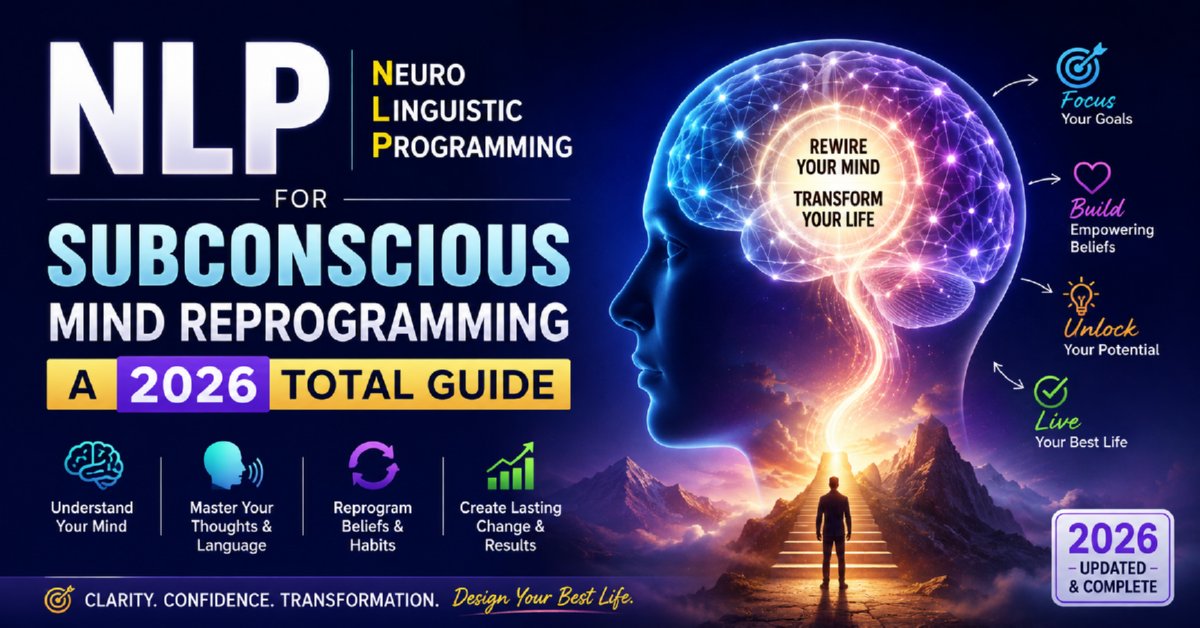
In this guide you will learn how NLP describes internal representations, language patterns, sensory processing, belief systems, emotional states, and behavioral strategies. You will also discover where NLP aligns with established psychological principles, where caution is warranted, and how its techniques may complement mindfulness, meditation, coaching, and evidence-based approaches to personal development.
This guide approaches NLP from both a practical and evidence-aware perspective. It explains the original NLP models, discusses their applications, reviews scientific findings where available, acknowledges ongoing debates, and presents practical exercises that readers can safely explore for personal growth. The goal is neither blind acceptance nor blanket skepticism, but informed understanding.
Subconscious mind reprogramming does not imply erasing memories or replacing one’s personality. Instead, it refers to gradually modifying habitual mental patterns to bring betterments in life. It includes modifications of emotional reactions to responses, beliefs to values, and behavior changes through deliberate practices. Like learning a musical instrument or acquiring a new language, meaningful psychological change generally emerges through repetition, reflection, feedback, and consistent application.
Key Takeaways
- Understand what Neuro-Linguistic Programming (NLP) is and how it developed.
- Learn how subconscious patterns influence habits, emotions, and decision-making.
- Explore the relationship between language, perception, beliefs, and behavior.
- Understand how neuroplasticity contributes to learning and behavioral change.
- Discover practical NLP techniques for communication and personal development.
- Learn where scientific evidence supports NLP-related concepts and where questions remain.
- Compare NLP with mindfulness, coaching, cognitive behavioral approaches, and hypnosis.
- Develop an ethical framework for applying NLP responsibly in everyday life.
What is Neuro Linguistic Programming (NLP)?
NLP (Neuro Linguistic Programming) is a training related to your mind functioning. It makes us aware of our mind power and provides structured methodologies for internal change. It also helps us to know how to use our mind power to achieve peak emotional and behavioral alignment.
We are what our beliefs are. Our reality, self-worth, and daily actions are dictated by deep-seated internal scripts stored within the neurological network. NLP helps us to reframe our subconscious mind with resourceful beliefs and remove unresourceful beliefs that create self-sabotage, fear, and stagnation.
By learning how language, sensory perception, and neural connections interact, you gain master access to your internal operating system. To apply these concepts effectively, practitioners rely on the foundational four pillars of NLP and specialized representational systems.
What Is NLP? Introduction & 2026 Context
Studies show that up to 95% of human behavior is driven by the subconscious mind [3]— the invisible operating system running your habits, fears, and beliefs every single day. NLP (Neuro Linguistic Programming) is a powerful training methodology developed in the 1970s that directly addresses how your mind processes the world and how that processing can be changed for the better. In 2026, with rising awareness of mental wellness, emotional intelligence, and personal performance, NLP has never been more relevant or more accessible.
NLP is a training related to your mind functioning — it makes us aware of our mind power and, crucially, teaches us how to use that power intentionally. As the foundation of modern behavioral change coaching, NLP bridges the gap between what you consciously want and what your subconscious automatically delivers. We are what our beliefs are — and NLP gives you a structured, evidence-informed toolkit to reframe those beliefs at the deepest level.
What Is Neuro Linguistic Programming (NLP)?
Neuro Linguistic Programming, commonly called NLP, is an approach to understanding human psychology, communication, and personal change. It was developed in the mid-1970s in California by Richard Bandler (a mathematician and psychology student) and John Grinder (a linguist), who studied the patterns of highly effective therapists and communicators — including Milton Erickson, Fritz Perls, and Virginia Satir.
The name itself tells the full story of what NLP is about:
- Neuro: Your nervous system and brain — the biological machinery that processes all experience through your five senses.
- Linguistic: The language — both the words you say out loud and the internal dialogue running inside your mind — that gives meaning to your experiences.
- Programming: The habitual patterns, behaviors, and emotional responses that have been “installed” in your subconscious through repetition, conditioning, and experience.
NLP is not therapy in the clinical sense, though it is widely used by therapists, coaches, educators, salespeople, athletes, and leaders. It is, above all, a practical model of human excellence — a set of tools and principles for understanding how people create their subjective experience and how that experience can be changed, quickly and effectively. To understand how it connects to deeper change, move to the next section on the subconscious mind.
Understanding the Subconscious Mind
The mind operates on two primary levels: the conscious mind and the subconscious mind. Your conscious mind is the part you are aware of right now — the thoughts you are choosing, the words you are reading, the decisions you are making deliberately. Your subconscious mind, on the other hand, is the vast, largely hidden engine driving everything else.
What Does the Subconscious Mind Do?
- Stores every memory, belief, and emotional association you have ever formed
- Runs automatic behaviors and habits without conscious effort
- Regulates your body functions (heart rate, breathing, digestion)
- Filters the world through your existing beliefs — showing you evidence that confirms what you already “know”
- Responds to imagery, emotion, and repetition rather than logic alone
- Protects you by triggering fear, avoidance, or stress when it perceives danger (even imagined danger)
Why Reprogramming the Subconscious Matters
Most people try to change their lives using willpower and conscious effort alone — setting goals, making plans, thinking positively. But if the subconscious mind carries a contradicting belief (such as “I am not good enough” or “money is dangerous”), it will consistently sabotage conscious efforts. The subconscious always wins in a battle against the conscious mind because it is faster, stronger, and operates 24 hours a day.
NLP reprogramming works at the subconscious level — using the same channels through which those old limiting beliefs were first installed: sensory experience, emotional intensity, language, imagery, and repetition. This is why NLP produces change that lasts, rather than temporary motivation that fades. Understand how this connects to the belief systems and identity section later in this guide.
The Four Pillars of NLP
The four pillars of Neuro Linguistic Programming serve as the foundation for all effective NLP practice, communication, and personal change. These core principles are not just theoretical — they are actionable guidelines that shape how every NLP technique is applied, including the subconscious reprogramming tools in this guide.
| Pillar | What It Means | Why It Matters |
|---|---|---|
| 1. Rapport | Building a deep connection of trust and understanding with yourself or another person | Without rapport, the subconscious mind remains defended and resistant to change |
| 2. Outcome Orientation | Being clear and specific about what you want, not just what you want to avoid | The subconscious moves toward vivid, emotionally charged goals — clarity accelerates change |
| 3. Sensory Acuity | Sharpening your ability to notice subtle signals — body language, tone, breathing, micro-expressions | Accurate observation gives you real information about what is happening below the surface |
| 4. Behavioral Flexibility | The willingness and ability to change your approach when what you are doing is not working | Rigid patterns keep you stuck; flexibility opens new pathways in the subconscious |
Behavioral flexibility is especially important in subconscious reprogramming. If one technique does not seem to produce the shift you want, a skilled NLP practitioner (or self-practitioner) adjusts the approach rather than forcing the same method harder. This flexibility is also what makes NLP useful across such a wide range of personal, emotional, and relational challenges.
The Five Senses & Representational Systems in NLP
In NLP, the five basic senses — visual, auditory, kinaesthetic, olfactory, and gustatory — are referred to as representational systems or modalities. These are the channels through which all human experience enters the mind and through which the subconscious builds its model of reality.
| Modality | Sense | Internal Representation | NLP Application |
|---|---|---|---|
| Visual (V) | Sight | Mental images, movies, colours, brightness | Swish Pattern, Submodalities, future pacing |
| Auditory (A) | Hearing | Internal voices, tone, volume, rhythm | Milton Model language, changing inner dialogue |
| Kinaesthetic (K) | Touch / Feeling | Body sensations, emotions, movement | Anchoring, Parts Integration, emotional release |
| Olfactory (O) | Smell | Scent-linked memories and moods | Memory anchors, sensory enrichment in techniques |
| Gustatory (G) | Taste | Taste-linked associations and states | Sensory grounding, full-body anchoring |
Why Representational Systems Matter for Subconscious Reprogramming
The five senses form the bridge between the physical world and the mind through sensation (detecting raw energy from the environment) and perception (how the brain organizes and gives meaning to that input). Every memory, belief, emotion, and habit in your subconscious mind is stored using combinations of these sensory modalities.
In NLP, we can have finer distinctions within each modality — these are called submodalities, and they are one of the most powerful tools for rapid subconscious change. For example, within the visual modality, a memory might be bright or dim, close or far, still or moving. Changing these fine details changes the emotional impact of the memory.
Identifying Your Dominant Representational System
Most people have a preferred representational system — the sense-channel they most naturally use to process and store experience. You can identify yours by noticing the language patterns you naturally use:
- Visual people say: “I see what you mean,” “That looks right,” “I can picture it.”
- Auditory people say: “That sounds good,” “I hear you,” “It rings a bell.”
- Kinaesthetic people say: “I feel that is right,” “I need to grasp this,” “It sits well with me.”
Knowing your dominant system helps you choose NLP techniques that will work most powerfully for your unique way of processing experience — a key part of the daily NLP practice outlined later.
Core NLP Techniques for Subconscious Reprogramming
This section is the practical heart of this guide. The following seven NLP tools are the most effective and widely used techniques for shifting subconscious habits, beliefs, and emotional patterns. Each technique targets the specific channels — sensory memory, internal language, imagery, and body sensation — through which the subconscious stores and retrieves experience. Jump to any specific technique using the links below, or read all seven in sequence for a complete picture.
1. Anchoring
Anchoring is one of the foundational and most frequently used NLP techniques. It is based on the principle — well established in behavioral psychology since Pavlov’s famous experiments — that a neutral stimulus can become linked to a specific emotional or physiological state through repetition and association.
What Is an Anchor in NLP?
An anchor is any sensory trigger — a touch, a sound, a word, a gesture, a smell — that has been linked to a specific emotional or mental state, so that activating the trigger reliably produces that state. You already have hundreds of natural anchors in your life: a song that brings back a memory, a smell that makes you feel safe, a word that makes you tense. NLP teaches you to create anchors intentionally.
How Anchoring Reprograms the Subconscious
By linking a physical trigger (like squeezing your thumb and forefinger together) to a peak positive emotional state (like profound confidence or deep calm), you create a direct subconscious pathway. Each time you fire that anchor later — even in a stressful situation — your nervous system is directed back to that resourceful state, bypassing the habitual anxious response.
Step-by-Step: How to Create a Positive Anchor
- Choose your resource state: Decide what emotional state you want to be able to access — confidence, calm, focus, joy, courage.
- Recall a peak experience: Think of a specific time when you felt that state intensely. Close your eyes and step back into that memory fully.
- Amplify the feeling: Make the internal images brighter and bigger. Turn up the sounds. Feel the sensations in your body intensifying. Let the emotion build to its peak.
- Set the anchor: Just as the emotion reaches its highest point, apply your chosen anchor — for example, press your thumb and forefinger together firmly. Hold it for 5–10 seconds.
- Release and break state: Let go of the anchor, open your eyes, shake out your hands. Think about something neutral for a moment.
- Test the anchor: Now fire the anchor again (squeeze thumb and forefinger). Notice whether you feel the resource state returning. If so, your anchor is set. If not, repeat the process with an even more intense memory.
- Reinforce: Repeat this process 3–5 times over several days to strengthen the neural pathway.
2. The Swish Pattern
The Swish Pattern is a rapid, visual NLP technique designed to break an unwanted automatic behavior or thought pattern and replace it with an empowering alternative — literally at the speed of thought. It works by using the brain’s natural tendency to move toward compelling mental images and away from undesirable ones.
What the Swish Pattern Does
The Swish Pattern creates a new subconscious habit of automatically moving from a problem state to a desired state. It is particularly effective for breaking habitual responses such as nail-biting, emotional eating, automatic negative thinking, or social anxiety triggers — anywhere a specific cue leads to an unwanted response.
Step-by-Step: How to Run the Swish Pattern
- Identify the cue image: Picture the internal image that appears just before the unwanted behavior or feeling begins. This is the “trigger picture.” Make it a still image, large and bright, as if seen through your own eyes (associated view).
- Create your desired self-image: Now create a separate image of the you who has already overcome this habit — confident, free, successful. Make this a slightly dissociated image (seeing yourself from outside, like watching a movie). Make it compelling, bright, attractive.
- Set up the Swish: Bring back the large trigger image. In the bottom corner of it, place a tiny, dark version of your desired self-image.
- Fire the Swish: In one rapid motion — “SWISH!” — let the tiny desired image explode to fill your entire mental screen, large and bright and compelling, while the trigger image shrinks and disappears into the corner.
- Break state: Open your eyes, look around the room. Clear the screen entirely.
- Repeat rapidly: Run the Swish 5–7 times in quick succession. Speed is essential — do not linger on either image.
- Test: Try to bring back the original trigger image. Notice whether it remains strong and clear, or whether it automatically shifts toward the desired image. If the technique has worked, you will find it difficult to maintain the old trigger image without the desired one appearing.
3. Reframing
Reframing is the NLP technique of changing the meaning or context given to an experience, behavior, or thought — so that the same event is now perceived in a way that is more resourceful, empowering, or useful. It is one of the most elegant and widely applicable tools in the NLP toolkit, used by therapists, coaches, and leaders around the world.
Two Types of Reframing
1. Context Reframing
This type of reframe asks: “In what context would this behavior or trait be an advantage?” Every behavior has a context in which it is useful. For example, someone who says “I am too stubborn” might be helped to see that in a different context — pursuing a business goal, fighting for justice, or maintaining personal boundaries — that same “stubbornness” is called determination and persistence.
2. Content (Meaning) Reframing
This type asks: “What else could this experience mean?” A job rejection, for instance, could mean failure — or it could mean “this was not the right fit and something better is coming,” or “I now know exactly what I need to develop.” The external event is the same; the subconscious meaning — and therefore the emotional response — is entirely different.
Everyday Reframing Examples
| Limiting Statement | Reframed Perspective |
|---|---|
| “I am a failure because I made a mistake.” | “Every mistake is data that makes my next attempt stronger.” |
| “I am too sensitive.” | “My sensitivity makes me an exceptionally empathetic and attuned person.” |
| “I am scared of public speaking.” | “My body is energizing me for an important performance.” |
| “I failed again — I am just not good enough.” | “This is one more piece of feedback pointing me toward the right strategy.” |
Regular reframing practice gradually installs a new subconscious habit of automatically finding the empowering meaning in challenging situations. This connects directly to the beliefs and identity section — because every belief is, at its core, a fixed frame through which all experience is filtered.
4. Visual-Kinesthetic Dissociation (VKD)
Visual-Kinesthetic Dissociation (VKD) — sometimes called the “Fast Phobia Cure” — is an NLP technique specifically designed to reduce or eliminate the intense emotional charge attached to a traumatic or fearful memory. It does this by changing the relationship between the visual representation of a memory and the kinaesthetic (emotional/physical) response to it.
The Core Mechanism
When you remember a traumatic or frightening event in an associated state — experiencing it through your own eyes as if it is happening again now — the subconscious re-activates the full emotional and physiological response. VKD works by moving you into a dissociated position — watching the memory from outside, as if on a cinema screen — which dramatically reduces the emotional intensity while the memory itself can still be processed and understood.
Step-by-Step: How to Use VKD
- Find a safe space: Sit comfortably. Take a few slow deep breaths. Remind yourself you are safe in the present moment.
- Create a mental cinema: Imagine you are sitting in a comfortable seat in a cinema. On the screen in front of you, you can see a still, black-and-white image of yourself just before the difficult event happened.
- Float out of your body: Now imagine floating up out of your body, up to the projection booth above and behind the cinema. You can see yourself sitting in the seat, watching the screen — you are now twice removed from the experience.
- Watch the movie: From the projection booth, watch the black-and-white movie of the difficult event play out on the screen, from beginning to a point after it ended, where you were safe.
- Rewind and repeat: Now, in the movie, freeze on the final frame. Float back down into your seat. From there, run the movie backwards very quickly — in color, with funny circus music — from the end back to the beginning. This takes about 2 seconds.
- Test: Try to bring back the original memory. Notice how the emotional charge has changed. Repeat the technique as needed.
5. Parts Integration (Visual Squash)
Parts Integration, also known as the Visual Squash, is an NLP technique that addresses one of the most common causes of persistent self-sabotage, procrastination, and internal conflict: the experience of having two parts of your mind that want opposite things.
Understanding Internal Conflict in NLP
You may recognize this feeling: part of you wants to eat healthily and another part craves comfort food. Part of you wants to build a business and another part is terrified of failure. Part of you wants to speak up and another part wants to stay safe and silent. In NLP, these are understood as distinct parts — subsystems of the personality, each with its own positive intention, even if their behaviors conflict.
Step-by-Step: How to Run the Visual Squash
- Identify the two parts: Name the conflict clearly. “Part of me wants X. Part of me wants Y.”
- Externalize each part: Hold your hands out, palms up. Invite one part to appear on each hand. Let an image, shape, color, or feeling emerge for each part spontaneously.
- Communicate with each part: Ask each part what it positively intends for you — what it is ultimately trying to give you or protect you from. Keep asking “and what does that give you?” until you reach a deep, shared positive intention (often something like “safety,” “love,” “freedom,” or “fulfillment”).
- Find the common ground: Both parts usually share a positive root intention at the deepest level. Help each part recognize that the other part also shares this deeper goal.
- Invite integration: Slowly bring your two hands together, allowing the two parts to merge at whatever pace feels natural. Watch and feel them combining into a single, integrated, more powerful resource.
- Bring it in: Once your hands are together, hold them to your heart or chest and breathe the integrated resource into your body. Let it settle.
6. Submodalities
Submodalities are the finer, more specific qualities or “settings” of each sensory representational system. If modalities are the channels of experience (visual, auditory, kinaesthetic), then submodalities are the knobs and dials — the specific parameters that determine how vivid, powerful, or emotionally significant an internal representation feels to your subconscious mind.
Key Submodalities by Sense
| Modality | Key Submodalities (Settings) |
|---|---|
| Visual | Brightness, size, distance, colour vs. black-and-white, focused vs. blurry, still vs. moving, framed vs. panoramic, associated vs. dissociated |
| Auditory | Volume, pitch, tempo, location (inside or outside head), tone, rhythm, clarity, distance of sound source |
| Kinaesthetic | Location in body, temperature (warm/cool), pressure, movement, texture, weight, intensity, rhythm |
How Submodalities Drive Emotion
Here is a powerful demonstration: think of something that worries you. Notice how big the mental image is, how close it feels, and how bright it appears. Now, in your mind, shrink that image to the size of a postage stamp, push it far into the distance, drain the colour from it until it is grey and faded. Notice how the emotional charge drops dramatically — even though the content of the worry is unchanged.
This is the power of submodalities: by adjusting the settings of an internal representation, you directly change how your subconscious mind evaluates its emotional importance. Making a fearful thought smaller and dimmer tells the subconscious: “This is not urgent or important.” Making a goal-related image larger, brighter, and closer tells the subconscious: “This matters — move toward it.”
7. The Milton Model
The Milton Model is a set of language patterns derived from the hypnotic communication style of Dr. Milton H. Erickson, widely regarded as the greatest hypnotherapist who ever lived. Richard Bandler and John Grinder studied Erickson’s communication in depth and identified the specific linguistic patterns that allowed him to guide his clients’ subconscious minds toward profound healing and change.
How the Milton Model Works
The Milton Model uses carefully constructed language that is deliberately vague, permissive, and open-ended. Because the language is non-specific, the listener’s subconscious mind fills in the blanks using their own most meaningful associations — essentially talking to themselves in their own inner language. This bypasses the critical conscious mind (the part that evaluates, judges, and resists) and communicates directly with the subconscious.
Core Milton Model Language Patterns
- Pacing and Leading: First describe what the person is definitely experiencing (pacing), then gently introduce a new suggestion (leading). “As you sit there, reading these words, you can begin to notice a growing sense of relaxed curiosity…”
- Embedded Commands: Commands hidden within longer sentences that bypass resistance. “You might find yourself feeling more confident than you expect.”
- Presuppositions: Language that assumes the desired outcome is already happening. “As you continue to improve, you may notice which changes come first.”
- Tag Questions: Questions that soften statements and invite agreement. “You can let yourself relax now, can’t you?“
- Nominalizations: Abstract nouns that the listener fills in personally. “You have all the resources, strength, and understanding you need.”
- Universal Quantifiers: Words like “all,” “every,” “always,” “never” used to generalize a positive experience. “Every time you practise, this becomes easier and more natural.”
Problems NLP Subconscious Techniques Solve
NLP subconscious techniques address a wide range of personal, psychological, emotional, and relational challenges by retraining thought patterns at their root. The following categories represent the most common and well-documented areas where NLP produces measurable change. For the specific techniques that address each area, refer back to the core techniques section.
Personal Growth and Habits
- Limiting beliefs: Removes deep mental blocks that silently prevent success, abundance, and confidence from taking hold.
- Bad habits: Breaks entrenched behavioral cycles like nail-biting, smoking, procrastination patterns, and emotional eating.
- Low self-esteem: Builds genuine inner confidence and self-worth by replacing the old internal narrative with resourceful beliefs and self-images.
- Procrastination: Overcomes the internal conflict and avoidance patterns that drain daily motivation and productivity.
- Goal achievement: Aligns the subconscious mind fully with conscious goals so that action flows naturally rather than being forced.
Emotions and Mental Health
- Phobias and fears: Rapidly clears intense, irrational fears using techniques like VKD and the Swish Pattern — often in a single session.
- Anxiety and stress: Calms the nervous system and rewires the anxious thought loops that keep the body in a state of chronic stress.
- Past trauma: Relieves the heavy emotional charge attached to painful memories without requiring detailed re-living of the experience.
- Grief and loss: Helps the subconscious mind process sadness and adjust to change more smoothly and with more self-compassion.
- Depression patterns: Interrupts the negative thought spirals and self-defeating internal dialogue that fuel depressive thinking.
Relationships and Communication
- Social anxiety: Eases fear and self-consciousness in group settings, public speaking, and new social situations.
- Conflict resolution: Improves empathy, listening, and rapport — both in professional and personal relationships.
- Relationship blocks: Clears hidden subconscious patterns of anger, fear, jealousy, or trust wounds that silently damage connections.
- Communication effectiveness: Helps people express themselves clearly, listen more accurately, and build stronger connections in every context.
Professional and Peak Performance
- Performance anxiety: Used by athletes, musicians, and speakers to eliminate stage fright and access peak mental states on demand.
- Leadership and influence: Develops the rapport and communication skills that make great leaders naturally compelling and trustworthy.
- Sales and negotiation: Builds the subconscious confidence and empathetic attunement that drive authentic persuasion.
- Learning and memory: Enhances the mind’s ability to absorb, retain, and apply new information by working with the subconscious’s preferred learning channels.
Step-by-Step NLP Subconscious Reprogramming Plan
This structured plan brings together the key principles and techniques from across this guide into a practical, actionable sequence. It is designed to be used over a 30-day period for maximum depth of subconscious reprogramming, though many people notice significant shifts within the first week. Refer to the daily practice section for a day-by-day routine.
Phase 1: Awareness (Days 1–7)
- Audit your beliefs: Write down your top 10 beliefs about yourself, money, relationships, and what is possible for you. Be ruthlessly honest.
- Identify your patterns: Notice recurring emotional reactions, habitual thoughts, and self-sabotaging behaviors. What are your automatic responses to stress, failure, or criticism?
- Discover your representational system: Spend a week noticing your language and sensory preferences using the representational systems framework.
- Set a clear outcome: Following the outcome orientation pillar, define exactly what you want your subconscious mind to be programmed with — in vivid sensory detail.
Phase 2: Clearing (Days 8–18)
- Apply VKD to your top 3 most charged painful memories or fears that are driving limiting beliefs.
- Run Parts Integration for the most persistent internal conflict holding you back.
- Use Submodalities to weaken the emotional power of your key limiting beliefs — make them smaller, greyer, farther away.
- Practice Reframing daily — every time a negative thought arises, immediately find two resourceful alternative meanings.
Phase 3: Installation (Days 19–30)
- Create and fire Anchors for your key resource states — confidence, calm, focus, courage. Use them daily in real situations.
- Run the Swish Pattern for each habitual behavior or thought pattern you want to replace.
- Use Milton Model language in your daily self-talk and journaling — permissive, open, forward-moving language.
- Future pace: Spend 10 minutes each morning vividly imagining yourself already living with the new subconscious programming — in full sensory detail, with genuine emotion.
NLP vs Other Mind Reprogramming Methods
NLP is one of several approaches to subconscious mind reprogramming. Understanding how it compares to other methods helps you choose the right tools for your specific situation — or combine approaches for even deeper results.
| Method | Approach | Speed | Best For | NLP Compatibility |
|---|---|---|---|---|
| NLP | Sensory, linguistic, behavioral patterns | Fast to moderate | Habits, phobias, communication, beliefs | — |
| Hypnotherapy | Deep trance states, direct suggestion | Moderate | Smoking, weight, anxiety, pain | Very high — NLP includes hypnotic language |
| CBT (Cognitive Behavioral Therapy) | Conscious thought restructuring | Slow to moderate | Depression, anxiety, OCD | High — reframing is a bridge between them |
| EFT (Tapping) | Acupoint tapping to release emotional charge | Fast | Trauma, anxiety, cravings | High — can combine with VKD and anchoring |
| Meditation/Mindfulness | Witness awareness, breath focus | Slow, cumulative | Stress, presence, emotional regulation | High — enhances sensory acuity pillar |
| Affirmations | Repeated positive statements | Slow | Belief shifting (with emotion) | High — most powerful when combined with NLP submodalities |
NLP is distinguished from most other approaches by its speed, its sensory specificity, and its focus on the structure of experience rather than just its content. Where many approaches ask “why do you feel this way?”, NLP asks “how are you creating this feeling, and how can we change it now?” This shift from why to how is what makes NLP uniquely practical and efficient. See how these distinctions play out in the science section.
Beliefs, Identity & NLP: How Deep Reprogramming Works
We are what our beliefs are. This is not a metaphor — it is a functional description of how the subconscious mind operates. Every belief you hold acts as a filter on your perception, a governor on your behavior, and a lens through which your results are interpreted. NLP helps us reframe our subconscious mind with resourceful beliefs and remove unresourceful beliefs.
The Structure of a Belief
In NLP terms, a belief is a generalization about the world, yourself, or others that feels certain rather than merely possible. That feeling of certainty is the key — and it is created by a specific set of submodalities and internal representations. This means that beliefs are not fixed facts; they are deeply habituated patterns of internal experience. And patterns can be changed.
Three Levels of Subconscious Change
NLP practitioner and author Robert Dilts identified six neurological levels at which change can occur. For subconscious reprogramming, three are most important:
- Behavior level: Changing what you do — the most visible and most surface-level form of change. Willpower-based change attempts to work here, and often fails when beliefs are unchanged.
- Belief and values level: Changing what you believe is true and what matters to you. Change here automatically and effortlessly produces behavioral change. This is where most NLP techniques operate.
- Identity level: Changing who you understand yourself to be — “I am a confident person,” rather than “I am trying to be confident.” Identity-level change is the deepest and most enduring. Techniques like Parts Integration and extended Anchoring work at this level.
Resourceful vs. Unresourceful Beliefs
| Unresourceful Belief | Resourceful Alternative |
|---|---|
| I am not smart enough to succeed. | My intelligence grows every time I apply myself and learn. |
| Money is hard to get and easy to lose. | Money flows to those who create value — and I create genuine value. |
| I am not the kind of person who can be confident. | Confidence is a state I can create and strengthen deliberately. |
| My past determines my future. | My past gave me experience. My choices today create my future. |
| People always let me down. | I attract people who share my values when I communicate clearly. |
The Science & Research Behind NLP
A complete and honest guide to NLP must address the science. NLP was developed primarily as a practical, empirically derived model of human excellence — not as a laboratory science — and this has been a source of both its strengths and its controversies. Here is an honest, balanced, people-first assessment of where the research stands in 2026.
What the Research Says
Neuroscience Support for Core NLP Principles
Modern neuroscience provides strong support for many of the foundational principles of NLP, even if the research was not designed specifically to test NLP:
- Neuroplasticity: The brain’s ability to rewire itself through new experiences, thoughts, and behaviors is now well established. This is the biological foundation for all subconscious reprogramming — and for NLP’s core claim that patterns can be changed.
- Mirror neurons: The discovery of mirror neurons provides biological support for NLP’s rapport and modeling principles — we are literally wired to reflect and internalize the patterns of others.
- Embodied cognition: Research confirms that body posture, gesture, and physical sensation influence thought and emotion — validating NLP’s kinaesthetic anchoring techniques.
- Predictive processing: Modern cognitive neuroscience shows that the brain constantly predicts and filters experience based on prior beliefs — exactly what NLP’s belief-change work addresses.
Clinical Research on Specific NLP Techniques
- Studies on the Fast Phobia Cure (VKD) have shown significant fear reduction in controlled conditions, comparable to exposure therapy — often more rapidly.
- Anchoring research aligns with classical and operant conditioning studies that demonstrate reliable stimulus-response linkage in humans.
- Reframing has been extensively studied in CBT research under terms like “cognitive restructuring” and “cognitive reappraisal” — with robust evidence for its effectiveness on anxiety, depression, and stress.
The most credible position on NLP in 2026 is this: its core techniques produce real, measurable results for real people in real situations — particularly for habits, phobias, communication, and beliefs. The theoretical explanations for why some techniques work continue to be refined by ongoing research in neuroscience and psychology. The goal, always, is your actual wellbeing — not theoretical purity. For practical application, see the daily practice section.
Daily NLP Practice for 2026: A Practical Morning-to-Evening Routine
Consistent daily practice is what transforms NLP from an interesting set of ideas into a genuinely transformed subconscious mind. The following routine is designed to be realistic, sustainable, and deeply effective — integrating the most powerful NLP tools into the natural rhythm of your day. It connects to every major technique covered in this guide.
Morning Routine (15–20 Minutes)
- Prime your state (2 min): Before looking at your phone, sit up, take 5 deep breaths, and fire your positive anchor for your key resource state — confidence, clarity, or energy.
- Future pacing visualization (5–7 min): Close your eyes and vividly imagine your ideal day unfolding — using full sensory detail (visual, auditory, kinaesthetic). See it, hear it, feel it as if it is already happening.
- Belief declaration with submodalities (3 min): Read your three most important resourceful beliefs out loud. As you say each one, make the internal image large, bright, and close. Turn up the feeling in your body.
- Reframing intention (2 min): Set the intention: “Today, every challenge I face is data that helps me improve.” This primes your subconscious to automatically reframe difficulties in real time.
- Milton Model self-talk (3 min): Journal 5 sentences using Milton Model language about your day ahead — permissive, open, forward-moving language that invites your subconscious to find the best path.
Throughout the Day
- Sensory acuity practice: In every conversation, practice the sensory acuity pillar — notice body language, tone shifts, and emotional signals you would normally miss.
- Instant reframes: Every time a negative or limiting thought arises, pause and apply a context or content reframe before continuing.
- Anchor firing: Before any challenging situation — a meeting, a difficult conversation, a performance — fire your resource anchor to access the optimal state instantly.
- Submodality check: If you notice worry or anxiety, immediately shrink the mental image, drain its colour, and push it further away in your mind’s eye.
Evening Routine (10 Minutes)
- Day review with NLP lens: Mentally replay your day looking for moments where your old subconscious patterns showed up. Do not judge — simply notice and identify what technique you will apply tomorrow.
- Gratitude + positive anchor: Recall 3 genuine positive experiences from the day in full sensory detail. Fire your anchor during each one to deepen its programming.
- Sleep suggestion: As you drift toward sleep, use a simple Milton Model self-suggestion: “As I sleep deeply tonight, my subconscious mind continues to integrate and strengthen these new resourceful patterns…”
Common Myths About NLP — Cleared Up
NLP is widely misunderstood — both by skeptics who dismiss it entirely and by enthusiasts who overclaim its capabilities. Here are the most common myths, addressed with clarity and honesty.
| Myth | The Truth |
|---|---|
| “NLP is mind control or manipulation.” | NLP is a communication and self-development model. Its tools can be used for influence, but so can any communication skill. Ethical NLP is always about empowering the individual, not controlling them. |
| “NLP works instantly for everything.” | Some techniques produce rapid results (phobia clearing can happen in one session). Deep belief change and identity reprogramming take consistent practice over weeks to months. |
| “NLP has no scientific basis.” | Many NLP principles align with established neuroscience. Some specific claims are not well supported. A balanced view: NLP is a useful practical model, not a complete scientific theory. |
| “You need a practitioner — you cannot do NLP on yourself.” | Many NLP techniques are highly effective as self-practice. A skilled practitioner adds value for deeper or more complex issues, but the tools in this guide are designed for self-application. |
| “NLP is just positive thinking.” | NLP works with the full structure of experience — including negative states — and uses specific, systematic techniques rather than simply replacing negative thoughts with positive ones. |
| “NLP is only for people with problems.” | NLP is equally — perhaps more — powerful as a performance and growth tool for people who are already functioning well and want to excel further. |
Frequently Asked Questions About NLP & Subconscious Reprogramming
What exactly is NLP and who created it?
NLP — Neuro Linguistic Programming — is a model of human psychology, communication, and change developed in the 1970s by Richard Bandler and John Grinder at the University of California, Santa Cruz. They studied the patterns used by exceptional therapists and communicators and codified those patterns into a practical, teachable system. Today NLP is used by coaches, therapists, athletes, business leaders, educators, and individuals worldwide for personal development, emotional healing, and performance excellence.
How long does it take to reprogram the subconscious mind with NLP?
It depends on the depth of the change and the consistency of practice. Specific phobias can sometimes be resolved in a single session using techniques like the VKD Fast Phobia Cure. Surface-level habits may shift within 1–3 weeks of daily practice. Deep-seated limiting beliefs and identity-level reprogramming typically require 30–90 days of consistent, intentional NLP work. The key variable is always consistency and emotional engagement — not just the number of hours spent.
Can I practice NLP on myself without a coach or therapist?
Yes — the majority of NLP techniques described in this guide, including anchoring, the Swish Pattern, reframing, and submodality work, are fully accessible as self-practice tools. Many people achieve significant results through self-directed NLP practice using books, audio guides, and structured routines like the daily practice outlined here. For complex trauma, severe anxiety, or persistent issues that do not respond to self-practice, working with a certified NLP practitioner or licensed mental health professional is recommended.
What are the four pillars of NLP?
The four pillars of NLP are: Rapport (building genuine trust and connection), Outcome Orientation (being clear and specific about what you want to achieve), Sensory Acuity (developing the ability to notice subtle signals in yourself and others), and Behavioral Flexibility (the willingness to change your approach when your current approach is not producing results). These pillars underpin every NLP technique and are explored in detail in the four pillars section of this guide.
What is the difference between NLP and hypnotherapy?
NLP and hypnotherapy are closely related — NLP actually incorporates many of the language patterns of Ericksonian hypnotherapy through the Milton Model. The primary difference is that hypnotherapy typically involves formal trance induction to access a deeply receptive subconscious state, while most NLP techniques work in an alert, wakeful state. Many practitioners combine both approaches for maximum depth. Both are working with the same underlying territory: the subconscious mind’s patterns, beliefs, and automatic responses.
Is NLP scientifically proven?
NLP sits at an interesting intersection of practical effectiveness and ongoing scientific scrutiny. Many of its core principles — neuroplasticity, embodied cognition, classical conditioning (the basis of anchoring), and cognitive reappraisal (the basis of reframing) — are well-supported by mainstream neuroscience and psychology research. Some more specific NLP claims (such as eye movement patterns indicating representational systems) have not been consistently replicated in controlled studies. The honest position is that NLP is a very useful practical model with strong empirical support for its key techniques — even if its theoretical explanations continue to evolve. See the science section for a full discussion.
What are representational systems in NLP?
Representational systems are the five sensory channels through which the subconscious mind stores and retrieves experience: Visual (images), Auditory (sounds and language), Kinaesthetic (body sensations and emotions), Olfactory (smell), and Gustatory (taste). Each person has a dominant representational system — the sense-channel they most naturally use — and NLP techniques are most powerful when tailored to that dominant system. Full details are in the representational systems section.
Can NLP help with anxiety and phobias?
Yes — this is one of the areas where NLP has produced some of its most impressive and well-documented results. The Visual-Kinesthetic Dissociation technique (also called the Fast Phobia Cure) has been shown to significantly reduce or eliminate phobic responses, often in a single session. Anchoring, reframing, and the Swish Pattern also contribute powerfully to anxiety management by giving the subconscious mind new, calmer default responses to previously triggering situations. For severe anxiety disorders or clinical phobias, NLP works best as part of a comprehensive approach that may include professional support.
How is NLP different from positive thinking or affirmations?
NLP is fundamentally different from simple positive thinking or affirmation practice in both its depth and its mechanism. Affirmations work at the conscious level and can actually create conflict when the subconscious holds a contradicting belief — the subconscious simply rejects statements that do not match its existing “reality.” NLP, by contrast, works inside the subconscious — changing the sensory structure, emotional charge, and representational settings of beliefs themselves. When you use submodalities to weaken a limiting belief or Parts Integration to resolve inner conflict, you are not trying to paste a positive statement over a negative belief — you are actually changing the belief at its root.
What is anchoring in NLP and how does it work?
Anchoring is an NLP technique that deliberately links a specific sensory stimulus — a touch, gesture, word, or sound — to a specific emotional state. When the anchor is set during a peak experience of a desired state (such as confidence, calm, or focus), it creates a direct neural connection that can be triggered later by activating the same stimulus. This works through the same classical conditioning mechanism identified by Pavlov — the brain naturally links stimuli that occur simultaneously with strong emotional states. Once set, an anchor allows you to access a resourceful emotional state instantly and on demand. The full step-by-step process is in the anchoring section.
Conclusion: Your Subconscious Mind Is Waiting to Be Reprogrammed
NLP (Neuro Linguistic Programming) is not magic, and it is not wishful thinking. It is a rigorous, practical, and deeply human-centered toolkit for understanding how the subconscious mind works — and how to work with it, rather than against it. We are what our beliefs are. And beliefs, as NLP demonstrates so powerfully, are not fixed facts. They are patterns. Patterns that were installed can be changed.
The tools in this guide — from the precision of anchoring and the elegance of reframing, to the deep resolution work of Parts Integration and the gentle power of the Milton Model — give you a complete system for working at the level of your subconscious mind where lasting change actually lives.
The four pillars of NLP — rapport, outcome orientation, sensory acuity, and behavioral flexibility — are not just NLP concepts. They are principles for a well-lived, self-aware, continually growing life. The five representational systems remind us that we each experience the world uniquely through our senses — and that our path to change runs through those same sensory channels.
In 2026, with neuroscience confirming the profound plasticity of the human brain and with growing global recognition that mental and emotional wellbeing is the foundation of everything else that matters, NLP is more relevant, more accessible, and more powerful than ever. Your subconscious mind shaped who you are today. With NLP, you have the tools to consciously shape who you become tomorrow.
“You already have all the resources you need. NLP simply teaches you how to access them.” — NLP Core Principle
References
-
-
- Austin, J. (1962). Sense and sensibilia. Oxford University Press.
- Grad, P. Access internalism and understanding. Synthese 207, 166 (2026). https://doi.org/10.1007/s11229-026-05544-7
- Clancy, A.L., Binkert, J. (2017). Accessing the Inner Self: Beliefs. In: Pivoting. Palgrave Macmillan, New York. https://doi.org/10.1057/978-1-137-60263-3_4.
-