
In 2005, during deep Himalayan meditation, Sri Amit Ray discovered the complete architecture of the 114 Chakra System and revealed its profound relationship with the timeless teachings of the Bhagavad Gita. Revelations from Bhagavad Gita, where the Divine Self is described as Upadrashta (Witness), Anumanta (Permitter), Bharta (Sustainer), Bhokta (Experiencer), Maheshwara (Supreme Lord), and Paramatma (Supreme Self) — Sri Amit Ray developed a multidimensional chakra framework that integrates ancient yogic wisdom, meditation science, consciousness evolution, and spiritual neuroscience into a unified map of human awakening.
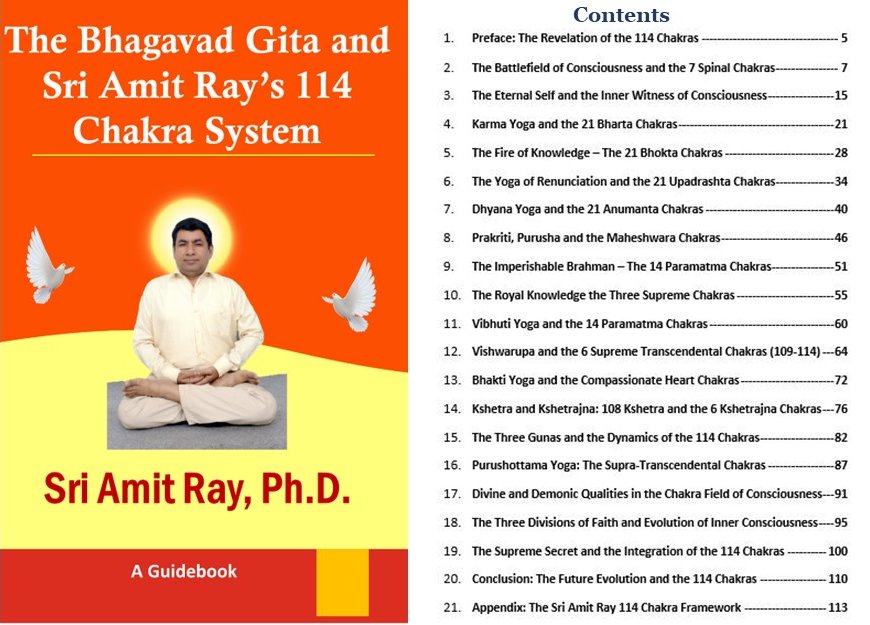
The Bhagavad Gita and Sri Amit Ray’s 114 Chakra System is a monumental spiritual and mind, body, consciousness studies book first published in 2015. The work presents a profound integration of the timeless wisdom of the Bhagavad Gita with Sri Amit Ray’s revolutionary discovery of the 114 Chakra Consciousness Framework. Combining ancient yogic philosophy, meditation science, subtle energy systems, mindfulness, neuroscience, and higher consciousness studies, the book offers a comprehensive multidimensional map of human spiritual evolution — guiding readers from foundational awareness to the highest states of transcendental realization and universal consciousness.
Introduction
The Bhagavad Gita and Sri Amit Ray’s 114 Chakra System presents a profound and multidimensional exploration of consciousness, spirituality, meditation, and inner transformation. Rooted in the timeless wisdom of the Bhagavad Gita and expanded through Sri Amit Ray’s revolutionary 114 Chakra Consciousness Framework, the book introduces an advanced spiritual architecture that transcends conventional chakra models and opens new dimensions of contemplative understanding.
For centuries, the Bhagavad Gita has served as one of humanity’s most influential spiritual texts, illuminating the path of self-realization, inner balance, ethical living, devotion, meditation, and liberation. Sri Amit Ray’s 114 Chakra System extends these teachings into a detailed experiential map of human consciousness, revealing how spiritual evolution unfolds through interconnected layers of energy, awareness, cognition, and transcendence.
The book bridges ancient yogic philosophy with modern consciousness studies, neuroscience, contemplative psychology, subtle energy systems, and meditation science. It offers readers not merely a theoretical discussion of chakras, but a practical framework for inner awakening, mindfulness, emotional refinement, expanded awareness, and spiritual transformation.
By integrating the metaphysical teachings of the Gita with a highly structured chakra architecture, the work creates a comprehensive model for understanding the deeper dimensions of the self, the mind, and the journey toward universal consciousness. It is both a philosophical text and a practical guide for meditators, yoga practitioners, researchers, and seekers of higher wisdom.
2. Book Summary and Structural Architecture
The Bhagavad Gita and Sri Amit Ray’s 114 Chakra System is a groundbreaking spiritual and consciousness study by Dr. Amit Ray, first published in 2015. The foundation of this work emerged from a profound meditative revelation experienced by Sri Amit Ray in the Himalayas in 2005, where the complete architecture of the 114 chakras unfolded for the first time, through deep states of contemplative awareness. This discovery was not merely theoretical or symbolic; it represented a direct experiential insight into how Supreme Consciousness permeates, organizes, and expresses itself through the human body, mind, and subtle energetic systems.
The book presents a remarkable synthesis of two vast streams of spiritual wisdom: the eternal teachings of the Bhagavad Gita and the multidimensional structure of the Sri Amit Ray 114 Chakra Consciousness Framework. Through this integration, the text offers a comprehensive roadmap of human evolution, consciousness expansion, meditation, and inner transformation. It guides the spiritual seeker from the instinctive energies of survival and emotional identity toward the highest realization of universal awareness, divine intelligence, and Purushottama — the Supreme Transcendent Reality described in the Gita.
Unlike traditional chakra models that focus primarily on seven major centers, this expanded framework introduces a highly structured and deeply layered consciousness architecture. Of the 114 chakras, 108 are located within the physical and subtle dimensions of the human system, while 6 transcend the bodily field entirely, representing states of liberation, cosmic unity, and nondual awareness beyond ordinary cognition.
The system is systematically organized into multiple consciousness domains, each corresponding to specific spiritual functions, psychological processes, energetic dynamics, and stages of realization:
- The 7 Foundational Spinal Chakras: The traditional root-to-crown energetic axis governing survival, vitality, emotion, intellect, intuition, and spiritual awakening.
- 21 Sustainer (Bharta) Chakras: The stabilizing and life-supporting consciousness centers that maintain biological harmony, energetic continuity, groundedness, and structural balance within the human system.
- 21 Experiencer (Bhokta) Chakras: The experiential centers governing sensory engagement, emotional processing, desire, relational intelligence, creativity, and interaction with the external world.
- 21 Witness (Upadrashta) Chakras: The higher observational centers associated with mindfulness, detached awareness, meta-cognition, contemplative clarity, and silent witnessing consciousness.
- 21 Permitter (Anumanta) Chakras: The energetic gateways of alignment, discernment, spiritual permission, karmic intelligence, inner guidance, and divine synchronization.
- 3 Supreme Lord (Maheshwara) Chakras: Rare and elevated centers associated with inner mastery, spiritual sovereignty, higher willpower, transcendental intelligence, and the integration of divine authority within consciousness.
- 14 Ultimate Self (Paramatma) Chakras: Deep spiritual reservoirs connecting individual consciousness with the Universal Self, cosmic compassion, unity-awareness, and the all-pervading divine presence.
- 6 Transcendental (Paratita) Chakras: Supra-physical chakras existing beyond the body-mind structure, representing liberation, nondual realization, cosmic silence, infinite awareness, and the transcendence of individuality.
A central philosophical contribution of the book lies in its reinterpretation of the profound verse from the Bhagavad Gita, where the Divine Self is described as Upadrashta (Witness), Anumanta (Permitter), Bharta (Sustainer), Bhokta (Experiencer), Maheshwara (Supreme Lord), and Paramatma (Supreme Self). Sri Amit Ray expands these six metaphysical principles into a living multidimensional chakra architecture, transforming ancient spiritual philosophy into an experiential map of consciousness evolution.
The book further bridges classical yoga philosophy with modern perspectives in neuroscience, contemplative psychology, bioenergetics, meditation science, and consciousness studies. It explores how meditation, breath regulation, awareness practices, mantra resonance, emotional purification, and ethical living influence the activation and harmonization of the 114 chakras. Through this integrative approach, the work presents spirituality not as abstract metaphysics alone, but as a practical science of inner transformation and expanded awareness.
More than a philosophical text, The Bhagavad Gita and Sri Amit Ray’s 114 Chakra System serves as a detailed spiritual atlas for seekers, meditators, yoga practitioners, consciousness researchers, and students of higher wisdom traditions. It offers a structured pathway toward inner balance, awakened intelligence, compassionate living, and the direct realization of the infinite dimensions of consciousness.
Conclusion
The Bhagavad Gita and Sri Amit Ray’s 114 Chakra System stands as an important contribution to modern spiritual literature, consciousness studies, and advanced chakra philosophy. By integrating the eternal teachings of the Bhagavad Gita with an expanded multidimensional chakra framework, the book offers readers a transformative model for understanding the deeper mechanics of awareness, meditation, and spiritual evolution.
The work moves beyond simplified interpretations of chakras and presents consciousness as a dynamic, structured, and evolving reality that encompasses the physical body, the subtle mind, emotional intelligence, higher cognition, spiritual witnessing, and transcendental realization. Through its detailed architecture of the 114 chakras, the book illuminates how human beings can cultivate balance, mindfulness, compassion, expanded awareness, and alignment with universal consciousness.
For practitioners of yoga, meditation, mindfulness, contemplative science, and spiritual inquiry, this book serves both as a philosophical guide and as a practical framework for inner transformation. It encourages readers to move beyond intellectual understanding into direct experiential realization through meditation, ethical living, self-awareness, and disciplined spiritual practice.
Ultimately, the book presents a vision of spirituality that harmonizes ancient wisdom with modern consciousness exploration, offering a profound roadmap toward self-realization, inner peace, awakened intelligence, and the direct experience of the infinite dimensions of existence.
Frequently Asked Questions
What is Sri Amit Ray’s 114 Chakra System?
Sri Amit Ray’s 114 Chakra System is an expanded multidimensional consciousness framework that goes beyond the traditional seven chakra model. It describes 114 chakras distributed across physical, subtle, psychological, spiritual, and transcendental dimensions of human consciousness.
How is the 114 Chakra System connected to the Bhagavad Gita?
The wisdom of Bhagavad Gita, where the Divine Self is described through multiple functions such as Witness, Sustainer, Experiencer, Permitter, Supreme Lord, and Supreme Self. Sri Amit Ray expands these principles into a structured chakra architecture representing different levels of consciousness and spiritual evolution.
Are there really more than seven chakras?
Many advanced yogic and tantric traditions describe numerous subtle energy centers beyond the seven major chakras. Sri Amit Ray’s framework systematically organizes these expanded consciousness centers into a comprehensive 114 chakra model.
What are the six transcendental chakras?
The six transcendental chakras exist beyond the physical and subtle body systems. They represent higher states of liberation, nondual awareness, cosmic consciousness, spiritual transcendence, and ultimate realization beyond ordinary mental processes.
Who can benefit from reading this book?
The book is valuable for meditation practitioners, yoga students, spiritual seekers, mindfulness teachers, consciousness researchers, psychologists, philosophers, and anyone interested in advanced chakra studies and spiritual transformation.
Does the book combine spirituality with neuroscience?
Yes. The book explores the relationship between meditation, consciousness, subtle energy systems, emotional regulation, awareness practices, and modern perspectives from neuroscience and contemplative psychology.
Is this book suitable for beginners?
Yes. Although the subject matter is advanced, the book provides a structured progression from foundational chakra concepts to deeper levels of consciousness, making it accessible to sincere beginners as well as advanced practitioners.
What is the main goal of the 114 Chakra System?
The primary goal of the system is to support spiritual awakening, inner harmony, expanded consciousness, mindfulness, compassionate living, and realization of the deeper dimensions of the self and universal consciousness.