
The human brain contains about 86 billion neurons and nearly 100 trillion synapses. Modern AI systems now operate with billions to trillions of parameters. Understanding AI and LLM parameters is key to understanding how today’s large language models work.
Large Language Models like GPT-4 and Llama contain hundreds of billions — and in some cases, over a trillion — internal mathematical variables called parameters. These parameters are the core reason why modern AI can write essays, debug code, and hold complex conversations. Understanding what LLM parameters actually are, and why their scale matters so dramatically, is the key to understanding how artificial intelligence truly works in 2026.
What Exactly Is a Parameter in AI?
Parameters in an LLM are the digital equivalent of synaptic weights in the human brain. In the human brain, you have billions of neurons connected by pathways called synapses. When you learn something new, the strength of the connections between certain neurons changes. When people say Large Language Models (LLMs) have billions or trillions of parameters, they are referring to the internal mathematical variables that determine how the model processes information. Think of parameters as adjustable knobs inside a massive virtual brain.
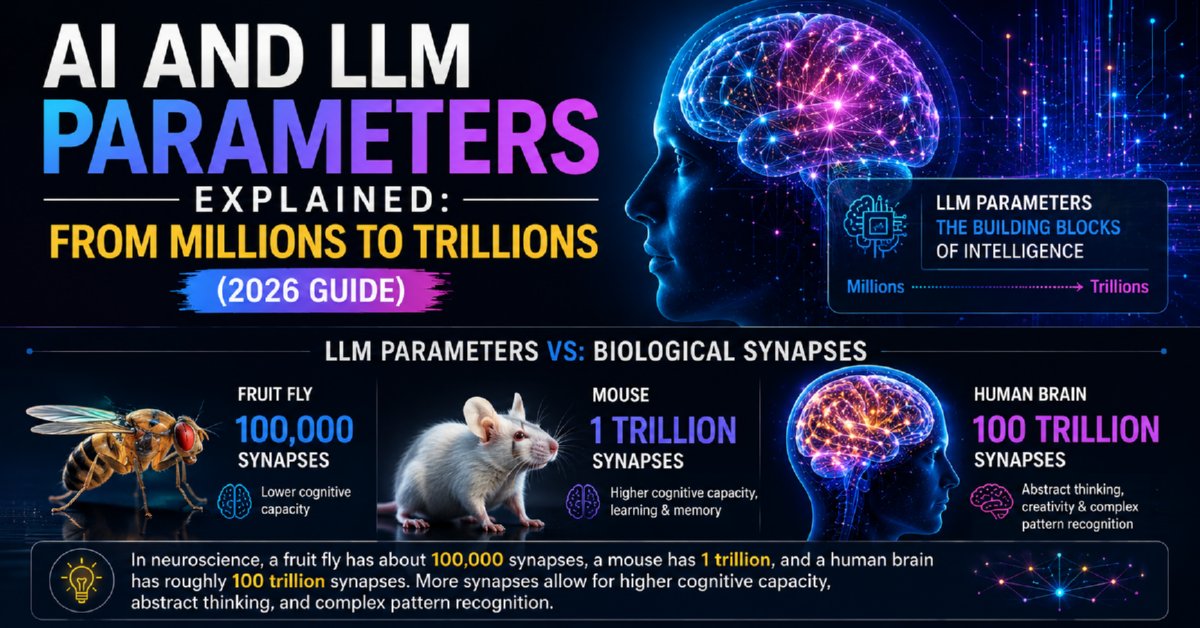
In neuroscience, a fruit fly has about 100,000 synapses, a mouse has 1 trillion, and a human brain has roughly 100 trillion synapses. More synapses allow for higher cognitive capacity, abstract thinking, and complex pattern recognition.
Similarly, an LLM with more parameters has a higher “capacity” to memorize facts, understand nuanced grammar, and mimic reasoning. However, just as a human brain prunes away inefficient synapses as it matures (synaptic pruning), AI researchers use techniques like quantization and pruning to make LLMs smaller and faster without losing their “intelligence.”
In machine learning, parameters are mainly made up of:
- Weights: These determine how important one word or concept is in relation to another. For example, the word “bank” may connect strongly to “river” or “money,” depending on surrounding context.
- Biases: These adjust the final prediction so the model can better match patterns it has learned from data.
Every time you type a prompt, your input flows through billions (or trillions) of these weights and biases. The model calculates probabilities to predict the most logical next word.
The “B” in LLM names stands for billion parameters (the numerical weights that form the model’s “brain”). 7B (7 Billion Parameters), runs locally on consumer laptops or devices with 16GB–24GB of RAM/VRAM. 70B (70 Billion Parameters). Minimum enterprise-grade LLM – requires large multi-GPU clusters (140GB+ VRAM). Next target, 700B+ (Massive Frontier Models), cloud-only infrastructure requiring massive enterprise-grade GPU clusters (e.g., thousands of H100s).
The Human Brain Analogy
The human brain has roughly 86 billion neurons connected by about 100 trillion synapses. While an LLM does not “think” like a human, scaling up parameters creates a dense web of virtual connections that can map language patterns, facts, and structures.
When a model scales to hundreds of billions or trillions of parameters, it increases its ability to capture nuance, context, tone, logic, and factual relationships. It’s not consciousness—it’s computational capacity.
Why Do LLMs Need So Many Parameters?
Human language is complex. It includes sarcasm, idioms, technical reasoning, mathematical logic, emotional tone, and cross-domain knowledge. Smaller models simply do not have enough representational capacity to capture all these relationships.
As parameter counts grow, models generally improve in:
- Context retention
- Multi-step reasoning
- Code generation and debugging
- Mathematical problem solving
- Translation accuracy
- Knowledge recall across domains
Table of Contents
- Introduction
- What Exactly Is a Parameter?
- Weights and Biases: The Two Building Blocks
- Why Do LLMs Need So Many Parameters?
- Parameter Scale: From Millions to Trillions
- The Human Brain Analogy
- The Millions Level: Where It All Begins
- The Billions Level: Modern AI Capability
- The Trillions Level: Frontier AI
- How Parameters Are Actually Trained
- Parameters vs. True Intelligence
- Open-Source Models vs. Frontier Models
- Why This Matters for Everyday Users
- Frequently Asked Questions
- Conclusion
What Is a Parameter?
Large Language Models (LLMs) have billions or trillions of parameters; they are essentially the model’s internal “connections” or “dials” that determine how it processes and generates information. To understand what this actually means in practical terms, think of parameters as the adjustable knobs inside a massive virtual brain.
In machine learning, a parameter represents an internal mathematical variable that the AI uses to make decisions. Every time you type a prompt into an LLM, your text passes through billions of these adjustable dials — each one nudging the model toward the most statistically probable and contextually accurate next word or idea.
These parameters are not hard-coded rules written by human programmers. They are learned values — numbers that were gradually shaped and refined during a massive training process involving enormous datasets of text from books, websites, research papers, and code. To explore how this connects to model scale, jump ahead to the parameter scale comparison table.
Weights and Biases: The Two Building Blocks of LLM Parameters
LLM parameters are primarily made up of two types of mathematical variables: weights and biases. Understanding the difference between these two is essential to understanding how an AI model actually “thinks” when it processes your input.
Weights: The Importance Dial
Weights determine how much importance — or “weight” — the model assigns to a specific word, token, or concept in relation to another. This is the mechanism that gives an LLM its contextual awareness.
For example, consider the word “bank.” In isolation, it is ambiguous. But through learned weights, the model has developed strong associative connections:
- If nearby words include “river,” “flood,” or “erosion,” the weight toward the geographical meaning of bank increases.
- If nearby words include “loan,” “deposit,” or “interest rate,” the weight toward the financial meaning of bank increases.
This is not rule-following — it is a statistical web of learned associations built from billions of real examples of human language. The more parameters a model has, the finer and more nuanced these associative webs can become. See how this scales in the billions-level capability section.
Biases: The Calibration Dial
Biases work differently. Where weights handle relationships between inputs, biases adjust the final output to help the model make more accurate predictions based on patterns it has encountered during training. Think of a bias as a small correction factor — a thumb on the scale that nudges predictions in a direction that the training data suggests is more likely to be correct.
Together, weights and biases form the complete mathematical machinery inside every layer of a neural network. A model with 7 billion parameters contains roughly 7 billion individual weight and bias values — all working in concert every single time you send a message.
Why Do LLMs Need So Many Parameters?
This is the question most people naturally ask: why billions? Why not thousands or millions? The answer comes down to the staggering complexity of human language itself.
Human language is not a simple lookup table. It is layered with:
- Context — the same sentence can mean different things depending on what came before it.
- Sarcasm and tone — “Yeah, that’s really helpful” can be sincere or deeply ironic.
- Facts and world knowledge — understanding that “The president in 1969 was Nixon” requires stored factual recall, not just grammar.
- Multi-step logic and reasoning — answering a math word problem requires understanding language and executing logical steps in sequence.
- Code, science, law, and medicine — highly specialized domains each with their own vocabularies, rules, and structures.
Each additional layer of nuance requires more parameters to represent. A model trying to handle all of these simultaneously — across dozens of languages — needs an enormous capacity. This is precisely why the jump from millions to billions to trillions of parameters represents such a dramatic leap in real-world capability. Explore the full leap in the parameter scale table below.
LLM Hardware Requirements and Model Sizes
| Model Size Tier | Typical Models | Unquantized VRAM (FP16/BF16) | 8-bit VRAM (Q8) | 4-bit VRAM (Q4_K_M) | Recommended Setup / System RAM |
|---|---|---|---|---|---|
| Small (1B–4B) | Phi-4 Mini, Gemma 2 2B | ~6 GB | ~3 GB | ~2 GB | 16 GB RAM Apple M-series base, GTX 1660, or CPU-only |
| Medium (7B–9B) | Llama 3.1 8B, Qwen 3.5 9B | ~16 GB | ~9 GB | ~5.5 GB | 16–32 GB RAM RTX 3060 (12GB), RTX 4060, Mac M-series Pro |
| Large (12B–15B) | Mistral Small 3, Phi-4 14B | ~28 GB | ~15 GB | ~9 GB | 32 GB RAM RTX 4060 Ti (16GB), Mac M-series Pro/Max |
| Workstation (27B–34B) | Gemma 3 27B, DeepSeek 32B | ~65 GB | ~35 GB | ~20 GB | 32–64 GB RAM RTX 4090 / 5090 (24GB-32GB), Mac Max |
| Flagship (70B–72B) | Llama 3.3 70B, Qwen 2.5 72B | ~145 GB | ~78 GB | ~42 GB | 64–128 GB RAM 2× RTX 3090/4090, Single RTX 5090, Mac Ultra |
| Frontier MoE (100B+) | Llama 4 Scout, DeepSeek R1 | ~220 GB+ | ~110 GB+ | ~60 GB+ | 128 GB+ RAM Mac Ultra (Unified Memory) or Enterprise GPUs (H100/H200) |
Parameter Scale Comparison: From Millions to Trillions
The following table maps out the three major tiers of LLM parameter counts, what they enable the model to do, and real-world examples you may already be familiar with. Each tier represents not just a quantitative jump in numbers, but a qualitative leap in capability.
| Parameter Count | Capability Level | Real-World Analogy / Examples |
|---|---|---|
| Millions (1M – 999M) | Basic auto-complete, simple text classification, keyword detection, spam filtering | Email spam filters, basic grammar checkers, early voice assistants |
| Billions (7B – 70B+) | Coherent essay writing, language translation, code generation and debugging, fluent contextual conversation | Llama 3, Mistral, Gemma, early versions of ChatGPT |
| Trillions (1T+) | Complex multi-step reasoning, advanced mathematical logic, cross-referencing vast obscure factual knowledge, nuanced judgment | GPT-4 (estimated), Gemini Ultra, frontier research models |
As you can see, the difference between a million-parameter model and a trillion-parameter model is not just speed — it is a fundamentally different class of cognitive task. For a deeper look at each tier, explore the dedicated sections on millions, billions, and trillions.
The Human Brain Analogy: Neurons, Synapses, and Parameters
One of the most powerful ways to understand the scale of LLM parameters is to compare them to what we know about the human brain. This analogy does not suggest that AI thinks or feels like a human — but it does help illustrate why scale matters in building something capable of processing human knowledge.
The human brain contains approximately 86 billion neurons. However, raw neuron count is not what gives the brain its power. The real complexity comes from the connections between those neurons — the synapses. Neuroscientists estimate the human brain has roughly 100 trillion synaptic connections.
It is those connections — not the neurons themselves — that encode memory, pattern recognition, language, reasoning, and emotion. Each synapse can be strengthened or weakened over time based on experience, much like how LLM parameters are adjusted during training based on exposure to data.
Parameters as the AI’s Synaptic Connections
In this analogy:
- The neurons of an LLM are its individual nodes or units within its neural network layers.
- The parameters (weights and biases) are the equivalent of synaptic connections — the values that determine how strongly one node influences another.
When an LLM scales up to hundreds of billions or trillions of parameters, it is not “thinking” like a human. But it is building a dense enough network of virtual connections to map out the patterns, facts, structures, and relationships that exist within the full body of human knowledge encoded in its training data. See how this translates to real capabilities in the trillions-level section.
The human brain’s 100 trillion synapses represent the current upper bound of biological intelligence as we know it. Frontier AI models pushing toward and beyond 1 trillion parameters are beginning to approach — though not match — that structural complexity in their own computational domain.
The Millions Level: Where It All Begins
The story of LLM parameters begins at the millions level — models containing anywhere from one million to several hundred million parameters. While these numbers sound enormous by everyday standards, in the context of language AI, they represent a relatively limited capability set.
Models in this range are capable of:
- Basic auto-complete — predicting the next word in a simple, predictable sentence.
- Spam detection — classifying email as spam or not spam based on learned word patterns.
- Sentiment analysis — determining whether a review is generally positive or negative.
- Keyword extraction — identifying the main topics in a short document.
These are genuinely useful tasks, and millions-parameter models power a huge number of real-world applications you interact with daily — from your email inbox to basic customer service chatbots. But they fall far short of what we expect from a modern AI assistant. They cannot hold a coherent multi-turn conversation, write a structured essay, or reason through a logic problem.
Think of the millions level as the foundation upon which everything else is built. To understand what becomes possible with the next step, move on to the billions-level capabilities.
The Billions Level: Where Modern AI Capability Lives (7B to 70B+)
The leap from millions to billions of parameters is where AI transforms from a useful utility tool into something that feels genuinely intelligent. Models in the 7 billion to 70 billion+ parameter range represent the current backbone of mainstream AI — the engines powering the AI tools that hundreds of millions of people use every day.
At this scale, LLMs become capable of:
- Writing coherent, structured essays and reports — with logical flow, appropriate tone, and relevant content.
- Translating languages with high accuracy — including handling idiomatic expressions and cultural nuance.
- Writing and debugging code — across multiple programming languages, identifying errors, and suggesting fixes.
- Holding fluent, contextual multi-turn conversations — remembering earlier parts of the conversation and building on them.
- Summarizing long documents — extracting key points from research papers, legal documents, and reports.
- Answering factual questions — drawing on broad world knowledge encoded during training.
The Open-Source Billions Revolution
The billions tier is also where the open-source AI revolution has had its greatest impact. Models like Meta’s Llama 3 (available in 8B and 70B versions), Mistral, Gemma, and Falcon have made frontier-quality AI accessible to developers, researchers, and businesses without the need for massive commercial API budgets.
A 7 billion parameter model can run on a modern consumer GPU or even a high-end laptop. A 70 billion parameter model requires more substantial hardware but remains feasible for small business servers and research clusters. This accessibility is transforming every industry. For a comparison with frontier models, see the open-source vs. frontier models section.
The Trillions Level: Frontier AI and What It Unlocks (1T+)
At the trillions level, AI enters territory that genuinely defies easy human comparison. Models estimated to contain over one trillion parameters — including models like GPT-4, Gemini Ultra, and other frontier systems — demonstrate capabilities that go far beyond conversation and writing.
At this scale, AI becomes capable of:
- Complex multi-step reasoning — working through problems that require holding multiple intermediate conclusions simultaneously before arriving at a final answer.
- Advanced mathematical logic — solving university-level math, formal proofs, and symbolic reasoning problems.
- Cross-referencing obscure factual knowledge — connecting pieces of information from disparate domains that no single human expert would likely hold simultaneously.
- Nuanced judgment in ambiguous situations — weighing competing considerations in ethical dilemmas, legal analysis, or medical scenarios with appropriate uncertainty.
- High-quality creative work — producing fiction, poetry, or screenwriting that demonstrates genuine stylistic sophistication and narrative coherence.
How Trillion-Parameter Models Are Built: Mixture of Experts
It is worth noting that not all trillion-parameter models activate all of their parameters simultaneously. Many frontier models use an architecture called Mixture of Experts (MoE), where only a relevant subset of parameters is activated for any given input. This makes trillion-parameter models computationally feasible to run despite their enormous total size.
Think of it like a large hospital: the building contains specialists in cardiology, neurology, oncology, and orthopedics. When you come in with a broken bone, only the orthopedic team is fully activated — the others remain on standby. This efficiency is what allows frontier AI to achieve trillion-scale capacity without trillion-scale computing costs for every single query. For the training side of this process, see the how parameters are trained section.
How LLM Parameters Are Actually Trained
Understanding what parameters are is one thing. Understanding how they get their values is equally important — and surprisingly elegant.
LLM training is essentially a massive, iterative optimization process. Here is how it works at a conceptual level:
- The model starts with random parameters. Before training begins, every weight and bias is initialized to a small random number. At this point, the model knows nothing — it produces gibberish.
- The model is fed enormous amounts of text. Training datasets for frontier models can include hundreds of billions or even trillions of tokens — individual words or word fragments drawn from books, websites, code repositories, academic papers, and more.
- The model makes a prediction and is measured on its error. Given a sentence with the last word hidden, the model tries to predict that word. The gap between its prediction and the correct answer is called the loss.
- Backpropagation adjusts the parameters. A mathematical process called backpropagation traces the error back through the network and slightly adjusts every weight and bias in the direction that would have made the prediction more accurate.
- This repeats billions of times. Over billions of prediction-and-correction cycles, the parameters gradually converge toward values that allow the model to make accurate, contextually appropriate predictions across an enormous range of inputs.
By the end of training, no human has explicitly written any rule into those billions of parameters. The values are entirely emergent — learned from the statistical patterns in human-generated text. This is why understanding parameters helps explain both the power and the limitations of LLMs, a theme explored in the next section.
Parameters vs. True Intelligence: What More Parameters Cannot Do
It is tempting to treat parameter count as a simple proxy for intelligence — more parameters equals smarter AI. The reality is more nuanced, and understanding the distinction is important for anyone making decisions about which AI tools to use or trust.
More parameters genuinely do unlock more capability. But parameters alone do not guarantee:
- Factual accuracy. Parameters encode statistical patterns, not verified facts. A model with 1 trillion parameters can still confidently state something false if the incorrect information appeared frequently in its training data. This is the root cause of AI “hallucination.”
- Up-to-date knowledge. Parameters are frozen at the point of training. A model trained on data through early 2024 has no knowledge of events that occurred after that date unless supplemented by external tools like web search or retrieval-augmented generation (RAG).
- Genuine understanding or consciousness. An LLM with trillions of parameters is an extraordinarily sophisticated pattern-matching system. It does not experience understanding, curiosity, or meaning in any philosophically meaningful sense.
- Consistent reasoning. Even frontier models can make elementary logical errors, especially in novel problem formulations they have not encountered in training data.
The right mental model is this: parameters encode the capacity for knowledge and capability, but they do not guarantee perfect deployment of that capacity in every situation. Architecture choices, training data quality, fine-tuning, and alignment techniques all play equally important roles. See how this plays out across model types in the open-source vs. frontier comparison.
Open-Source Models vs. Frontier Models: A Parameter Perspective
One of the most significant debates in AI today centers on the gap — and the closing distance — between open-source models in the billions range and frontier closed models in the trillions range.
Open-Source Models: Accessible Billions
Models like Llama 3 (8B and 70B), Mistral 7B, Mixtral 8x7B, and Gemma are freely available for download, modification, and deployment. For the vast majority of practical business and developer use cases, a well-tuned 70B model delivers results that are genuinely competitive with frontier models — at a fraction of the infrastructure cost.
Open-source models are particularly strong for:
- Tasks where privacy matters and data cannot leave your own servers.
- Specialized domains where fine-tuning on domain-specific data dramatically improves performance.
- Cost-sensitive applications running at scale.
- Research and experimentation where full model transparency is required.
Frontier Models: The Trillion-Parameter Edge
Where frontier models like GPT-4 and Gemini Ultra retain a meaningful edge is in the most demanding tasks: highly complex multi-step reasoning, cutting-edge coding challenges, nuanced legal or medical analysis, and tasks requiring broad, cross-domain synthesis of obscure knowledge.
The trillion-parameter advantage is real — but it comes with trade-offs: higher API costs, less transparency about model architecture, data privacy considerations when sending prompts to third-party servers, and dependency on external providers.
The practical takeaway: choose the parameter scale that matches your actual task requirements, not simply the largest available number. For most users, a well-configured billions-scale model is more than sufficient. Jump to why this matters for everyday users for actionable guidance.
Why LLM Parameters Matter for Everyday Users and Businesses
You do not need to understand the mathematics of backpropagation to benefit from knowing about parameters. Here is what this knowledge actually means for the decisions you make when choosing and using AI tools.
Choosing the Right Model for Your Needs
Parameter count is one of the clearest signals about what a model can and cannot do. When evaluating an AI tool or API for a project, asking about parameter count helps you quickly calibrate expectations:
- A millions-scale model is appropriate for classification, filtering, and simple automation tasks.
- A 7B–13B model is suitable for most conversational applications, content drafting, and basic coding assistance — especially where cost or local deployment matters.
- A 70B model delivers near-frontier quality for demanding writing, complex coding, and nuanced analysis tasks.
- A frontier trillion-scale model is justified for cutting-edge research, advanced reasoning pipelines, and applications where maximum accuracy is the non-negotiable priority.
Understanding Why AI Makes Mistakes
Knowing that parameters encode statistical patterns rather than verified facts helps you understand why AI hallucinations happen — and why you should always fact-check AI output on high-stakes topics. Even a trillion-parameter model is ultimately predicting the most statistically likely text, not retrieving ground truth from a verified database.
The Future: Beyond Parameter Count
The AI research community is increasingly focused on getting more capability per parameter rather than simply scaling up parameter counts indefinitely. Techniques like better training data curation, improved architectures, reasoning-time compute scaling (letting models “think longer” on hard problems), and retrieval-augmented generation are all pushing the performance frontier without requiring ever-larger models.
This means the parameter arms race is evolving. Tomorrow’s most capable AI system may not be the one with the most parameters — it may be the one that uses its parameters most efficiently. For the foundational concepts, revisit the weights and biases explanation or the human brain analogy.
Frequently Asked Questions: AI and LLM Parameters
What are parameters in an LLM?
Parameters in a Large Language Model are the internal mathematical variables — primarily weights and biases — that the model uses to process input and generate output. They are learned during training and collectively determine how the model interprets language, stores knowledge, and makes predictions. A model with more parameters generally has a greater capacity to represent complex patterns and relationships in language. See the full explanation in the what is a parameter section.
What is the difference between weights and biases in AI?
Weights determine the strength of the connection between different inputs and outputs — essentially how much importance the model places on one piece of information relative to another. Biases are additional adjustable values that shift the output of a calculation, helping the model fine-tune its predictions beyond what weights alone can achieve. Both are updated during training through backpropagation. More detail is available in the weights and biases section.
How many parameters does GPT-4 have?
OpenAI has not officially published the exact parameter count for GPT-4. However, credible industry estimates suggest it uses a Mixture of Experts architecture with a total parameter count in the range of approximately 1 to 1.8 trillion parameters, with only a fraction of those activated for any given query. This makes it one of the largest deployed language models in existence.
Can a smaller model ever outperform a larger model?
Yes, absolutely — and this happens regularly in practice. A smaller model that has been fine-tuned on high-quality domain-specific data can outperform a much larger general-purpose model on tasks within that domain. For example, a 13B model fine-tuned on medical literature can provide more accurate clinical information than a 70B general model that has seen less focused training in that area. Training data quality, fine-tuning, and architectural choices all matter as much as raw parameter count.
What does “billions of parameters” actually mean in practice?
In practical terms, a model with billions of parameters can hold a vast web of statistical associations between words, concepts, facts, and structures learned from training data. A 7 billion parameter model can write coherent essays, translate languages, and debug code. A 70 billion parameter model can do all of that with noticeably higher quality, nuance, and factual accuracy. See the full capability breakdown in the parameter scale table.
What is the human brain comparison to LLM parameters?
The human brain has approximately 86 billion neurons connected by an estimated 100 trillion synapses. Those synaptic connections are roughly analogous to LLM parameters — they are the connections that encode knowledge, memory, and the ability to process information. Frontier LLMs approaching and exceeding 1 trillion parameters are beginning to approach — though not replicate — that structural complexity in a computational context. Full details are in the human brain analogy section.
Why do larger LLMs cost more to run?
Larger models require more computational resources because more parameters means more mathematical calculations per inference (per time the model generates a response). Running a 70B parameter model requires significantly more GPU memory and processing power than running a 7B model. Trillion-parameter frontier models require massive data center infrastructure to serve at scale. This is why API access to frontier models is priced higher than access to open-source billions-scale models.
What is Mixture of Experts (MoE) and how does it relate to parameters?
Mixture of Experts is an architecture where a model contains multiple “expert” sub-networks, but only activates a relevant subset of them for any given input. This allows a model to have a very large total parameter count while keeping the active parameter count — and therefore the computational cost per query — much lower. GPT-4 and Mixtral are believed to use MoE architectures, which is how they achieve trillion-scale capacity with manageable inference costs. See more in the mixture of experts section.
Do more parameters mean an AI will never hallucinate?
No. Even the largest frontier models with trillions of parameters hallucinate — generating confident-sounding but factually incorrect information. This is because parameters encode statistical patterns from training data, not verified ground truth. If incorrect information appeared in the training data, the model may reproduce it. More parameters can reduce hallucination frequency by improving nuance and reasoning, but they do not eliminate it entirely. This is explored in the parameters vs. intelligence section.
What is the future of LLM parameter scaling?
The AI research community is increasingly focused on efficiency over raw scale. Techniques like better training data curation, improved architectures, reasoning-time compute (allowing models to “think” longer on hard problems), and retrieval-augmented generation (RAG) are enabling models to achieve more with fewer parameters. The future is likely to involve smarter use of parameters rather than simply adding more. The practical implications are covered in the future of parameters section.
Conclusion: Parameters Are the Foundation of AI Understanding
LLM parameters — from the millions that power basic spam filters to the trillions that underlie frontier reasoning models — are the fundamental building blocks of modern artificial intelligence. They are not magic numbers, but they are meaningful ones: each parameter represents a learned piece of the complex, interlocking web of weights and relationships that allows an AI to process human language with increasing sophistication.
Understanding that parameters are trained mathematical variables — not hard-coded rules, and not conscious thoughts — gives you a grounded, accurate mental model of what AI can and cannot do. It helps you choose the right model for the right task, understand why hallucinations happen, and appreciate the genuine engineering achievement that modern LLMs represent.
Whether you are a developer choosing between a 7B and 70B open-source model, a business evaluating frontier AI for a critical application, or simply a curious person who wants to understand the technology reshaping the world, the concept of parameters is the best single starting point. To revisit any part of this guide, use the table of contents or explore the FAQ section for quick answers to the most common questions.