
The Rudrashtakam (श्रीरुद्राष्टकम्) is one of the most powerful and beloved hymns dedicated to Lord Shiva, composed by the great saint-poet Goswami Tulsidas. Beginning with the immortal words “Namamisham Ishana Nirvana Rupam”, this eight-versed devotional masterpiece captures the cosmic grandeur, compassion, and transcendence of Mahadeva in sublime Sanskrit poetry. Recited daily by millions of devotees across the world, the Rudrashtakam is featured in the epic Ramcharitmanas and forms the cornerstone of Shiva worship during Maha Shivaratri, Shravan Maas, and daily evening prayers (Sandhya Aarti).
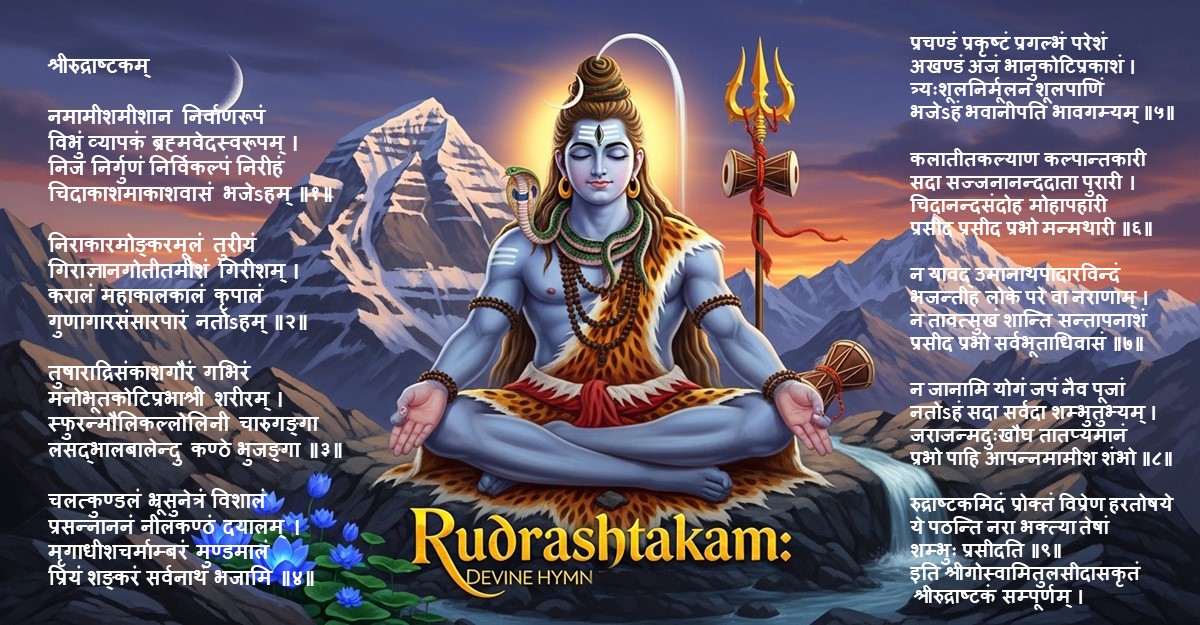
In this comprehensive guide, we present the complete Rudrashtakam lyrics in both Hindi (Sanskrit) and English transliteration — with every word separated sandhi-free for easy chanting — along with detailed verse-by-verse meanings, word-by-word translations, the profound spiritual significance of each stanza, the benefits of chanting, and answers to frequently asked questions.
What is Rudrashtakam?
The word Rudrashtakam is a Sanskrit compound: “Rudra” (one of the fierce forms of Lord Shiva, meaning “the one who eradicates sorrow”) + “Ashtakam” (a composition of eight verses). Together, Rudrashtakam means “Eight Verses in Praise of Rudra (Lord Shiva).”
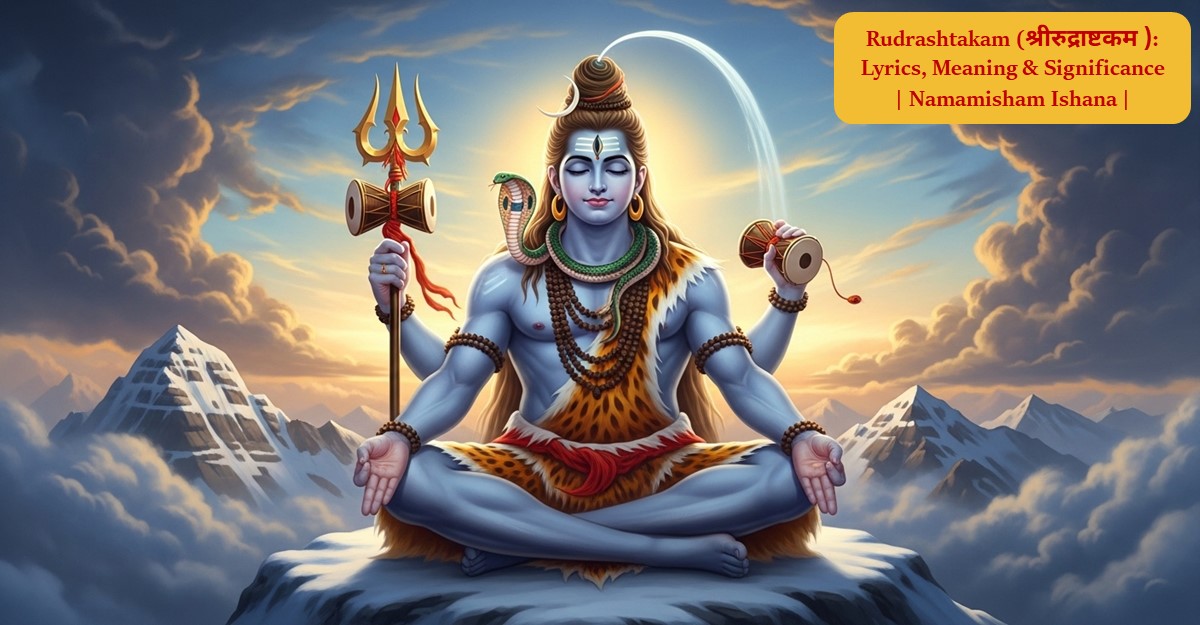
This stotra is a fervent prayer that describes Lord Shiva’s divine attributes — his formlessness, his cosmic dance of creation and destruction, his adorning of serpents and crescent moon, his role as the supreme consciousness, and his compassionate nature towards devotees. Each verse layers deeper philosophical and devotional meaning, making it simultaneously a prayer of surrender, a meditation on the absolute, and a celebration of Shiva’s infinite forms.
- Composer: Goswami Tulsidas (16th century CE)
- Language: Sanskrit
- Verses: 8 main verses + 1 Phal Shruti (concluding verse)
- Deity: Lord Shiva (Rudra / Mahadeva)
- Source: Appears in the Uttara Kanda of Ramcharitmanas
- Meter: Based on classical Sanskrit chandas (poetic meter)
- Purpose: Devotion, spiritual upliftment, removal of sorrows
Origin & Historical Background of Rudrashtakam
Goswami Tulsidas (1532–1623 CE), the celebrated poet-saint of the Bhakti movement, is universally revered as the author of the Ramcharitmanas — the Hindi retelling of the Ramayana. While Tulsidas was primarily a devotee of Lord Rama, his deep reverence for Lord Shiva is evident throughout his works. In the Hindu tradition, Shiva and Rama are inseparable: Shiva is Rama’s greatest devotee, and Rama worships Shiva. This unity is beautifully reflected in the Rudrashtakam.
The Rudrashtakam appears in the Uttara Kanda (the concluding section) of the Ramcharitmanas. According to tradition, Tulsidas composed this hymn during his time in Varanasi (Kashi), the sacred city of Lord Shiva, where he spent a significant portion of his life. The hymn is believed to have been inspired by his direct spiritual experience of Shiva’s cosmic presence.
Historically, the Rudrashtakam has been an integral part of temple worship across North India, especially in Shiva temples in Varanasi, Ujjain, and other Jyotirlinga sites. It is traditionally recited during the evening Aarti and on auspicious occasions dedicated to Lord Shiva.
About the Sandhi-Free Easy Chanting Format
Sanskrit poetry uses Sandhi — the merging of sounds between words for smooth poetic flow. For example, “Namami” + “Isham” becomes “Namamisham”, and “Chit” + “Akasham” becomes “Chidakasham”.
While Sandhi makes the verse melodious, it can make it difficult for many to identify individual words and understand the meaning. In the English transliteration below, we have broken every compound into its original component words, separated them clearly, and highlighted each word individually. This allows you to:
- ✅ Read each word distinctly while chanting
- ✅ Understand the meaning word by word
- ✅ Learn Sanskrit vocabulary naturally
- ✅ Chant at your own pace without stumbling over long compounds
- ✅ Meditate on each attribute of Lord Shiva as you say it
अर्थज्ञानविहीनो यो मन्त्रजापः प्रवर्तते ।

न फलाय भवेत् तस्य भस्मनि घृतार्पणम् ॥

Arthajñānavihīno yo mantrajāpaḥ pravartate ।

Na phalāya bhavet tasya bhasmani ghṛtārpaṇam ॥
Complete Rudrashtakam Lyrics – Hindi (Sanskrit) & Sandhi-Free English for Easy Chanting
Below are the complete lyrics of श्रीरुद्राष्टकम् (Sri Rudrashtakam) presented verse by verse in original Devanagari script alongside sandhi-free, word-by-word English transliteration, detailed meaning, and word-by-word translation.
Verse 1 – नमामीशमीशान निर्वाणरूपम्
विभुं व्यापकं ब्रह्मवेदस्वरूपम्।
निजं निर्गुणं निर्विकल्पं निरीहं
चिदाकाशमाकाशवासं भजेऽहम्॥१॥
Vibhum Vyapakam Brahma Veda Svarupam
Nijam Nirgunam Nirvikalpam Niriham
ChitAkashamAkashaVasam BhajeAham
Namami = I bow / I salute | Isham = the Supreme Lord | Ishana = the ruler / controller | Nirvana = liberation / ultimate bliss | Rupam = form / embodiment | Vibhum = all-pervading | Vyapakam = omnipresent | Brahma = the Absolute Reality | Veda = the Vedas (sacred knowledge) | Svarupam = true nature / essence | Nijam = self-existent / innate | Nirgunam = without qualities (beyond three gunas) | Nirvikalpam = without doubt / beyond duality | Niriham = desireless | Chit = consciousness | Akasham = sky / space | Akasha = sky / ether | Vasam = dwelling / abode | Bhaje = I worship | Aham = I
Significance: The opening verse establishes Lord Shiva as the Supreme Absolute Reality — formless, attributeless, and beyond all worldly dualities. Tulsidas immediately elevates the prayer from a personal devotional plea to a profound philosophical declaration. The word “Nirvana Rupam” connects Shiva to the ultimate goal of spiritual liberation. The description of Shiva as “Chit Akasham” (consciousness-space) aligns with the Advaita Vedanta concept of Brahman as pure consciousness. This verse invites the devotee to transcend physical worship and meditate on the formless, infinite nature of the Divine.
Verse 2 – निराकारमोंकारमूलम् तुरीयम्
गिराज्ञानगोतीतमीशं गिरीशम्।
करालं महाकालकालं कृपालं
गुणागारसंसारपारं नतोऽहम्॥२॥
Gira Jnana Go Atitam Isham Girisham
Karalam Maha Kala Kalam Kripalam
GunaAgaramSamsaraParamNatahAham
Nirakaram = formless | Omkara = the sacred syllable Om | Mulam = root / origin | Turiyam = the fourth state of consciousness (beyond waking, dreaming, deep sleep) | Gira = speech | Jnana = knowledge | Go = senses | Atitam = beyond / transcending | Isham = Lord | Girisham = Lord of the mountains | Karalam = terrifying / fierce | Maha = great | Kala = time / death | Kalam = the death of (destroyer of) | Kripalam = compassionate / merciful | Guna = virtues / qualities | Agaram = abode / storehouse | Samsara = worldly existence / cycle of birth-death | Param = beyond | Natah = bowed / surrendered | Aham = I
Significance: This verse beautifully captures the paradoxical nature of Shiva — simultaneously the most terrifying (Karala) and the most compassionate (Kripala). The reference to “Maha Kala Kala” (the destroyer of Time itself) places Shiva beyond the reach of even death, establishing him as the eternal, timeless reality. The mention of “Turiya” connects to Mandukya Upanishad’s teaching about the fourth state of consciousness, reinforcing Shiva’s identity as pure awareness. The phrase “Omkara Mulam” declares Shiva as the source of Om — the primordial sound from which all creation emerges.
Verse 3 – तुषाराद्रिसंकाशगौरं गभीरम्
मनोभूतकोटिप्रभाश्रीशरीरम्।
स्फुरन्मौलिकल्लोलिनीचारुगंगा
लसद्भालबालेन्दुकण्ठे भुजंगा॥३॥
Manah Bhuta Koti Prabha Shri Shariram
Sphurat Mauli Kallolini Charu Ganga
LasatBhalaBalaInduKantheBhujanga
Tushara = snow | Adri = mountain | Samkasha = resembling / like | Gauram = fair / radiant white | Gabhiram = profound / deep | Manah = mind (refers to Kamadeva / Cupid) | Bhuta = born of | Koti = millions / crores | Prabha = brilliance / radiance | Shri = glorious / beautiful | Shariram = body | Sphurat = shining / flowing | Mauli = head / crown of matted hair | Kallolini = playing / frolicking (waves) | Charu = beautiful | Ganga = the river Ganges | Lasat = shining / sparkling | Bhala = forehead | Bala = young / crescent | Indu = moon | Kanthe = on the neck / throat | Bhujanga = serpent / snake
Significance: After describing Shiva’s formless nature in the first two verses, Tulsidas now paints a vivid portrait of Shiva’s physical form — a form beloved by devotees for meditation and worship. The comparison to snow-clad mountains evokes his abode on Mount Kailash. The Ganges on his head symbolizes his role as the one who received the celestial river to save Earth from its impact. The crescent moon represents the cycle of time, and the serpents around his neck signify his mastery over fear and death. This verse is ideal for dhyana (meditation) — it provides a complete visual for contemplating Shiva’s divine form.
Verse 4 – चलत्कुण्डलं भ्रूसुनेत्रं विशालम्
प्रसन्नाननं नीलकण्ठं दयालम्।
मृगाधीशचर्माम्बरं मुण्डमालं
प्रियं शंकरं सर्वनाथं भजामि॥४॥
Prasanna Ananam Nila Kantham Dayalam
Mriga Adhisha Charma Ambaram Munda Malam
PriyamShankaramSarvaNathamBhajami
Chalat = swaying / moving | Kundalam = earrings | Bhru = eyebrows | Su = beautiful | Netram = eyes | Vishalam = large / expansive | Prasanna = pleased / serene | Ananam = face | Nila = blue | Kantham = throat | Dayalam = compassionate / merciful | Mriga = animal / deer | Adhisha = lord / king (lion/tiger) | Charma = skin / hide | Ambaram = garment / clothing | Munda = skull | Malam = garland | Priyam = beloved / dear | Shankaram = Shankara (the auspicious one / doer of good) | Sarva = all | Natham = Lord / master | Bhajami = I worship
Significance: This verse continues the physical description while introducing key mythological references. “Nila Kantha” recalls the famous episode of Samudra Manthan (churning of the ocean), where Shiva drank the deadly poison Halahala to save the universe, turning his throat blue — an ultimate act of selfless compassion. The garland of skulls and tiger skin represent his ascetic nature and his supremacy over death and the animal kingdom. Despite these fearsome attributes, he is described as “Prasanna Ananam” (with a pleased, calm face) and “Dayalam” (compassionate), showing that Shiva’s fierce exterior conceals infinite love.
Verse 5 – प्रचण्डं प्रकृष्टं प्रगल्भं परेशम्
अखण्डं अजं भानुकोटिप्रकाशम्।
त्र्यःशूलनिर्मूलनं शूलपाणिं
भजेऽहं भवानीपतिं भावगम्यम्॥५॥
Akhandam Ajam Bhanu Koti Prakasham
Trayah Shula Nirmulanam Shula Panim
BhajeAhamBhavaniPatimBhavaGamyam
Prachandam = fierce / powerful | Prakrushtam = most exalted / supreme | Pragalbham = courageous / bold | Para = supreme / highest | Isham = Lord | Akhandam = indivisible / whole | Ajam = unborn / without birth | Bhanu = sun | Koti = millions / crores | Prakasham = radiance / light | Trayah = three | Shula = suffering / pain (also: trident point) | Nirmulanam = uprooting / destroying | Shula = trident | Panim = in hand / holding | Bhaje = I worship | Aham = I | Bhavani = Goddess Parvati (Bhavani) | Patim = husband / Lord | Bhava = devotion / feeling / emotion | Gamyam = accessible / reachable
Significance: The fifth verse is a declaration of Shiva’s supreme power and accessibility. The phrase “Bhava Gamyam” is profoundly significant — it declares that despite being the most powerful being in existence, Shiva can be reached only through sincere devotion (Bhava). The Trishula (trident) is not merely a weapon; it symbolically destroys the three types of suffering that afflict human beings. The term “Bhavani Pati” tenderly presents Shiva as the consort of the Divine Mother, humanizing the cosmic deity and making him relatable to householder devotees.
Verse 6 – कलातीतकल्याणकल्पान्तकारी
सदासज्जनानन्ददाता पुरारी।
चिदानन्दसंदोहमोहापहारी
प्रसीद प्रसीद प्रभो मन्मथारी॥६॥
Sada Sat Jana Ananda Data Pura Ari
Chit Ananda Samdoha Moha Apahari
PrasidaPrasidaPrabhoManmathaAri
Kala = time / divisions of time | Atita = beyond / transcending | Kalyana = auspicious / welfare | Kalpa = cosmic age / epoch | Anta = end | Kari = doer / one who brings about | Sada = always | Sat = good / virtuous | Jana = people | Ananda = bliss / joy | Data = giver / bestower | Pura = cities (Tripura — three demon cities) | Ari = enemy / destroyer | Chit = consciousness | Samdoha = mass / abundance | Moha = delusion / attachment | Apahari = remover / destroyer | Prasida = be pleased / be gracious | Prabho = O Lord | Manmatha = Kamadeva (god of desire / Cupid) | Ari = enemy / destroyer
Significance: This is the first verse where the devotee directly pleads with Shiva — “Prasida Prasida” (Be pleased! Be pleased!). This shift from description to supplication marks a deepening of the devotional relationship. The reference to “Pura Ari” (destroyer of Tripura) recalls the legend where Shiva destroyed the three fortified cities of the demons with a single arrow. “Manmatha Ari” refers to Shiva burning Kamadeva (god of desire) to ashes, symbolizing the conquest over lust and attachment. The phrase “Moha Apahari” is especially relevant — Shiva removes the veil of Maya (illusion) that keeps the soul trapped in the cycle of birth and death.
Verse 7 – न यावत् उमानाथपादारविन्दम्
भजन्तीह लोके परे वा नराणाम्।
न तावत् सुखं शान्तिसन्तापनाशं
प्रसीद प्रभो सर्वभूताधिवासम्॥७॥
Bhajanti Iha Loke Pare Va Naranam
Na Tavat Sukham Shanti Santapa Nasham
PrasidaPrabhoSarvaBhutaAdhiVasam
Na = not | Yavat = until / as long as | Uma = Goddess Uma (Parvati) | Natha = Lord / husband | Pada = feet | Aravindam = lotus | Bhajanti = they worship | Iha = here / in this (world) | Loke = world | Pare = in the other (world) / hereafter | Va = or | Naranam = of people / of human beings | Tavat = till then | Sukham = happiness | Shanti = peace | Santapa = sorrow / affliction | Nasham = destruction | Prasida = be pleased | Prabho = O Lord | Sarva = all | Bhuta = beings / creatures | Adhi = in / within | Vasam = dwelling
Significance: This verse makes a bold spiritual assertion: there is no lasting peace or happiness without the worship of Shiva. It is not a sectarian statement but a declaration about the necessity of connecting with the Supreme Reality for genuine fulfillment. The phrase “Sarva Bhuta Adhi Vasam” is deeply significant — Shiva is not a distant deity but dwells within all living beings as the inner Self (Antaratma). This verse bridges the gap between external worship and internal realization, directing the devotee inward.
Verse 8 – न जानामि योगं जपं नैव पूजाम्
नतोऽहं सदा सर्वदा शम्भुतुभ्यम्।
जराजन्मदुःखौघतातप्यमानं
प्रभो पाहि आपन्नमामीश शम्भो॥८॥
Natah Aham Sada Sarvada Shambhu Tubhyam
Jara Janma Duhkha Ogha Tatapyamanam
PrabhoPahiApannamAmIshaShambho
Na = not | Janami = I know | Yogam = yoga (spiritual discipline) | Japam = chanting / repetition of mantras | Na = not | Eva = even / indeed | Pujam = worship / ritual | Natah = bowed / surrendered | Aham = I | Sada = always | Sarvada = at all times | Shambhu = O Shambhu (the auspicious one) | Tubhyam = to you | Jara = old age | Janma = birth | Duhkha = sorrow / suffering | Ogha = flood / torrent | Tatapyamanam = burning / scorched | Prabho = O Lord | Pahi = protect / save | Apannam = the afflicted / helpless one | Am = me (mam) | Isha = O Supreme Lord | Shambho = O Shambhu (giver of auspiciousness)
Significance: The final verse is perhaps the most emotionally powerful and universally relatable of all eight. Here, Tulsidas strips away all pretense of spiritual accomplishment and presents himself — and by extension, every devotee — as a humble, ignorant, suffering soul who has nothing to offer but surrender. “Na Janami Yogam Japam Na Eva Pujam” — this radical admission of helplessness is the highest form of devotion in the Bhakti tradition. It echoes the sentiment found across Hindu devotional literature: that God responds not to elaborate rituals but to the sincere cry of the heart. The verse ends with the word “Shambho” (the auspicious one) — the name that embodies hope, as Shambhu is the one who grants auspiciousness even to the most undeserving.
Phal Shruti – फलश्रुति (Concluding Verse – The Fruit of Recitation)
ये पठन्ति नरा भक्त्या तेषां शम्भुः प्रसीदति॥
YePathantiNaraBhaktyaTeshamShambhuhPrasidati
Rudra = Lord Rudra (Shiva) | Ashtakam = eight verses | Idam = this | Proktam = spoken / composed | Viprena = by the Brahmin (Tulsidas) | Hara = Lord Hara (Shiva) | Toshaye = for the pleasure / satisfaction | Ye = those who | Pathanti = recite / read | Nara = people / human beings | Bhaktya = with devotion | Tesham = upon them / for them | Shambhuh = Lord Shambhu (Shiva) | Prasidati = becomes pleased / bestows grace
Significance: The Phal Shruti serves as a promise and benediction. It guarantees that anyone who recites the Rudrashtakam with sincere devotion will earn the grace and pleasure of Lord Shiva. This concluding verse acts as a divine seal of assurance, encouraging regular recitation. The simplicity of the condition — just “Bhaktya” (with devotion) — echoes the message of Verse 8: no elaborate qualifications are needed, only a sincere heart.
Spiritual Significance of Rudrashtakam
The Rudrashtakam is not merely a devotional hymn — it is a complete spiritual journey compressed into eight verses. Understanding its layered significance enhances both the intellectual and experiential dimensions of chanting.
1. A Journey from Formless to Form and Back to Surrender
The hymn begins with the Nirguna (formless) aspect of Shiva (Verses 1–2), transitions to the Saguna (with form) aspect (Verses 3–5), and culminates in complete surrender (Verses 6–8). This structure mirrors the spiritual aspirant’s own journey — from philosophical inquiry to devotional love to ultimate surrender.
2. Integration of Vedanta and Bhakti
Tulsidas masterfully weaves Advaita Vedantic concepts (Nirgunam, Nirvikalpam, Chit Akasham) with the warmth of Bhakti (personal devotion, emotional surrender). This makes the Rudrashtakam accessible to both intellectually inclined seekers and emotionally driven devotees.
3. Shiva as the Complete Reality (Purna Brahman)
Through the eight verses, every aspect of reality is attributed to Shiva — he is formless and yet has a beautiful form; he is fierce yet compassionate; he destroys the universe yet sustains it; he is the ultimate ascetic yet the devoted husband of Parvati. This coincidentia oppositorum (union of opposites) is a hallmark of the Hindu understanding of the Supreme Being.
4. The Revolutionary Power of Surrender
The eighth verse — “Na Janami Yogam” — is the beating heart of the Rudrashtakam. It teaches that spiritual advancement does not require mastery of techniques but sincerity of heart. This democratizes spiritual practice, making it accessible to every human being regardless of education, caste, gender, or ritual knowledge.
5. Cosmological and Mythological Integration
References to Samudra Manthan (Nila Kantha), Tripura destruction (Pura Ari), burning of Kamadeva (Manmatha Ari), and Ganga on Shiva’s head serve dual purposes: they enrich the hymn with narrative depth and simultaneously encode philosophical teachings about the nature of desire, ego, time, and grace.
6. The Immanent God — Sarva Bhuta Adhi Vasam
Verse 7’s description of Shiva as dwelling within all beings (Sarva Bhuta Adhi Vasam) transforms Shiva from an external deity to an internal reality. This is the bridge between temple worship and self-realization — recognizing that the Shiva you pray to outside is the same consciousness within you.
Benefits of Chanting Rudrashtakam
Devotees and spiritual traditions attribute numerous benefits to the regular recitation of Rudrashtakam. These benefits span the spiritual, psychological, and material dimensions of life:
- 🙏 Attainment of Lord Shiva’s Grace: As promised in the Phal Shruti, sincere recitation pleases Lord Shambhu, who bestows his blessings upon the devotee.
- 🕉️ Spiritual Purification: The sacred Sanskrit syllables create powerful vibrations that purify the mind, body, and subtle energy channels (nadis).
- 😌 Mental Peace & Stress Relief: The rhythmic chanting calms the nervous system, reduces anxiety, and promotes deep inner peace — comparable to the effects of meditation.
- 🔥 Removal of Negative Energies: Shiva is the supreme protector. Chanting Rudrashtakam is believed to create a protective spiritual shield around the devotee.
- 🎯 Destruction of Three-fold Suffering: As described in Verse 5, the Trishula destroys Adhyatmika, Adhibhautika, and Adhidaivika sufferings — mental, physical, and supernatural afflictions.
- 📿 Enhancement of Meditation: The vivid descriptions of Shiva’s form in Verses 3–4 serve as excellent objects for dhyana (meditation), helping practitioners develop concentration.
- 🌊 Dissolution of Ego and Attachment: The progressive surrender across the eight verses naturally weakens the ego and fosters detachment from worldly entanglements.
- 🌟 Auspiciousness in Daily Life: Regular recitation, especially during Shravan Maas and on Mondays, is believed to bring overall auspiciousness, harmony in relationships, and material well-being.
- 🔄 Liberation from the Cycle of Birth & Death: The ultimate spiritual benefit — the devotee who genuinely surrenders through this hymn moves toward Moksha (liberation).
- 💪 Courage and Fearlessness: Meditating on Shiva as the destroyer of death itself (Maha Kala Kala) instills deep courage and freedom from the fear of death.
- 🧠 Improved Concentration & Memory: Regular Sanskrit chanting has been shown to improve cognitive function, memory, and attention span.
- ❤️ Emotional Healing: The act of pouring out one’s helplessness before the Divine (as in Verse 8) provides cathartic emotional release and healing.
When & How to Chant Rudrashtakam
While the Rudrashtakam can be chanted at any time with devotion, certain times and practices amplify its spiritual potency:
| Occasion / Time | Significance |
|---|---|
| Maha Shivaratri | The most powerful night for Shiva worship; chanting Rudrashtakam during the four Praharas (night watches) yields immense spiritual merit. |
| Shravan Maas (July–August) | The entire month is sacred to Shiva. Daily recitation during this month is considered highly auspicious. |
| Every Monday (Somvar) | Monday is Shiva’s day. Reciting Rudrashtakam after morning bath and puja is a widespread practice. |
| Pradosh Vrat | The 13th day of each lunar fortnight, dedicated to Shiva. Rudrashtakam is traditionally recited during evening worship. |
| Sandhya Kala (Twilight) | The junction between day and night is considered an ideal time for spiritual practices, including Rudrashtakam recitation. |
| During Abhishekam | Reciting Rudrashtakam while performing the ritual bathing of Shiva Linga with milk, water, or honey enhances the worship. |
| Before Meditation | Chanting the hymn before meditation prepares the mind and invokes Shiva’s presence for deeper spiritual practice. |
- Sit in a clean, quiet place facing East or North.
- Light a diya (lamp) and incense if possible.
- Begin with three chants of “Om Namah Shivaya.”
- Recite the Rudrashtakam slowly and clearly, focusing on the meaning of each word.
- Use the sandhi-free format above if you are a beginner — it helps you pronounce each word correctly.
- Maintain a feeling of devotion and surrender throughout.
- Conclude with the Phal Shruti and offer mental prostrations to Lord Shiva.
- There is no strict rule about the number of recitations — even one heartfelt recitation is considered powerful.
Rudrashtakam vs Other Shiva Stotras — A Comparison
Hindu devotional literature offers numerous hymns to Lord Shiva. Here is how the Rudrashtakam compares with other popular Shiva stotras:
| Stotra | Author | Verses | Focus | Difficulty |
|---|---|---|---|---|
| Rudrashtakam | Goswami Tulsidas | 8 + 1 | Complete — formless to form to surrender | Easy to Moderate |
| Shiva Tandava Stotram | Ravana | 16 | Cosmic dance of Shiva; power and grandeur | Advanced |
| Lingashtakam | Adi Shankaracharya | 8 | Worship of the Shiva Linga | Easy |
| Shiv Mahimna Stotram | Pushpadanta | 43 | Glory and greatness of Shiva in detail | Moderate to Advanced |
| Bilvashtakam | Adi Shankaracharya | 8 | Offering Bilva leaves to Shiva | Easy |
| Sri Rudram (Vedic) | Vedic Rishis | 11+ 11 Anuvakas | Vedic hymn to Rudra; cosmic and ritualistic | Advanced |
The Rudrashtakam holds a unique position because it is short enough for daily recitation, rich enough in philosophy for deep contemplation, and emotionally moving enough to bring tears to a devotee’s eyes. Its accessibility, especially in the sandhi-free format presented above, makes it the most widely recited Shiva stotra in North India and increasingly popular worldwide.
Frequently Asked Questions (FAQ) About Rudrashtakam
1. Who wrote the Rudrashtakam?
The Rudrashtakam was composed by Goswami Tulsidas, the 16th-century saint-poet of India, best known as the author of the Ramcharitmanas. He composed this hymn in Varanasi (Kashi) as part of his devotion to Lord Shiva.
2. What does “Rudrashtakam” mean?
Rudrashtakam is a Sanskrit compound word: “Rudra” (a name of Lord Shiva meaning “the one who removes sorrow” or “the fierce one”) + “Ashtakam” (a composition of eight verses). It literally means “Eight Verses in Praise of Rudra.”
3. What is the meaning of “Namamisham Ishana Nirvana Rupam”?
When broken into individual words: Namami (I bow) + Isham (to the Supreme Lord) + Ishana (the ruler) + Nirvana (liberation) + Rupam (form/embodiment). It translates to: “I bow to the Supreme Lord, the ruler, who is the embodiment of liberation.” It is the opening line of the Rudrashtakam.
4. Can anyone chant the Rudrashtakam?
Yes, absolutely. The Rudrashtakam can be chanted by anyone regardless of gender, age, caste, or religious background. There are no ritualistic restrictions. The only requirement is sincerity and devotion. Tulsidas himself emphasized in the eighth verse that one need not know yoga, japa, or formal puja — simple, heartfelt surrender is enough.
5. When is the best time to chant the Rudrashtakam?
While it can be chanted at any time, the most auspicious times are: early morning (Brahma Muhurta), during evening twilight (Sandhya Kala), on Mondays (Somvar), during Shravan Maas, on Maha Shivaratri, and during Pradosh Vrat. Chanting during Abhishekam (ritual bathing of Shiva Linga) is also highly recommended.
6. How many times should one chant the Rudrashtakam?
There is no fixed number. Even a single sincere recitation is considered powerful. However, many devotees chant it 1, 3, 5, 8, or 11 times in a single sitting for deeper spiritual impact. During special occasions like Maha Shivaratri, some devotees chant it continuously through the night.
7. What are the benefits of chanting Rudrashtakam daily?
Regular chanting brings: Lord Shiva’s grace and protection, mental peace and reduction of anxiety, removal of negative energies, spiritual purification, dissolution of karmic debts, courage and fearlessness, and ultimately, progress toward Moksha (liberation). The Phal Shruti explicitly promises that Lord Shambhu becomes pleased with those who recite it with devotion.
8. Is Rudrashtakam part of the Ramcharitmanas?
Yes. The Rudrashtakam appears in the Uttara Kanda (final section) of the Ramcharitmanas, Tulsidas’s magnum opus. This placement underscores the inseparable relationship between Lord Rama and Lord Shiva in the devotional tradition.
9. What is the difference between Rudrashtakam and Sri Rudram?
The Rudrashtakam is a devotional hymn of 8 verses composed by Tulsidas in classical Sanskrit, suitable for personal devotion by anyone. Sri Rudram (also called Rudra Prashna or Shatarudriya) is a Vedic hymn from the Yajurveda, consisting of 11 Anuvakas (sections), traditionally chanted by trained Vedic priests with specific intonations. Both are powerful Shiva prayers, but Rudrashtakam is far more accessible for the general devotee.
10. Can women chant the Rudrashtakam?
Yes. There is absolutely no restriction on women chanting the Rudrashtakam. Lord Shiva himself is inseparable from Shakti (the Divine Feminine), and devotion knows no gender. Women have been among the most devoted Shiva worshippers throughout Hindu history, and this hymn is equally open and beneficial to all.
11. What is the Phal Shruti of Rudrashtakam?
The Phal Shruti is the concluding verse that describes the fruits (benefits) of reciting the hymn. It states: “This Rudrashtakam, spoken by the Brahmin (Tulsidas) for the pleasure of Lord Hara — those who recite it with devotion, upon them Lord Shambhu becomes pleased.” It serves as a divine guarantee of Shiva’s grace for sincere reciters.
12. Can Rudrashtakam be chanted without a bath or puja setup?
Yes. While it is ideal to chant after bathing in a clean and peaceful environment, devotion is the primary requirement, not external rituals. If circumstances do not permit a formal setup, one can chant the Rudrashtakam mentally or softly anywhere — while traveling, resting, or even during illness. Lord Shiva, being “Bholenath” (the innocent and easily pleased Lord), responds to the purity of intention, not the grandeur of arrangements.
13. What is “sandhi-free” chanting and why is it helpful?
Sandhi is the Sanskrit grammatical rule of merging sounds between words for smooth flow. For example, “Namami” + “Isham” becomes “Namamisham.” While melodious, sandhi makes it hard for many to identify individual words, and their meanings. Sandhi-free chanting means separating each word clearly — “Namami Isham” — so you can understand, pronounce, and meditate on each word individually. This is especially helpful for those new to Sanskrit chanting.
14. In which language is the Rudrashtakam originally composed?
The Rudrashtakam is composed in classical Sanskrit, though Tulsidas’s primary literary language was Awadhi Hindi. The use of Sanskrit for this hymn reflects the gravitas and universality of the prayer, connecting it to the ancient Vedic and Upanishadic tradition of Shiva worship.
15. Does chanting Rudrashtakam help with fear and anxiety?
Many devotees report experiencing significant relief from fear, anxiety, and mental disturbance through regular Rudrashtakam chanting. The hymn describes Shiva as “Maha Kala Kala” (the destroyer of death/time), “Dayalam” (compassionate), and the one who dwells within all beings. Meditating on these attributes naturally dispels fear. Additionally, the rhythmic recitation of Sanskrit syllables has a documented calming effect on the nervous system, similar to the effects of chanting “Om.”
16. What is the significance of calling Shiva both “Karalam” (fierce) and “Kripalam” (compassionate) in the same verse?
This juxtaposition in Verse 2 represents the complete nature of the Divine. Shiva is fierce (Karala) toward ignorance, ego, and evil — he is the cosmic destroyer who annihilates what is harmful. Simultaneously, he is infinitely compassionate (Kripala) toward his devotees and all beings who seek refuge. This teaches that true compassion sometimes requires fierceness — like a surgeon who must cut to heal. It also shows that the same Lord who terrifies demons is the gentlest protector of the surrendered soul.
Conclusion: The Eternal Relevance of Rudrashtakam
The Rudrashtakam, composed over four centuries ago by Goswami Tulsidas, remains as powerful and relevant today as it was when it first echoed through the ancient ghats of Varanasi. In just eight verses, it encompasses the entirety of Shiva’s cosmic nature — from the formless Brahman to the compassionate Lord adorned with crescent moon and serpents, from the destroyer of the universe to the protector of the helpless.
What makes the Rudrashtakam truly timeless is its final verse: the raw, honest confession of a devotee who knows nothing of yoga, japa, or ritual, yet surrenders completely. In an age of spiritual complexity and information overload, this message is profoundly liberating — you don’t need to be perfect; you just need to be sincere.
The sandhi-free, word-by-word format presented in this guide makes the Rudrashtakam accessible to beginners and experienced chanters alike. Each word becomes a seed of meditation, each syllable a doorway to the Divine. Whether you chant it in a grand temple or whisper it silently in your heart, whether you understand every Sanskrit word or simply feel its rhythm, the Rudrashtakam opens a direct channel to the grace of Mahadeva.
As the Phal Shruti assures us — Ye Pathanti Nara Bhaktya Tesham Shambhuh Prasidati — those who recite it with devotion, upon them Lord Shambhu becomes pleased.
॥ ॐ नमः शिवाय ॥
|| Om Namah Shivaya ||