
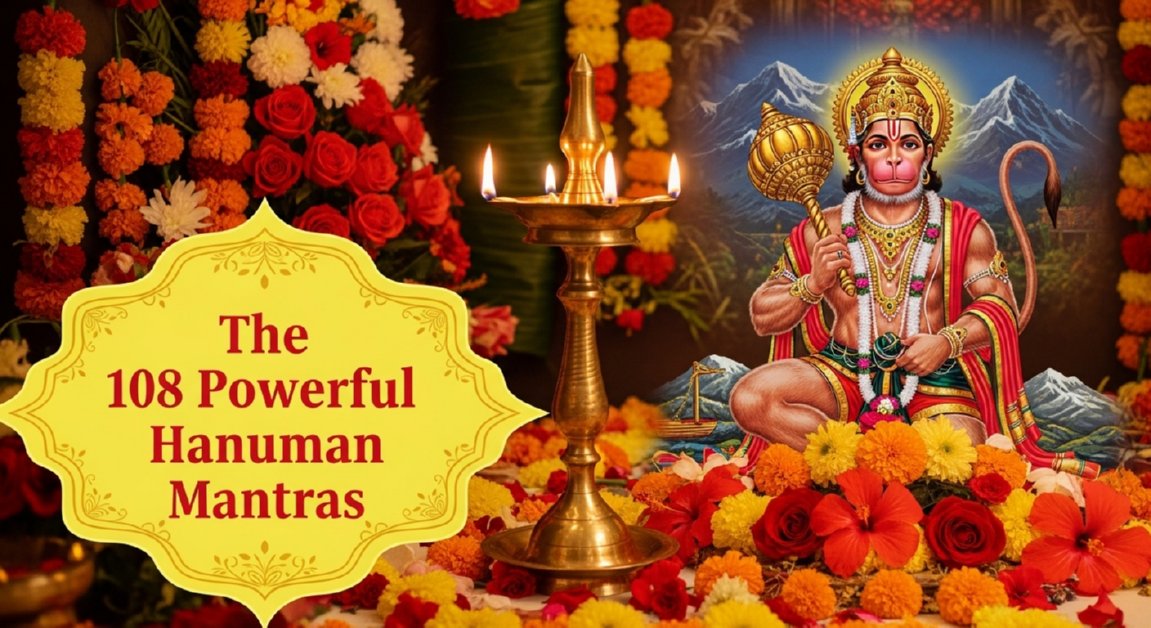
The 108 names of Lord Hanuman, known as Hanuman Ashtottara Shatanamavali, are among the most powerful mantras in Hindu spiritual practice. Chanting these 108 mantras using a Rudraksha mala removes fear, negative energy, and planetary afflictions while building inner strength and divine protection. This is the complete japa list with original Sanskrit text, accurate English transliteration, meaning, chanting instructions, and spiritual benefits for each group of mantras.
When to Chant 108 Hanuman Mantras
Best Days: Every Tuesday and Saturday throughout the year
Best Time: Brahma Muhurta (4:00–6:00 AM) or Sunset
Most Auspicious Occasion: Hanuman Jayanti 2026 — April 2, 2026 (Thursday)
Chanting Duration: 25–40 minutes for complete 108 mantras
Chanting during Shani Sade Sati, Mangal Dosh periods, or any Tuesday/Saturday amplifies the protective and healing power of these mantras manifold.
Table of Contents
What Are the 108 Hanuman Mantras?
The 108 Hanuman Mantras are a sacred collection of divine names of Lord Hanuman, collectively known as Hanuman Ashtottara Shatanamavali (हनुमान अष्टोत्तरशतनामावलि). Each name represents a unique quality, power, or divine attribute of Bajrangbali — from his supreme strength and unwavering devotion to his role as protector, healer, and destroyer of evil.
The number 108 holds profound significance in Hinduism. There are 108 Upanishads, 108 energy lines (nadis) converging at the heart chakra, and 108 beads on a japa mala. Chanting each of Hanuman’s 108 names completes one full cycle of the mala, creating a powerful spiritual circuit of devotion and protection.
Origin and Scriptural References
These 108 names are derived from multiple ancient scriptures including the Parasara Samhita, Ananda Ramayana, and various Puranic texts. The tradition of reciting Hanuman’s names as a form of worship (namavali puja) has been practiced for centuries across India, especially in the traditions of Ramayana bhakti.
Why 108 Is Sacred
| Aspect | Significance of 108 |
|---|---|
| Upanishads | There are 108 principal Upanishads |
| Mala Beads | A japa mala has exactly 108 beads |
| Nadis | 108 energy lines converge at the heart chakra |
| Sun and Earth | Distance between Sun and Earth is 108 times the Sun’s diameter |
| Sanskrit Alphabet | 54 letters × 2 (masculine and feminine) = 108 |
| Astrology | 12 zodiac signs × 9 planets = 108 |
7 Most Powerful Core Hanuman Mantras
Before beginning the complete 108-name japa, many practitioners chant these 7 core Hanuman mantras as an invocation. Each mantra serves a distinct spiritual purpose and can also be chanted independently for specific benefits.
1. Om Hanumate Namah — The Universal Hanuman Mantra
ॐ हनुमते नमः
IAST: Om Hanumate Namaḥ
Meaning: Salutations to Lord Hanuman
Best for: Daily worship, general protection, and building a connection with Hanuman. This is the simplest and most widely chanted Hanuman mantra suitable for everyone.
2. Om Namo Bhagavate Hanumate Namah
ॐ नमो भगवते हनुमते नमः
IAST: Om Namo Bhagavate Hanumate Namaḥ
Meaning: Salutations to the Divine Lord Hanuman
Best for: Deep devotional practice, surrendering to divine will, and seeking Hanuman’s grace during major life challenges.
3. Om Shri Vajradehaya Ramabhaktaya Vayuputraya Namostute
ॐ श्री वज्रदेहाय रामभक्ताय वायुपुत्राय नमोऽस्तुते
IAST: Om Śrī Vajradehāya Rāmabhaktāya Vāyuputrāya Namo’stute
Meaning: Salutations to the one with a thunderbolt body, devoted to Rama, son of the Wind God
Best for: Physical strength, bodybuilding, athletic performance, and building an invincible body and mind.
4. Hanuman Gayatri Mantra
ॐ आञ्जनेयाय विद्महे वायुपुत्राय धीमहि तन्नो हनुमत् प्रचोदयात्
IAST: Om Āñjaneyāya Vidmahe Vāyuputrāya Dhīmahi Tanno Hanumat Prachodayāt
Meaning: We meditate upon Anjaneya, the son of Vayu. May Lord Hanuman illuminate our minds.
Best for: Students, exams, intellectual growth, decision-making clarity, and academic success. This is the Gayatri format mantra of Hanuman.
5. Om Ramdutaya Namah
ॐ रामदूताय नमः
IAST: Om Rāmadūtāya Namaḥ
Meaning: Salutations to the Messenger of Lord Rama
Best for: Communication success, delivering important messages, job interviews, and business negotiations.
6. Om Pavanputraya Namah
ॐ पवनपुत्राय नमः
IAST: Om Pavanaputrāya Namaḥ
Meaning: Salutations to the Son of the Wind God
Best for: Respiratory health, pranayama enhancement, breathing disorders, and vitality.
7. Om Sankat Mochan Hanumanaya Namah
ॐ संकटमोचन हनुमानाय नमः
IAST: Om Saṅkaṭamocana Hanumānāya Namaḥ
Meaning: Salutations to Hanuman, the remover of all difficulties
Best for: Crisis situations, removing obstacles, court cases, financial problems, and any situation where you feel trapped or helpless.
Complete 108 Hanuman Mantras — Japa Sequence
Below is the complete Hanuman Ashtottara Shatanamavali organized into 6 thematic groups. Each mantra includes the original Sanskrit (Devanagari), English transliteration, and meaning. Use this list for your daily japa practice with a 108-bead Rudraksha mala.
🙏 Group 1: Sacred Names of Hanuman (Mantras 1–20)
These first 20 mantras invoke Hanuman by his primary sacred names — each name representing his core identity as the son of Anjana and Vayu, the mighty warrior, the devoted messenger of Rama, and the king of the Vanaras.
| # | Mantra (English) | Sanskrit (Devanagari) | Meaning |
|---|---|---|---|
| 1 | Om Hanumate Namah | ॐ हनुमते नमः | Salutations to Lord Hanuman |
| 2 | Om Anjaneyaya Namah | ॐ आञ्जनेयाय नमः | Son of Anjana |
| 3 | Om Vayuputraya Namah | ॐ वायुपुत्राय नमः | Son of the Wind God |
| 4 | Om Mahaviraya Namah | ॐ महावीराय नमः | The Great Warrior |
| 5 | Om Ramdutaya Namah | ॐ रामदूताय नमः | Messenger of Lord Rama |
| 6 | Om Pavanputraya Namah | ॐ पवनपुत्राय नमः | Son of Pavan (Wind) |
| 7 | Om Mahabalaya Namah | ॐ महाबलाय नमः | The Supremely Strong One |
| 8 | Om Kapirajaya Namah | ॐ कपिराजाय नमः | King of the Monkeys |
| 9 | Om Bajrangbaliye Namah | ॐ बजरंगबलीये नमः | One with a Body of Thunder |
| 10 | Om Sankat Mochanaya Namah | ॐ संकटमोचनाय नमः | Remover of Obstacles |
| 11 | Om Kesarinandanaya Namah | ॐ केसरीनन्दनाय नमः | Son of Kesari |
| 12 | Om Marutaye Namah | ॐ मारुतये नमः | Son of Marut (Wind God) |
| 13 | Om Pingalakshaya Namah | ॐ पिङ्गलाक्षाय नमः | One with Tawny Eyes |
| 14 | Om Amitatejase Namah | ॐ अमिततेजसे नमः | One with Limitless Radiance |
| 15 | Om Kapishwaraya Namah | ॐ कपीश्वराय नमः | Lord of the Monkeys |
| 16 | Om Mahadhyutaye Namah | ॐ महाद्युतये नमः | One with Great Splendor |
| 17 | Om Ramapriyaya Namah | ॐ रामप्रियाय नमः | Beloved of Lord Rama |
| 18 | Om Marutinandanaya Namah | ॐ मारुतिनन्दनाय नमः | Delightful Son of Maruti |
| 19 | Om Prabhanjanaya Namah | ॐ प्रभञ्जनाय नमः | The Destroyer of Evil |
| 20 | Om Lankadahanaya Namah | ॐ लङ्कादहनाय नमः | One Who Burned Lanka |
✨ Group 2: Divine Qualities and Legends (Mantras 21–40)
This group celebrates Hanuman’s legendary deeds — his immortality, his burning of Lanka, his service to Sita, and his fearsome yet compassionate divine form. These mantras connect the devotee to Hanuman’s mythological power.
| # | Mantra (English) | Sanskrit (Devanagari) | Meaning |
|---|---|---|---|
| 21 | Om Chiranjivine Namah | ॐ चिरञ्जीविने नमः | The Immortal One |
| 22 | Om Ramacharitrakathakaya Namah | ॐ रामचरित्रकथकाय नमः | Narrator of Rama’s Story |
| 23 | Om Dantakaralikavigrahamaya Namah | ॐ दान्तकरालिकविग्रहमाय नमः | One with a Fearsome Form |
| 24 | Om Daityakulantakaya Namah | ॐ दैत्यकुलान्तकाय नमः | Destroyer of the Demon Race |
| 25 | Om Surarchitaya Namah | ॐ सुरार्चिताय नमः | Worshipped by the Devas |
| 26 | Om Mahatejasvine Namah | ॐ महातेजस्विने नमः | One with Immense Brilliance |
| 27 | Om Ramasevakaya Namah | ॐ रामसेवकाय नमः | Devoted Servant of Rama |
| 28 | Om Sitashokanivaranaya Namah | ॐ सीताशोकनिवारणाय नमः | Remover of Sita’s Sorrow |
| 29 | Om Vajradehaya Namah | ॐ वज्रदेहाय नमः | One with a Thunderbolt Body |
| 30 | Om Vardhanaya Namah | ॐ वर्धनाय नमः | The Enhancer of Good |
| 31 | Om Rudraviraye Namah | ॐ रुद्रवीराय नमः | Heroic Form of Rudra |
| 32 | Om Dharmacharinine Namah | ॐ धर्मचारिणे नमः | Practitioner of Dharma |
| 33 | Om Mahasattvaya Namah | ॐ महासत्त्वाय नमः | One with Supreme Essence |
| 34 | Om Siddhasevitaya Namah | ॐ सिद्धसेविताय नमः | Served by Perfected Beings |
| 35 | Om Vagmine Namah | ॐ वाग्मिने नमः | The Eloquent Speaker |
| 36 | Om Durdharshaya Namah | ॐ दुर्धर्षाय नमः | The Invincible One |
| 37 | Om Kalanabhaya Namah | ॐ कालनाभाय नमः | Controller of Time |
| 38 | Om Divyamangalavigrahamaya Namah | ॐ दिव्यमङ्गलविग्रहमाय नमः | Auspicious Divine Form |
| 39 | Om Bhaktavatsalaya Namah | ॐ भक्तवत्सलाय नमः | Affectionate to Devotees |
| 40 | Om Sanjivinenagacharaharanaya Namah | ॐ सञ्जीविनेनगचरहरणाय नमः | Brought the Sanjivani Mountain |
🛡️ Group 3: Strength and Protection (Mantras 41–60)
These mantras invoke Hanuman’s protective and warrior aspect. They are especially powerful for removing diseases, destroying enemy forces, overcoming fear, and building physical and mental courage. Chanting this group is recommended for people facing threats, legal battles, or health crises.
| # | Mantra (English) | Sanskrit (Devanagari) | Meaning |
|---|---|---|---|
| 41 | Om Shuchirvarchasyaya Namah | ॐ शुचिर्वर्चस्याय नमः | The Pure and Radiant One |
| 42 | Om Sanatanaprabhudevaya Namah | ॐ सनातनप्रभुदेवाय नमः | The Eternal Lord |
| 43 | Om Sarvarogaharaya Namah | ॐ सर्वरोगहराय नमः | Remover of All Diseases |
| 44 | Om Sarvavasyakaraya Namah | ॐ सर्ववश्यकराय नमः | Attractor of All |
| 45 | Om Chaturbhujadharaya Namah | ॐ चतुर्भुजधराय नमः | Bearer of Four Arms |
| 46 | Om Dheeroddhata Hanumate Namah | ॐ धीरोद्धत हनुमते नमः | The Courageous Hanuman |
| 47 | Om Kamaroopine Namah | ॐ कामरूपिणे नमः | One Who Assumes Any Form |
| 48 | Om Shriramachandrapadapremitaya Namah | ॐ श्रीरामचन्द्रपादप्रेमिताय नमः | Devoted to Rama’s Feet |
| 49 | Om Vanaraaya Namah | ॐ वानराय नमः | The Divine Monkey |
| 50 | Om Achaladhritaye Namah | ॐ अचलधृतये नमः | One Who Lifted the Mountain |
| 51 | Om Doshaharine Namah | ॐ दोषहरिणे नमः | Remover of Faults and Sins |
| 52 | Om Dukhanashanaya Namah | ॐ दुःखनाशनाय नमः | Destroyer of Sorrows |
| 53 | Om Durachaashrayanashakaya Namah | ॐ दुराचारश्रयनाशकाय नमः | Destroyer of Evil Refuge |
| 54 | Om Kalanashakaya Namah | ॐ कालनाशकाय नमः | Destroyer of Death’s Influence |
| 55 | Om Gunagrahine Namah | ॐ गुणग्राहिणे नमः | Appreciator of Virtues |
| 56 | Om Dashagrivadarpaharine Namah | ॐ दशग्रीवदर्पहरिणे नमः | Destroyer of Ravana’s Pride |
| 57 | Om Lakshmanapranadatre Namah | ॐ लक्ष्मणप्राणदात्रे नमः | Savior of Lakshmana’s Life |
| 58 | Om Samudrollanghanakartre Namah | ॐ समुद्रोल्लङ्घनकर्त्रे नमः | Leaped Across the Ocean |
| 59 | Om Prabalaya Namah | ॐ प्रबलाय नमः | The Supremely Powerful |
| 60 | Om Bhimasenasamarakshamaya Namah | ॐ भीमसेनसमरक्षमाय नमः | Equal to Bhima in Battle |
📖 Group 4: Wisdom and Devotion (Mantras 61–80)
Hanuman is not only the strongest deity but also among the wisest. He is one of the nine masters of grammar (Nava Vyakarana Pandit) and a supreme yogi. These mantras invoke his intellectual and spiritual aspects — ideal for students, scholars, teachers, and spiritual seekers.
| # | Mantra (English) | Sanskrit (Devanagari) | Meaning |
|---|---|---|---|
| 61 | Om Jnanavairagyadayakaya Namah | ॐ ज्ञानवैराग्यदायकाय नमः | Bestower of Wisdom and Detachment |
| 62 | Om Ashtasiddhidayakaya Namah | ॐ अष्टसिद्धिदायकाय नमः | Bestower of Eight Siddhis |
| 63 | Om Navasiddhidayakaya Namah | ॐ नवसिद्धिदायकाय नमः | Bestower of Nine Nidhis (Treasures) |
| 64 | Om Panchavaktranijamurtaye Namah | ॐ पञ्चवक्त्रनिजमूर्तये नमः | Five-Faced Form (Panchamukhi) |
| 65 | Om Yogine Namah | ॐ योगिने नमः | The Great Yogi |
| 66 | Om Ramasugrivamitraya Namah | ॐ रामसुग्रीवमित्राय नमः | Friend of Rama and Sugriva |
| 67 | Om Tattvagyanapradaya Namah | ॐ तत्त्वज्ञानप्रदाय नमः | Bestower of True Knowledge |
| 68 | Om Sarvagrahanivaranaya Namah | ॐ सर्वग्रहनिवारणाय नमः | Remover of Planetary Afflictions |
| 69 | Om Parasshatrubalavimardanaya Namah | ॐ परश्शत्रुबलविमर्दनाय नमः | Crusher of Enemy Forces |
| 70 | Om Atma Vidya Vishaaradaya Namah | ॐ आत्मविद्याविशारदाय नमः | Expert in Self-Knowledge |
| 71 | Om Navyavyakaranapanditaya Namah | ॐ नव्यव्याकरणपण्डिताय नमः | Master of Grammar and Language |
| 72 | Om Chaturaaya Namah | ॐ चतुराय नमः | The Clever and Skillful One |
| 73 | Om Prasannatmane Namah | ॐ प्रसन्नात्मने नमः | The Joyful Soul |
| 74 | Om Shatakantyupaliphanaya Namah | ॐ शतकण्ठोपलिफनाय नमः | One Who Humbled Ravana |
| 75 | Om Yogavairagyadayakaya Namah | ॐ योगवैराग्यदायकाय नमः | Bestower of Yoga and Dispassion |
| 76 | Om Upadhyayaya Namah | ॐ उपाध्यायाय नमः | The Supreme Teacher |
| 77 | Om Balachidramadapahaya Namah | ॐ बालचिद्रमदापहाय नमः | Remover of Childhood Ignorance |
| 78 | Om Sarvavidyapataye Namah | ॐ सर्वविद्यापतये नमः | Lord of All Knowledge |
| 79 | Om Markateshwaraya Namah | ॐ मर्कटेश्वराय नमः | Lord of the Monkeys |
| 80 | Om Brahmacharine Namah | ॐ ब्रह्मचारिणे नमः | The Celibate and Disciplined One |
🔥 Group 5: Blessings and Auspiciousness (Mantras 81–100)
The fifth group of mantras invokes Hanuman as the conqueror of inner enemies — anger, ego, illusion, and sensory attachment. These names also celebrate his role as the protector of dharma and the one worshipped by all worlds. Chanting this group purifies the mind and attracts auspiciousness.
| # | Mantra (English) | Sanskrit (Devanagari) | Meaning |
|---|---|---|---|
| 81 | Om Jitakrodhaya Namah | ॐ जितक्रोधाय नमः | Conqueror of Anger |
| 82 | Om Jitendriyaya Namah | ॐ जितेन्द्रियाय नमः | Conqueror of the Senses |
| 83 | Om Jitamandanaya Namah | ॐ जितमण्डनाय नमः | Conqueror of Vanity |
| 84 | Om Jitamayaya Namah | ॐ जितमायाय नमः | Conqueror of Illusion (Maya) |
| 85 | Om Lokapujyaya Namah | ॐ लोकपूज्याय नमः | Worshipped by the Entire World |
| 86 | Om Amarasevyaya Namah | ॐ अमरसेव्याय नमः | Served by the Immortals |
| 87 | Om Mahabhagaya Namah | ॐ महाभागाय नमः | The Most Fortunate One |
| 88 | Om Pavanakhyaya Namah | ॐ पवनाख्याय नमः | Known as the Son of Wind |
| 89 | Om Bhaktaraktayarakshakaya Namah | ॐ भक्तरक्तायरक्षकाय नमः | Protector of Devoted Devotees |
| 90 | Om Yogidhyanantayogaya Namah | ॐ योगिध्यानान्तयोगाय नमः | Absorbed in Eternal Meditation |
| 91 | Om Dharmarakshakaya Namah | ॐ धर्मरक्षकाय नमः | Protector of Dharma |
| 92 | Om Amoghaya Namah | ॐ अमोघाय नमः | The Infallible One |
| 93 | Om Aadityasadrishaya Namah | ॐ आदित्यसदृशाय नमः | Radiant Like the Sun |
| 94 | Om Bhaktabhayaharaya Namah | ॐ भक्तभयहराय नमः | Remover of Devotees’ Fear |
| 95 | Om Anapayine Namah | ॐ अनपायिने नमः | The Imperishable One |
| 96 | Om Gunabhritaye Namah | ॐ गुणभृतये नमः | Embodiment of Virtues |
| 97 | Om Dharmishtaya Namah | ॐ धर्मिष्ठाय नमः | Most Righteous Among All |
| 98 | Om Virataye Namah | ॐ विरतये नमः | The Detached One |
| 99 | Om Viratanandanaya Namah | ॐ विरतानन्दनाय नमः | Bliss in Detachment |
| 100 | Om Mangalakartre Namah | ॐ मङ्गलकर्त्रे नमः | Creator of Auspiciousness |
⭐ Group 6: Supreme Glory — Final Sacred Names (Mantras 101–108)
The final eight mantras represent the culmination of the Ashtottara Shatanamavali. They celebrate Hanuman as the all-knowing, all-fulfilling, all-suffering-removing supreme being. The 108th mantra — Om Shri Hanumate Namah — is the ultimate salutation that seals the complete japa cycle.
| # | Mantra (English) | Sanskrit (Devanagari) | Meaning |
|---|---|---|---|
| 101 | Om Mangalayaya Namah | ॐ मङ्गलायाय नमः | The Auspicious One |
| 102 | Om Mahadharmatmane Namah | ॐ महाधर्मात्मने नमः | The Great Righteous Soul |
| 103 | Om Mahabuddhanipunaya Namah | ॐ महाबुद्धनिपुणाय नमः | Supremely Intelligent and Skilled |
| 104 | Om Sarvadoshavinirmukthaya Namah | ॐ सर्वदोषविनिर्मुक्ताय नमः | Free from All Faults |
| 105 | Om Sarvagnaaya Namah | ॐ सर्वज्ञाय नमः | The All-Knowing One |
| 106 | Om Sarvakamadhayakaya Namah | ॐ सर्वकामधायकाय नमः | Fulfiller of All Desires |
| 107 | Om Sarvaduhkhaprashamanaya Namah | ॐ सर्वदुःखप्रशमनाय नमः | Reliever of All Suffering |
| 108 | Om Shri Hanumate Namah | ॐ श्री हनुमते नमः | Supreme Devotee, Eternal Protector, Embodiment of Devotion |
॥ इति श्री हनुमान अष्टोत्तरशतनामावलिः सम्पूर्णम् ॥
Thus concludes the 108 Sacred Names of Lord Hanuman
How to Chant 108 Hanuman Mantras (Step-by-Step Guide)
Proper chanting of the 108 Hanuman mantras requires following a traditional process that maximizes spiritual benefit. Whether you are a beginner or an experienced practitioner, this step-by-step guide will help you perform the japa correctly.
Step 1: Choose the Right Day and Time
| Factor | Recommendation |
|---|---|
| Best Days | Tuesday (Mangalvar) and Saturday (Shanivar) |
| Most Auspicious | Hanuman Jayanti, Purnima (Full Moon), Amavasya (New Moon) |
| Best Time | Brahma Muhurta (4:00–6:00 AM) for maximum spiritual potency |
| Alternative Time | Sunset (Sandhya Kaal) or after evening aarti |
| Avoid | Midday (12:00–2:00 PM) is considered less effective |
Step 2: Prepare Your Puja Space
- Clean the area where you will sit and place a red or orange cloth (asana)
- Face East (for wisdom) or South (for protection)
- Place a Hanuman idol or image in front of you
- Light a ghee diya or sesame oil lamp
- Light an incense stick (agarbatti) — preferably jasmine or sandalwood
Step 3: Gather Puja Samagri (Items Needed)
| Item | Purpose |
|---|---|
| Rudraksha Mala (108 beads) | Counting mantras — one bead per name |
| Sindoor (Vermillion) | Apply on Hanuman idol and your forehead |
| Jasmine Oil (Chameli Tel) | Anoint the idol |
| Red/Orange Cloth | Sitting asana and offering |
| Besan Ladoo or Jaggery | Prasad offering |
| Red Flowers (Hibiscus) | Floral offering |
| Ghee Diya or Sesame Oil Lamp | Light source for puja |
| Panchamrit | Abhishek (ritual bathing of idol) |
Step 4: Begin with Sankalpa (Sacred Intention)
Before starting the japa, close your eyes and set a clear intention (sankalpa). State mentally or aloud why you are performing this chanting — for protection, health, success, spiritual growth, or for the welfare of your family. A focused sankalpa directs the energy of the mantras toward your specific need.
Step 5: Chant the 108 Names
- Hold the Rudraksha mala in your right hand
- Begin from the bead next to the Meru (Sumeru) bead — never cross the Meru
- Chant each name with the prefix “Om” and suffix “Namah”
- Move one bead per mantra using your thumb and middle finger
- Do NOT use the index finger (it represents ego)
- Maintain a steady, rhythmic pace — neither too fast nor too slow
- Pronounce each Sanskrit name clearly and with devotion
Step 6: Conclude the Japa
- After completing all 108 names, chant “Om Shri Hanumate Namah” 3 additional times
- Recite the Hanuman Chalisa once
- Perform aarti with the ghee diya
- Offer prasad (ladoo, jaggery, or banana)
- Sit silently for 2–3 minutes to absorb the spiritual energy
- Touch the mala to your forehead and heart before storing it in a clean cloth
Which Hanuman Mantra to Chant for Specific Problems?
Each of Hanuman’s 108 names carries specific energy. While chanting all 108 is ideal, you can also focus on specific mantras based on your current life situation. Below is a practical guide matching common problems to the most effective mantras.
| Problem / Need | Recommended Mantra | Mantra # |
|---|---|---|
| Fear and Anxiety | Om Bhaktabhayaharaya Namah (Remover of Devotees’ Fear) | #94 |
| Obstacles and Difficulties | Om Sankat Mochanaya Namah (Remover of Obstacles) | #10 |
| Health and Disease | Om Sarvarogaharaya Namah (Remover of All Diseases) | #43 |
| Court Cases and Legal Matters | Om Prabalaya Namah (The Supremely Powerful) | #59 |
| Exam Success and Studies | Om Sarvavidyapataye Namah (Lord of All Knowledge) | #78 |
| Shani Sade Sati and Planetary Issues | Om Sarvagrahanivaranaya Namah (Remover of Planetary Afflictions) | #68 |
| Depression and Sorrow | Om Dukhanashanaya Namah (Destroyer of Sorrows) | #52 |
| Physical Strength and Fitness | Om Mahabalaya Namah (The Supremely Strong One) | #7 |
| Evil Eye and Black Magic | Om Doshaharine Namah (Remover of Faults and Sins) | #51 |
| Enemy Problems | Om Parasshatrubalavimardanaya Namah (Crusher of Enemy Forces) | #69 |
| Anger Management | Om Jitakrodhaya Namah (Conqueror of Anger) | #81 |
| Spiritual Growth | Om Yogine Namah (The Great Yogi) | #65 |
| Job and Career Success | Om Sarvakamadhayakaya Namah (Fulfiller of All Desires) | #106 |
| Marriage Obstacles | Om Mangalakartre Namah (Creator of Auspiciousness) | #100 |
| General Protection | Om Vajradehaya Namah (One with a Thunderbolt Body) | #29 |
| Addiction and Bad Habits | Om Jitendriyaya Namah (Conqueror of the Senses) | #82 |
| Death Fear and Terminal Illness | Om Chiranjivine Namah (The Immortal One) | #21 |
| Communication and Interviews | Om Vagmine Namah (The Eloquent Speaker) | #35 |
Tip: For targeted results, chant the specific mantra 108 times daily for 40 days (one mala round of that single mantra) in addition to the complete Ashtottara Shatanamavali.
Benefits of Chanting 108 Hanuman Mantras
Regular chanting of the complete 108 Hanuman mantras produces transformative results across physical, mental, emotional, and spiritual dimensions. These benefits have been experienced by millions of devotees across centuries and are supported by both scriptural references and modern observations about the effects of mantra meditation.
Physical Benefits
- Boosts physical strength and stamina — Hanuman is the deity of strength (Mahabali)
- Improves respiratory health — as the son of Vayu (Wind God), these mantras strengthen prana (life force)
- Supports healing from chronic diseases — Mantra #43 (Sarvarogaharaya) specifically addresses health
- Enhances immunity and vitality — the vibrations of Sanskrit mantras positively affect the nervous system
Mental and Emotional Benefits
- Removes fear, anxiety, and panic attacks — Hanuman is Bhaktabhayahara (Remover of Fear)
- Builds courage and confidence during difficult situations
- Controls anger — Mantra #81 (Jitakrodhaya) helps master anger
- Reduces depression and sorrow — Mantra #52 (Dukhanashanaya) destroys grief
- Improves focus and concentration — especially beneficial for students
- Overcomes addictions — Mantra #82 (Jitendriyaya) conquers sensory attachments
Spiritual Benefits
- Creates a divine protective shield (kavach) around the practitioner
- Removes negative energy, evil eye (nazar dosh), and black magic
- Grants ashta siddhis (8 yogic perfections) and nav nidhis (9 divine treasures) — as promised in Hanuman Chalisa
- Deepens devotion (bhakti) and connection with Lord Rama
- Activates the Muladhara (root) and Manipura (solar plexus) chakras
- Purifies karma and reduces past-life sins
Astrological Benefits
- Reduces effects of Shani Sade Sati — Saturn’s 7.5-year transit
- Neutralizes Mangal Dosh — Mars affliction in horoscope
- Removes all Graha Doshas — Mantra #68 (Sarvagrahanivaranaya) specifically addresses planetary problems
- Strengthens Mars (Mangal) in the birth chart — Hanuman is considered a form of Rudra associated with Mars
Practical Life Benefits
- Success in court cases and legal battles
- Victory in competitions and examinations
- Resolution of property disputes
- Career advancement and job opportunities
- Removal of marriage obstacles
- Protection during travel
- Harmony in family relationships
Scientific and Spiritual Perspective on Mantra Chanting
Modern research in neuroscience and psychology has begun to validate what ancient yogic traditions have known for millennia — that repetitive chanting of mantras produces measurable changes in brain activity, stress hormones, and emotional regulation.
Neurological Effects
Studies published in the International Journal of Yoga and Brain and Behavior have shown that mantra repetition activates the vagus nerve, which regulates the parasympathetic nervous system. This leads to reduced heart rate, lower cortisol levels, and a shift from the stress-driven sympathetic mode to the calm parasympathetic mode.
Vibration and Resonance
Sanskrit mantras are designed with specific phonetic structures that create resonance within the body. The sounds “Om” (ॐ), “Na” (न), and “Ma” (म) activate different parts of the palate and nasal cavity, which in turn stimulate the pituitary and pineal glands. This is why practitioners often report feeling deeply calm yet mentally alert after chanting.
Psychological Benefits
Repetitive mantra chanting functions similarly to cognitive behavioral techniques — it replaces negative thought loops with positive, focused attention. The rhythmic nature of 108-bead mala counting also activates theta brain waves, associated with deep meditation, creativity, and intuitive insight.
Heart Rate Variability (HRV)
Research has shown that chanting at a rhythmic pace of approximately 6 cycles per minute (which naturally happens during mala-based japa) significantly improves Heart Rate Variability — a key marker of cardiovascular health and emotional resilience.
108 Hanuman Mantras vs Hanuman Chalisa — What Is the Difference?
Both the 108 Hanuman Mantras and Hanuman Chalisa are powerful devotional practices, but they serve different purposes and have distinct structures. Here is a detailed comparison to help you understand when to use each one.
| Aspect | 108 Hanuman Mantras | Hanuman Chalisa |
|---|---|---|
| Format | 108 individual names (namavali) | 40 verses (chaupai) + 2 dohas |
| Duration | 25–40 minutes | 8–12 minutes |
| Origin | Puranic texts and Parasara Samhita | Composed by Tulsidas (16th century) |
| Language | Sanskrit | Awadhi Hindi |
| Primary Purpose | Invoking all divine attributes systematically | Narrating Hanuman’s glory and seeking blessings |
| Mala Required | Yes — 108 bead Rudraksha mala | No — but can be counted |
| Best For | Deep japa sadhana, specific problem-solving | Daily devotion, quick protection |
| Difficulty Level | Moderate (Sanskrit pronunciation needed) | Easy (Hindi verses, widely known) |
| When To Use | Tuesday/Saturday sadhana, 40-day vrats | Daily — morning or evening |
| Combined Practice | Best results: Chant 108 Mantras first, then Hanuman Chalisa to conclude | |
Recommendation: For maximum spiritual benefit, chant the 108 Hanuman Mantras using a mala as your primary sadhana, and then conclude with one recitation of Hanuman Chalisa and aarti. This combined practice covers both the namavali tradition (invoking each attribute) and the stuti tradition (devotional praise).
Rules and Precautions for Chanting Hanuman Mantras
While Hanuman mantras are accessible to everyone, following traditional guidelines enhances their effectiveness and shows respect for the sacred practice.
Do’s (Things to Follow)
- Maintain physical cleanliness — bathe before chanting
- Wear clean clothes, preferably red, orange, or saffron
- Sit in the same place daily for consistency
- Maintain brahmacharya (celibacy) during 40-day sadhana if possible
- Eat sattvic (vegetarian) food during the chanting period
- Keep a regular schedule — same time every day
- Chant with full devotion and faith — mechanical recitation has limited effect
- Apply sindoor tilak on your forehead before chanting
Don’ts (Things to Avoid)
- Do not chant while lying down or in bed
- Do not use the index finger to count mala beads (use thumb and middle finger)
- Do not cross the Meru bead — reverse direction if doing multiple rounds
- Avoid non-vegetarian food, alcohol, and tobacco during sadhana periods
- Do not leave the japa incomplete once started — complete all 108
- Avoid talking or interruptions during chanting
- Do not place the mala on the ground — keep it on a clean cloth
Can Women Chant Hanuman Mantras?
Yes, absolutely. There is no scriptural prohibition against women chanting Hanuman mantras. Lord Hanuman first revealed himself to Sita Mata in Lanka and served her with utmost devotion. Many female saints and devotees have worshipped Hanuman throughout history. Women can chant all 108 mantras, Hanuman Chalisa, and perform Hanuman puja without any restrictions.
40-Day Hanuman Mantra Sadhana Guide
A 40-day (Mandala) sadhana of the 108 Hanuman Mantras is one of the most powerful spiritual practices for transformation. The number 40 has deep significance — it takes approximately 40 days of consistent practice to form a new neural pathway and establish a spiritual habit.
How to Perform the 40-Day Sadhana
| Aspect | Guideline |
|---|---|
| Start Date | Begin on a Tuesday or Saturday, ideally during Shukla Paksha (waxing moon) |
| Daily Routine | Wake before sunrise, bathe, and chant all 108 mantras at the same time daily |
| Mala Rounds | Minimum 1 round (108 names) — advanced practitioners can do 3, 5, or 11 rounds of a single mantra |
| Diet | Strictly vegetarian (sattvic). Avoid garlic, onion, alcohol, non-veg |
| Brahmacharya | Celibacy recommended for the full 40 days |
| Breaking the Chain | If you miss a day, restart from Day 1 (the chain must be unbroken) |
| Offering | Offer sindoor, jasmine oil, and ladoo to Hanuman daily |
| Conclusion (Day 40) | Perform a special puja, donate food to the needy, and visit a Hanuman temple |
What Happens After 40 Days?
Devotees who have completed the 40-day sadhana consistently report experiencing one or more of the following:
- A profound sense of inner fearlessness and confidence
- Resolution of long-standing problems that seemed impossible
- Vivid dreams of Hanuman or spiritual visions
- Unexpected help and support appearing from unknown sources
- A deep, unshakable feeling of divine protection
- Improvement in physical health and energy levels
- Career breakthroughs and financial improvements
- Enhanced intuition and decision-making ability
Frequently Asked Questions About 108 Hanuman Mantras
How many times should I chant Hanuman mantra daily?
For the complete 108-name Ashtottara Shatanamavali, chanting one full round (all 108 names once) daily is sufficient for most devotees. If you are chanting a single specific mantra like “Om Hanumate Namah,” the recommended count is 108 times (one mala round) or multiples of 108 — such as 216, 324, or 1,008 times for intensive sadhana. Consistency matters more than quantity — chanting 108 times daily with devotion is more powerful than chanting 1,000 times occasionally.
Can I chant Hanuman mantras at night?
Yes, you can chant Hanuman mantras at night. While Brahma Muhurta (pre-dawn) and sunset are traditionally considered the most potent times, Hanuman mantras are not restricted by time. Many devotees chant before sleeping for protection during the night. In fact, chanting “Om Hanumate Namah” or “Om Sankat Mochanaya Namah” before bedtime is known to prevent nightmares and sleep disturbances. Avoid only the hour around midnight (12:00 AM) if following strict traditional rules.
Can women chant Hanuman mantras?
Yes. There is absolutely no authentic scriptural prohibition against women chanting Hanuman mantras. This is a common misconception. Hanuman himself served Sita Mata with the deepest devotion and respect. Countless women devotees, including female saints, have worshipped Hanuman throughout history. Women can chant all 108 mantras, recite Hanuman Chalisa, and perform Hanuman puja freely during all days including menstruation — though some women choose to pause during periods out of personal tradition, this is not a requirement.
Which is the most powerful Hanuman mantra?
The most universally powerful Hanuman mantra is “Om Hanumate Namah” (ॐ हनुमते नमः) — it is the seed (beej) invocation of all Hanuman energy. For specific situations: “Om Sankat Mochanaya Namah” is most powerful for removing obstacles, “Om Sarvarogaharaya Namah” for health, and the Hanuman Gayatri Mantra for intellectual growth. However, chanting all 108 names together is considered the most comprehensive and complete practice.
Can I chant Hanuman mantras without a mala?
Yes, you can chant without a mala. The mala is a tool for counting and maintaining focus, but it is not mandatory. You can count on your fingers, use a digital counter, or simply chant without counting. However, using a Rudraksha mala is strongly recommended because the physical act of moving beads helps maintain concentration and creates a tactile meditation anchor. The mala also becomes energized over time with repeated use, amplifying the spiritual effect.
How long does it take to chant all 108 Hanuman mantras?
At a moderate, devotional pace, chanting all 108 names of the Hanuman Ashtottara Shatanamavali takes approximately 25 to 40 minutes. Beginners who are learning the Sanskrit pronunciation may take 45 minutes to an hour. With regular practice, the time naturally reduces as you become familiar with the names. Do not rush — maintain clarity of pronunciation and emotional devotion over speed.
What is the difference between Hanuman Ashtottara Shatanamavali and Hanuman Sahasranama?
Hanuman Ashtottara Shatanamavali contains 108 names — it is the standard daily practice used with a 108-bead mala. Hanuman Sahasranama contains 1,000 names and is a much longer, more advanced practice typically performed on special occasions like Hanuman Jayanti, during extended sadhana, or by advanced practitioners. The 108-name version covers the most essential divine attributes and is sufficient for most devotees.
Can I chant Hanuman mantras during Shani Sade Sati?
Not only can you — you should. Hanuman mantras are among the most effective remedies for the negative effects of Shani (Saturn) Sade Sati. According to Hindu astrology, Hanuman is the only deity who defeated Shani Dev and freed him from Ravana’s prison. In gratitude, Shani promised to reduce his malefic effects on anyone who worships Hanuman. Chanting Mantra #68 (Om Sarvagrahanivaranaya Namah — Remover of Planetary Afflictions) is specifically recommended during Sade Sati periods.
Can children chant Hanuman mantras?
Yes, children can and should be encouraged to chant Hanuman mantras. Hanuman is often called “Bal Hanuman” — reflecting his own childhood adventures. Chanting builds concentration, reduces exam anxiety, and instills discipline in children. Start with the simple “Om Hanumate Namah” (11 or 21 times daily) and gradually introduce more names as they grow. The Hanuman Gayatri Mantra is especially beneficial for student success.
What happens if I miss a day during 40-day sadhana?
In traditional practice, a 40-day (Mandala) sadhana requires an unbroken chain of daily chanting. If you miss a day, the traditional guideline is to restart from Day 1. This rule exists because the 40-day cycle builds cumulative spiritual energy that requires consistency to reach its full potency. However, if restarting feels overwhelming, many modern teachers suggest acknowledging the break, performing a brief prayaschitta (atonement — such as extra rounds of chanting), and continuing from where you left off. The most important factor is sincere devotion and intention.
Can I chant these mantras for someone else?
Yes. You can chant the 108 Hanuman mantras with the intention (sankalpa) of benefiting another person — a family member, friend, or anyone who is ill, troubled, or in danger. In your sankalpa before starting, state clearly: “I offer the merit of this chanting for the health/protection/success of [person’s name].” This practice of dedicating chanting merit to others is called punya daan (sharing of spiritual merit) and is considered highly virtuous.
Is there a specific Hanuman mantra for financial problems?
Yes. For financial difficulties and poverty, chant “Om Sarvakamadhayakaya Namah” (ॐ सर्वकामधायकाय नमः) — Mantra #106, meaning “Fulfiller of All Desires.” Additionally, “Om Ashtasiddhidayakaya Namah” (Mantra #62 — Bestower of Eight Siddhis) and “Om Navasiddhidayakaya Namah” (Mantra #63 — Bestower of Nine Treasures) are specifically related to material and spiritual abundance. Chant any of these 108 times daily on Tuesdays for 40 days.
Should I chant Hanuman Chalisa after the 108 mantras?
It is highly recommended but not mandatory. The ideal practice is: begin with the 108 Hanuman Mantras (Ashtottara Shatanamavali) as the primary japa, then conclude with one recitation of Hanuman Chalisa followed by aarti. This combines the namavali tradition (invoking each divine attribute) with the stuti tradition (devotional praise), creating the most complete and powerful Hanuman worship session. See our detailed comparison of 108 Mantras vs Hanuman Chalisa above.
Conclusion
The 108 Hanuman Mantras (Ashtottara Shatanamavali) represent one of the most powerful and comprehensive devotional practices in Hinduism. Each of the 108 sacred names invokes a specific divine quality of Lord Hanuman — from his supreme physical strength and unwavering devotion to Rama, to his mastery over knowledge, his conquest of inner enemies, and his role as the eternal protector of all devotees.
Whether you are seeking protection from fear and negative energy, healing from illness, success in exams or career, relief from Shani Sade Sati, or deep spiritual transformation — these 108 mantras provide a complete spiritual toolkit. The practice requires no expensive rituals, no priestly intermediary, and no special qualification — only a sincere heart, a Rudraksha mala, and consistent daily practice.
Begin today. Start with “Om Hanumate Namah” and gradually learn all 108 names. Commit to a 40-day sadhana and experience the transformative power of Bajrangbali’s divine names in your own life.
The most auspicious time to begin this practice is on Hanuman Jayanti 2026 — April 2 (Thursday).
Jai Shri Ram. Jai Hanuman. 🙏