
Lord Hanuman is known by hundreds of names, each reflecting a unique aspect of his divine personality, lineage, and cosmic purpose. Among all his sacred names, three stand out as the foundational pillars of his identity — Anjaneya (आंजनेय), Vayuputra (वायुपुत्र), and Ramaduta (रामदूत). These three names together encapsulate his origin, power, and purpose — who he was born from, what cosmic force empowers him, and what divine mission defines his existence. Understanding these three names unlocks the deepest spiritual significance of Hanuman worship, especially on Hanuman Jayanti 2026.
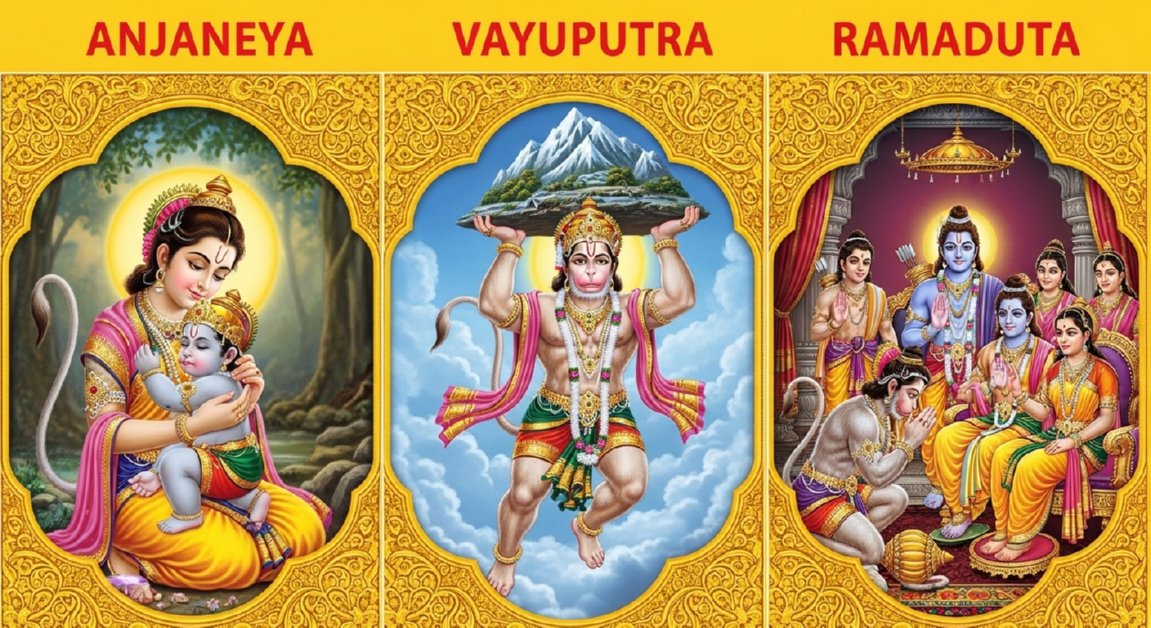
🙏 The Trinity of Hanuman’s Identity
Anjaneya = His Origin (Son of Anjana) |
Vayuputra = His Power (Son of Wind God) |
Ramaduta = His Purpose (Messenger of Rama)
1. Anjaneya (आंजनेय) — The Son of Anjana: Origin, Devotion, and Divine Grace
The name Anjaneya (Sanskrit: आंजनेय) literally means “the son of Anjana” — derived from his mother’s name, Mata Anjana. In Sanskrit grammar, the suffix “-eya” denotes “born of” or “descendant of,” making Anjaneya one of the most ancient and revered names of Lord Hanuman. In Sanskrit the root word Anj (अञ्ज्) means “to shine,” or “to beautify.” The Bija mantra Anj (अञ्ज्), provides deeper symbolic layers in the Ray 114 chakra system – the shining chakras associated with breath.
Anjaneya: Therefore, can be interpreted as one who is born from clarity, purity, or the “shining one.” This name is particularly popular in South India, where Hanuman temples are often called “Anjaneya Temples” or “Anjaneya Swamy Temples.”
The Story of Mata Anjana
According to the Valmiki Ramayana and Puranic texts, Mata Anjana was originally a celestial apsara (divine nymph) named Punjikasthala in the court of Lord Brahma. Due to a curse from a sage, she was born on earth in the form of a female vanara (monkey). The curse could only be lifted when she gave birth to an incarnation of Lord Shiva.
Anjana married Kesari, a powerful vanara chieftain and the son of Brihaspati (Jupiter). She performed intense penance and austerities on the Anjaneri hill (near present-day Nashik, Maharashtra) to invoke Lord Shiva’s blessings for a divine child. Pleased by her twelve years of unwavering tapasya (penance), Lord Shiva granted her the boon that he himself would be born as her son.
Simultaneously, when King Dasharatha performed the Putrakameshti Yagna (fire ritual for begetting sons), the sacred fire produced divine payasam (consecrated food). A portion of this payasam was carried by Vayu Deva (the Wind God) and delivered to Anjana while she was in deep meditation. Upon consuming the divine payasam, Anjana conceived and gave birth to Hanuman on the Purnima (full moon) of Chaitra Shukla Paksha — the day we celebrate as Hanuman Jayanti.
🔱 Spiritual Significance of the Name “Anjaneya”: The name Anjaneya reminds us that even divine beings like Hanuman have a mother’s love and grace at the foundation of their existence. It teaches that the highest spiritual achievements begin with the blessings of the mother. When devotees call upon “Anjaneya,” they invoke not only Hanuman’s power but also the maternal grace, devotion, and divine feminine energy (Shakti) that brought him into existence. This is why the name Anjaneya carries a particularly gentle, protective, and nurturing vibration — making it ideal for prayers seeking safety, healing, and compassionate protection.
The Anjaneya Mantra
ॐ आञ्जनेयाय विद्महे वायुपुत्राय धीमहि।
तन्नो हनुमत् प्रचोदयात्॥
[Om Anjaneyaya Vidmahe Vayuputraya Dhimahi, Tanno Hanumat Prachodayat]
Meaning: “We meditate upon Anjaneya (son of Anjana), we contemplate upon Vayuputra (son of the Wind God). May Lord Hanuman inspire and illuminate our intellect.”
This is the Hanuman Gayatri Mantra, and remarkably, it contains all three divine names — Anjaneya, Vayuputra, and Hanumat — within a single verse. This mantra is chanted 108 times on Hanuman Jayanti for wisdom, courage, and mental clarity. It is particularly powerful when chanted during the morning puja muhurat (06:11 AM – 07:41 AM) on April 2, 2026, while the Purnima Tithi is still active.
Anjaneya Worship in South India
In Tamil Nadu, Karnataka, Andhra Pradesh, Telangana, and Kerala, Lord Hanuman is predominantly worshipped as Anjaneya Swamy. The worship traditions differ significantly from North India:
- Tamil Nadu: Anjaneya temples feature unique Vada Mala offerings — garlands made of medu vadas — which are considered Hanuman’s favorite food in the Tamil tradition. The famous Namakkal Anjaneyar Temple has an 18-feet tall rock-cut standing Hanuman idol that attracts millions of devotees.
- Karnataka: The festival is celebrated as “Hanuma Jayanthi” with elaborate rituals. The Ragigudda Anjaneya Temple in Bangalore is one of the most visited temples on Hanuman Jayanti.
- Andhra Pradesh & Telangana: Anjaneya Swamy temples celebrate with special turmeric paste (pasupu) abhishekam and sandalwood paste application on the idol. The Kondagattu Anjaneya Swamy Temple in Telangana witnesses massive gatherings.
- Kerala: Lord Hanuman is worshipped in a unique warrior form, and temples conduct special Kalari-based rituals honoring his martial prowess.
📍 Sacred Site: The Anjaneri Hill near Nashik, Maharashtra, is believed to be the birthplace of Lord Hanuman. The hill is named after Mata Anjana, who performed her penance here. Devotees trek to the ancient Hanuman temple atop the 4,264-feet hill, especially on Hanuman Jayanti, to seek blessings at the very place where Anjaneya was born.
2. Vayuputra (वायुपुत्र) — The Son of the Wind God: Cosmic Power, Speed, and Invincibility
The name Vayuputra (Sanskrit: वायुपुत्र) means “the son of Vayu” — Vayu being the Vedic God of Wind, Air, and Breath (Prana). This name, along with its synonyms Pavanputra (पवनपुत्र), Pavansut (पवनसुत), Maruti (मारुति), and Vatatmaja (वातात्मज), points to the most extraordinary aspect of Hanuman’s birth — his dual divine parentage. While Anjana is his earthly mother and Kesari his earthly father, Vayu Deva is his spiritual and cosmic father who infused him with the divine life-force (prana).
How Vayu Deva Became Hanuman’s Father
The story of Vayu’s involvement in Hanuman’s birth is deeply significant. When King Dasharatha’s Putrakameshti Yagna produced the divine payasam, it was meant for Dasharatha’s queens — Kausalya, Sumitra, and Kaikeyi — to produce divine sons (Rama, Lakshmana, Bharata, and Shatrughna). However, a portion of this sacred payasam was carried away by a divine kite (bird), and Vayu Deva — following the cosmic plan — caught the payasam midair and delivered it into the outstretched hands of Mata Anjana during her meditation.
In another version from the Shiva Purana, Lord Shiva himself transferred his divine energy (tejas) to Vayu Deva, who then carried it to Anjana. This is why Hanuman is considered both an incarnation (avatar) of Lord Shiva and a son of Vayu Deva simultaneously. The wind carried the divine essence — hence Hanuman embodies both Shiva’s destruction of evil and Vayu’s boundless, all-pervading life energy.
The Powers Hanuman Inherited from Vayu
Being the son of the Wind God, Hanuman inherited extraordinary cosmic powers that are directly related to Vayu’s domain over wind, breath, space, and movement:
| Power | Connection to Vayu | Manifestation |
|---|---|---|
| 🌬️ Supernatural Speed | Vayu is the fastest cosmic element | Hanuman flew to Lanka and the Himalayas at the speed of mind (Manojavam — swift as thought) |
| 💨 Flight | Wind traverses all spaces freely | Ability to fly anywhere in the universe — crossed the ocean to Lanka in a single leap |
| 🏔️ Immense Strength | Wind can uproot mountains and reshape landscapes | Uprooted the entire Dronagiri mountain carrying the Sanjeevani herb |
| 🔄 Shape-shifting (Anima-Mahima) | Wind can be a gentle breeze or a devastating storm | Could become as tiny as a fly (to enter Lanka) or as massive as a mountain |
| 🫁 Prana (Life Force) | Vayu is Prana — the breath of all living beings | Hanuman controls prana — this is why pranayama practitioners worship him for breath mastery |
| 🛡️ Invincibility | Wind cannot be destroyed or contained | No weapon could permanently harm Hanuman — Brahma’s boon of invincibility |
| 🌍 Omnipresence | Wind pervades every corner of the universe | Hanuman is Chiranjeevi (immortal) and is believed to be present wherever Rama’s name is chanted |
The Incident of Baby Hanuman and the Sun
The most famous story illustrating Hanuman’s Vayuputra identity is the Sun-swallowing incident. As a newborn baby, Hanuman saw the rising sun and, thinking it was a ripe fruit, leaped toward it. Powered by the wind-energy inherited from his father Vayu, baby Hanuman flew across the sky at tremendous speed, reaching toward the sun. Even Surya Deva (the Sun God) was astonished by the infant’s power.
Indra, the king of gods, alarmed by this disruption of cosmic order, struck Hanuman with his Vajra (thunderbolt). The thunderbolt hit Hanuman’s jaw (Hanu in Sanskrit), breaking it — and from this injury, he received the name “Hanuman” (one with a prominent/broken jaw). The child fell to earth unconscious.
Vayu Deva, enraged that his son had been harmed, withdrew all air and wind from the universe. Every living being began to suffocate. The three worlds (Triloka) plunged into chaos. All the gods rushed to pacify Vayu, and each god granted baby Hanuman extraordinary boons:
- Brahma: Immunity from the Brahmastra and the power of inducing fear in enemies
- Indra: His body would be stronger than the Vajra itself (hence the name Vajrang → Bajrang)
- Surya (Sun God): One-hundredth of his own brilliance and the ability to change form at will
- Varuna (Water God): Protection from water for all eternity
- Agni (Fire God): Immunity from fire
- Yama (God of Death): Freedom from death — making Hanuman a Chiranjeevi (immortal)
- Vishwakarma (Divine Architect): Safety from all celestial weapons
Only then did Vayu Deva restore the wind to the universe. This episode demonstrates why the Vayuputra identity is so powerful — Hanuman’s strength is not merely physical but cosmic. His power comes from the very force that sustains all life — Vayu (Prana).
🧘 Yogic Significance of Vayuputra:
In the yogic tradition, Vayu represents Prana (life force or breath). Hanuman, as Vayuputra, is considered the supreme master of Prana. This is why:
- Pranayama practitioners worship Hanuman for mastery over breath and life energy.
- Wrestlers and athletes invoke Vayuputra for physical stamina, endurance, and raw power.
- Yoga practitioners consider Hanuman the presiding deity of the Muladhara Chakra (root energy center) and the Manipura Chakra (solar plexus — center of willpower and physical vitality).
- The Hanumanasana (full splits yoga pose) is named after his legendary leap across the ocean, symbolizing the unlimited expansion possible when prana flows freely.
- Chanting “Om Ham Hanumate Namah” is believed to activate the pranic energy channels (nadis), especially the Sushumna, leading to spiritual awakening.
The Vayuputra Mantra
ॐ हं हनुमते नमः
[Om Ham Hanumate Namah]
The beej (seed) sound “Ham” (हं) is the sound vibration of Vayu tattva (wind element). Chanting this mantra 108 times invokes Hanuman’s wind-born power for strength, protection, fear removal, and pranic vitality.
Why “Maruti” in Maharashtra?
In Maharashtra and parts of Western India, Hanuman is commonly known as Maruti (मारुति). This name comes from Marut, which is another name for Vayu Deva in the Vedas. The Maruts are the storm gods — powerful, fast, and fierce — and Hanuman, as the son of Marut (Vayu), naturally carries this name. Every village in Maharashtra has a Maruti temple, and the deity is worshipped as the protector of the village and its people. The popular phrase “Jai Maruti” is essentially an invocation of the Vayuputra aspect of Hanuman.
3. Ramaduta (रामदूत) — The Messenger of Rama: Supreme Devotion, Purpose, and Selfless Service
If Anjaneya defines Hanuman’s origin and Vayuputra defines his power, then Ramaduta (Sanskrit: रामदूत) defines his purpose — the very reason for his existence. The name Ramaduta literally means “the messenger (duta) of Lord Rama” — but it signifies far more than a mere messenger. It represents the highest form of devotion, surrender, and selfless service that a being can offer to God.
Hanuman’s identity as Ramaduta is the crown of his spiritual significance. All his powers — his wind-born speed, his mountain-moving strength, his shape-shifting abilities, his immortality — exist for one single purpose: to serve Lord Rama. This is what makes Hanuman unique among all divine beings in Hindu mythology. He is not merely powerful; he is power perfectly aligned with devotion.
The Meeting That Changed Everything
The pivotal moment when Hanuman fully became Ramaduta is described in the Kishkindha Kanda of the Ramayana. When Lord Rama and Lakshmana arrived at the Rishyamukha mountain searching for Sita, Sugriva — the exiled vanara king — sent Hanuman disguised as a Brahmin to assess whether the two princes were friend or foe.
The moment Hanuman saw Lord Rama, something extraordinary happened. Despite being an immensely powerful being with the combined blessings of all the gods, Hanuman felt an overwhelming surge of love, devotion, and recognition. He immediately dropped his disguise, revealed his true form, fell at Rama’s feet, and declared himself Rama’s eternal servant. Lord Rama, recognizing Hanuman’s devotion, embraced him — and from that moment, Hanuman became Ramaduta forever.
As the Ramcharitmanas beautifully states: Hanuman found the very purpose of his birth when he met Rama. All his dormant powers — placed in him by the gods but forgotten due to a sage’s curse — awakened fully the moment he dedicated himself to Rama’s service. This teaches the profound spiritual truth that our greatest powers awaken only when we align them with a higher purpose and selfless devotion.
How Hanuman Fulfilled His Role as Ramaduta
Hanuman’s role as Ramaduta (the messenger of Rama) manifested through several legendary acts that are celebrated in the Ramayana:
| Event | Ramaduta Role | Spiritual Lesson |
|---|---|---|
| 🌊 Crossing the Ocean to Lanka | Hanuman leaped 100 yojanas (approximately 800 miles) across the ocean to reach Lanka — a feat no other being could accomplish | When powered by devotion to God, no obstacle is too great — oceans become crossable |
| 🔍 Finding Sita in Ashoka Vatika | Using his intelligence and shape-shifting, he located Sita in Ravana’s Ashoka Vatika and delivered Rama’s message and ring to her | A true messenger delivers hope to those in despair — Hanuman restored Sita’s faith that rescue was coming |
| 🔥 Burning Lanka | After being captured and his tail set on fire, Hanuman used it to burn down Lanka — a single messenger devastated an entire demon kingdom | One devoted soul empowered by God can overcome the mightiest evil |
| 🏔️ Carrying the Sanjeevani Mountain | When Lakshmana was dying, Hanuman flew to the Himalayas and brought back the entire Dronagiri mountain because he couldn’t identify the specific herb | A true devotee gives more than what is asked — when in doubt, bring everything rather than risk failure |
| 💎 Tearing Open His Chest | When questioned about his devotion, Hanuman tore open his chest to reveal Rama and Sita residing in his heart | The ultimate Ramaduta — God doesn’t just live in temples; He lives in the heart of His devoted messenger |
| 🙏 Eternal Presence | After Rama’s mission was complete, Hanuman chose to remain on earth as a Chiranjeevi, forever serving Rama by protecting His devotees | True service has no end — Ramaduta’s mission continues eternally wherever Rama’s name is chanted |
The Ramaduta Mantras
The Ramaduta aspect of Hanuman is invoked through specific mantras that combine the power of Rama’s name with Hanuman’s devoted service:
ॐ श्री रामदूताय नमः
[Om Shri Ramadutaya Namah]
Meaning: “I bow to the divine messenger of Lord Rama.” Chanted for invoking Hanuman’s protective and intercessory power.
ॐ ऐं भ्रीम हनुमते श्री रामदूताय नमः
[Om Aim Bhrim Hanumate Shri Ramadutaya Namah]
Meaning: The Hanuman Beej Mantra — combining the seed sounds of Saraswati (Aim) and Lakshmi (Bhrim) with Hanuman’s Ramaduta identity. This is one of the most powerful mantras for comprehensive protection, wisdom, and prosperity.
श्रीरामदूतं शरणं प्रपद्ये
[Shriramadutam Sharanam Prapadye]
Meaning: “I take refuge in the messenger of Lord Rama.” This is the concluding phrase of the Hanuman Dhyana Shloka and represents complete surrender to Hanuman as Ramaduta.
❤️ The Deepest Meaning of Ramaduta:
The name Ramaduta encapsulates the highest spiritual ideal in Hinduism — Dasa Bhava (the attitude of being a servant of God). Hanuman doesn’t merely serve Rama out of obligation; he serves out of overwhelming love. His service is not a duty — it is his greatest joy and the very purpose of his existence. This is why Hanuman is called Bhakta Shiromani (the crown jewel of devotees). When devotees worship Hanuman as Ramaduta, they are not just seeking his blessings — they are aspiring to cultivate the same quality of selfless, joyful, total devotion in their own lives.
The Three Names Together: A Complete Spiritual Framework
When we understand Anjaneya, Vayuputra, and Ramaduta together, a beautiful and complete spiritual framework emerges:
🙏
ANJANEYA
आंजनेय — Son of Anjana
Represents: Origin, Birth, Grace
Element: Earth (Mother, Foundation)
Quality: Humility, Devotion, Purity
Teaches: Even the mightiest beings are born through grace and love
Invoked for: Protection, healing, nurturing energy, gentle strength
💨
VAYUPUTRA
वायुपुत्र — Son of Wind God
Represents: Power, Energy, Force
Element: Wind (Prana, Cosmic Energy)
Quality: Strength, Speed, Invincibility
Teaches: True power is cosmic and unstoppable when aligned with righteousness
Invoked for: Physical strength, courage, fear removal, pranayama mastery
🙏
RAMADUTA
रामदूत — Messenger of Rama
Represents: Purpose, Mission, Service
Element: Devotion (Bhakti, Surrender)
Quality: Selfless service, Loyalty, Love
Teaches: The greatest power finds its true meaning only in devoted service to God
Invoked for: Spiritual growth, divine connection, overcoming life’s mission obstacles
🕉️ The Complete Hanuman Gayatri Mantra — Uniting All Three Names
ॐ आञ्जनेयाय विद्महे वायुपुत्राय धीमहि।
तन्नो हनुमत् प्रचोदयात्॥
Anjaneya (Origin) + Vayuputra (Power) + Hanumat (the living embodiment serving as Ramaduta)
This single mantra invokes all three aspects of Hanuman’s divine identity — making it the most complete Hanuman mantra for Hanuman Jayanti worship.
How to Invoke the Three Names on Hanuman Jayanti 2026
On Thursday, April 2, 2026, devotees can structure their worship to honor all three aspects of Hanuman’s identity for complete spiritual benefit:
| Time | Aspect | Practice |
|---|---|---|
| Brahma Muhurat (04:35 AM – 05:23 AM) |
Anjaneya (Origin) | Wake up, take a purifying bath, prepare the altar with Hanuman’s image. Meditate on Mata Anjana’s devotion and the divine grace that brought Hanuman into existence. Set your Sankalp (intention) for the day. |
| Sunrise Puja (06:11 AM – 07:41 AM) |
Vayuputra (Power) | Perform abhishek, apply sindoor, offer red flowers and oil. Chant “Om Ham Hanumate Namah” 108 times. This is the period when Purnima Tithi is still active — invoke Hanuman’s wind-born cosmic power for strength and protection. |
| Morning to Afternoon (08:00 AM – 04:00 PM) |
Ramaduta (Purpose) | Recite Hanuman Chalisa (7 times), read Sunderkand, chant the Hanuman Gayatri Mantra. Focus on Hanuman’s role as Rama’s devoted messenger. Observe fast, do selfless service (seva), and donate to the needy. |
| Evening Puja (06:30 PM – 08:00 PM) |
All Three United | Perform evening aarti under the Purnima full moon. Chant the complete Hanuman Gayatri Mantra (Anjaneya + Vayuputra + Hanumat). Light a mustard oil diya. Distribute prasad. Chant “Jai Shri Ram, Jai Bajrang Bali” to complete the worship. |
🌟 Key Insight: Understanding the three names reveals that Hanuman is not just a deity of physical strength — he represents the complete spiritual journey. We are all born through grace (Anjaneya), we all possess inner power waiting to be awakened (Vayuputra), and we all have a higher purpose to fulfill through devoted service (Ramaduta). When we worship Hanuman on Hanuman Jayanti, we are actually seeking to awaken these same three qualities within ourselves — grace, power, and purpose.
🙏 ॐ आंजनेयाय नमः | ॐ वायुपुत्राय नमः | ॐ रामदूताय नमः 🙏
I bow to Anjaneya, the son of Anjana — born of divine grace.
I bow to Vayuputra, the son of the Wind God — embodiment of cosmic power.
I bow to Ramaduta, the messenger of Rama — the eternal servant of God.
जय श्री राम! जय बजरंग बली! 🚩
Frequently Asked Questions: Anjaneya, Vayuputra & Ramaduta
What does the name Anjaneya mean?
Anjaneya (आंजनेय) means “the son of Anjana.” It is derived from the name of Lord Hanuman’s mother, Mata Anjana, who was originally a celestial apsara named Punjikasthala. The Sanskrit suffix “-eya” denotes “born of” or “descendant of.” This name is particularly revered in South India, where Hanuman temples are commonly called Anjaneya Swamy Temples. The name represents Hanuman’s divine origin and the grace, devotion, and penance of his mother that made his birth possible.
What does the name Vayuputra mean?
Vayuputra (वायुपुत्र) means “the son of Vayu” — Vayu being the Vedic God of Wind, Air, and Breath (Prana). This name highlights Hanuman’s cosmic parentage, as Vayu Deva carried Lord Shiva’s divine energy and the sacred payasam from King Dasharatha’s Putrakameshti Yagna to Mata Anjana, resulting in Hanuman’s birth. Vayuputra signifies Hanuman’s supernatural powers including flight, immense speed, shape-shifting abilities, invincibility, and mastery over Prana (life force). Other synonyms include Pavanputra, Pavansut, Maruti, and Vatatmaja.
What does the name Ramaduta mean?
Ramaduta (रामदूत) means “the messenger of Lord Rama.” While it literally translates to messenger, the name signifies far more — it represents the highest form of devotion, surrender, and selfless service (Dasa Bhava) that a being can offer to God. Hanuman’s entire existence, all his powers, and his immortality serve one single purpose: devoted service to Lord Rama. This name became definitive when Hanuman crossed the ocean to Lanka as Rama’s emissary to find Sita, delivered Rama’s message and ring to her, and later played a pivotal role in the battle against Ravana.
Why is Hanuman called Pavanputra and Maruti?
Pavanputra (पवनपुत्र) and Maruti (मारुति) are both synonyms of Vayuputra, meaning “son of the Wind God.” Pavan is a Hindi word for wind or gentle breeze, so Pavanputra means “son of the wind.” Maruti comes from “Marut,” which is a Vedic name for Vayu Deva — the Maruts being the powerful storm gods in the Rig Veda. The name Maruti is especially popular in Maharashtra and Western India, where every village has a Maruti temple dedicated to Lord Hanuman as the village protector.
What is the connection between the three names Anjaneya, Vayuputra, and Ramaduta?
The three names together form a complete spiritual framework of Hanuman’s identity. Anjaneya represents his origin — who he was born from and the divine grace behind his birth. Vayuputra represents his power — the cosmic wind energy that gives him supernatural abilities. Ramaduta represents his purpose — the devoted service to Lord Rama that gives meaning to all his powers. Together they teach that origin (grace), power (energy), and purpose (devotion) must be aligned for spiritual fulfillment. The Hanuman Gayatri Mantra beautifully unites all three: “Om Anjaneyaya Vidmahe Vayuputraya Dhimahi, Tanno Hanumat Prachodayat.”
What is the Hanuman Gayatri Mantra and how does it connect all three names?
The Hanuman Gayatri Mantra is: “Om Anjaneyaya Vidmahe Vayuputraya Dhimahi, Tanno Hanumat Prachodayat” (ॐ आञ्जनेयाय विद्महे वायुपुत्राय धीमहि, तन्नो हनुमत् प्रचोदयात्). This mantra uniquely contains all three aspects of Hanuman’s identity within a single verse — Anjaneya (his origin as son of Anjana), Vayuputra (his power as son of the Wind God), and Hanumat (the living embodiment who serves as Ramaduta). It means “We meditate upon Anjaneya, we contemplate upon Vayuputra, may Lord Hanuman inspire and illuminate our intellect.” Chanting this mantra 108 times is considered extremely powerful for gaining wisdom, courage, and mental clarity.
Who was Mata Anjana, and what is her story?
Mata Anjana was originally a celestial apsara (divine nymph) named Punjikasthala who served in Lord Brahma’s court. Due to a sage’s curse, she was born on earth as a female vanara (monkey). The curse could only be lifted when she gave birth to an incarnation of Lord Shiva. Anjana married Kesari, a powerful vanara chieftain, and performed intense penance for twelve years on the Anjaneri Hill near present-day Nashik, Maharashtra. Pleased by her unwavering devotion, Lord Shiva blessed her that he himself would be born as her son. Vayu Deva delivered the divine payasam to her, and she gave birth to Hanuman on the Purnima of Chaitra Shukla Paksha.
How did Vayu Deva become Hanuman’s father?
When King Dasharatha performed the Putrakameshti Yagna for divine sons, the sacred fire produced divine payasam. A portion was carried away by a divine kite (bird), and Vayu Deva — following the cosmic plan — caught the payasam midair and delivered it to Mata Anjana during her meditation. In another version from the Shiva Purana, Lord Shiva transferred his divine energy (tejas) to Vayu Deva, who carried it to Anjana. This dual process made Hanuman both an incarnation of Lord Shiva and a son of Vayu Deva, inheriting Shiva’s spiritual power and Vayu’s cosmic physical energy.
What powers did Hanuman inherit from Vayu Deva?
Being the son of the Wind God, Hanuman inherited several extraordinary cosmic powers: supernatural speed (Manojavam — swift as thought), the ability to fly anywhere in the universe, immense physical strength (he uprooted the entire Dronagiri mountain), shape-shifting abilities (Anima and Mahima — becoming as tiny as a fly or as large as a mountain), mastery over Prana (life force and breath), invincibility (no weapon could permanently harm him), and omnipresence (as a Chiranjeevi, he is present wherever Rama’s name is chanted). These powers are all derived from Vayu’s domain over wind, breath, space, and movement.
How did Hanuman get his name from the Sun incident?
As a newborn baby, Hanuman mistook the rising sun for a ripe fruit and leaped toward it, powered by the wind-energy from his father Vayu. He flew across the sky at tremendous speed. Indra, the king of gods, struck him with his Vajra (thunderbolt), which hit his jaw — “Hanu” in Sanskrit means jaw or chin. From this injury, he received the name “Hanuman” (one with a prominent or broken jaw). When Vayu Deva became enraged and withdrew all air from the universe, all the gods rushed to pacify him and granted baby Hanuman extraordinary boons including immortality, invincibility, and powers from every god.
Why is the name Anjaneya more popular in South India?
In South India — Tamil Nadu, Karnataka, Andhra Pradesh, Telangana, and Kerala — Hanuman is predominantly worshipped as Anjaneya Swamy. This is partly because the South Indian worship tradition emphasizes the devotional and maternal aspect of Hanuman’s identity, connecting him to his mother Anjana’s devotion and penance. Additionally, the Anjaneri Hill (believed to be Hanuman’s birthplace) is located in Maharashtra, which culturally bridges North and South. South Indian Anjaneya temples feature unique worship practices like Vada Mala offerings in Tamil Nadu, turmeric paste abhishekam in Andhra Pradesh, and Kalari-based rituals in Kerala.
What is the yogic significance of the name Vayuputra?
In yogic tradition, Vayu represents Prana (life force or breath), and Hanuman as Vayuputra is considered the supreme master of Prana. Pranayama practitioners worship Hanuman for mastery over breath and life energy. Yoga practitioners consider Hanuman the presiding deity of the Muladhara Chakra (root energy center) and the Manipura Chakra (solar plexus — center of willpower). The Hanumanasana (full splits yoga pose) is named after his legendary leap across the ocean, symbolizing unlimited expansion when prana flows freely. Chanting “Om Ham Hanumate Namah” is believed to activate pranic energy channels, especially the Sushumna nadi.
What is the spiritual meaning of Ramaduta?
Ramaduta encapsulates the highest spiritual ideal in Hinduism — Dasa Bhava (the attitude of being a devoted servant of God). Hanuman doesn’t merely serve Rama out of obligation but out of overwhelming love. His service is not a duty — it is his greatest joy and the very purpose of his existence. This is why he is called Bhakta Shiromani (the crown jewel of devotees). All of Hanuman’s extraordinary powers — his wind-born speed, mountain-moving strength, shape-shifting abilities, and immortality — exist for one single purpose: to serve Lord Rama. When devotees worship Hanuman as Ramaduta, they aspire to cultivate the same quality of selfless, joyful, and total devotion.
What are the most powerful mantras for invoking Anjaneya, Vayuputra, and Ramaduta?
For invoking the Anjaneya aspect, chant the Hanuman Gayatri Mantra: “Om Anjaneyaya Vidmahe Vayuputraya Dhimahi, Tanno Hanumat Prachodayat.” For invoking the Vayuputra aspect, chant the Hanuman Beej Mantra: “Om Ham Hanumate Namah” — the seed sound “Ham” represents the Vayu tattva (wind element) for strength, protection, and pranic vitality. For invoking the Ramaduta aspect, chant: “Om Shri Ramadutaya Namah” or the complete beej mantra “Om Aim Bhrim Hanumate Shri Ramadutaya Namah.” For invoking all three together, the Hanuman Gayatri Mantra is the most complete single mantra.
What is the meaning of “Shriramadutam Sharanam Prapadye”?
“Shriramadutam Sharanam Prapadye” (श्रीरामदूतं शरणं प्रपद्ये) means “I take refuge in the messenger of Lord Rama.” This is the concluding phrase of the Hanuman Dhyana Shloka: “Manojavam Marutatulya Vegam, Jitendriyam Buddhimatam Varishtham, Vatatmajam Vanara Yuthmukhyam, Shriramadutam Sharanam Prapadye.” It represents complete surrender to Hanuman as Ramaduta. Notably, this single shloka also contains Vayuputra references — “Marutatulya Vegam” (speed equal to the wind) and “Vatatmajam” (son of Vayu) — making it another verse that unites all three divine names.
Where is Hanuman’s birthplace associated with the name Anjaneya?
The Anjaneri Hill near Nashik, Maharashtra, is believed to be the birthplace of Lord Hanuman. The hill is named after Mata Anjana, who performed her twelve years of penance here before Hanuman’s birth. Standing at 4,264 feet, the hill has an ancient Hanuman temple at its summit. Devotees trek to this sacred site, especially on Hanuman Jayanti, to seek blessings at the very place where Anjaneya was born. The site is also significant because it connects the South Indian tradition of Anjaneya worship with the geographical heritage of Western India.
How does the story of Hanuman tearing his chest relate to the Ramaduta identity?
When Sita gave Hanuman a pearl necklace, he began breaking each pearl to check if Lord Rama was inside — because anything without Rama had no value for him. When people mocked him asking if Rama was inside him too, Hanuman tore open his chest to reveal Lord Rama and Sita seated in his heart. This iconic moment is the ultimate expression of the Ramaduta identity — it shows that God doesn’t just live in temples but resides in the heart of His devoted messenger. It demonstrates that being a Ramaduta means carrying God within oneself at every moment, not merely delivering messages externally.
Can women chant the Anjaneya, Vayuputra, and Ramaduta mantras?
Yes, absolutely. There is no scriptural prohibition against women chanting any Hanuman mantra, including the Hanuman Gayatri Mantra (Om Anjaneyaya Vidmahe Vayuputraya Dhimahi, Tanno Hanumat Prachodayat), the Vayuputra beej mantra (Om Ham Hanumate Namah), or the Ramaduta mantra (Om Shri Ramadutaya Namah). Women can chant these mantras at home with full devotion and will receive the same spiritual benefits. While some traditional temples may restrict women from touching the Hanuman idol, personal mantra practice and home worship are open to all devotees regardless of gender.
How are the three names connected to the Ashta Siddhis and Nava Nidhis mentioned in Hanuman Chalisa?
The Hanuman Chalisa states “Ashta Siddhi Nava Nidhi ke Data” — meaning Hanuman can grant the eight supernatural powers (Ashta Siddhis) and nine divine treasures (Nava Nidhis). These powers directly connect to his three identities. As Anjaneya (born of divine grace), he received blessings from all gods, making him the custodian of these powers. As Vayuputra (son of the Wind God), his cosmic wind energy is the medium through which these siddhis manifest — particularly Anima (becoming tiny), Mahima (becoming huge), Laghima (becoming weightless), and Garima (becoming immovable). As Ramaduta (servant of Rama), he distributes these blessings to Rama’s devotees — “As Rama wishes” (Ram Rasayan Tumhare Pasa).
What is the difference between chanting Om Hanumate Namah and Om Ham Hanumate Namah?
“Om Shri Hanumate Namah” is the Hanuman Moola (root) Mantra — a gentle, devotional mantra suitable for general worship, daily practice, and seeking overall blessings. It invokes Hanuman’s complete divine presence. “Om Ham Hanumate Namah” is the Hanuman Beej (seed) Mantra — more intense, fiery, and specifically connected to the Vayuputra aspect. The seed sound “Ham” (हं) is the bija of Vayu tattva (wind element), making this mantra more powerful for fear removal, strong protection against enemies and negative energies, Saturn-related troubles, and awakening pranic vitality. The beej mantra is recommended for specific protective and empowering purposes.
Is Hanuman an avatar of Lord Shiva?
Yes, according to several Puranic texts including the Shiva Purana and Narada Purana, Lord Hanuman is considered the 11th Rudra avatar (incarnation) of Lord Shiva. Lord Shiva transferred his divine energy (tejas) to Vayu Deva, who then delivered it to Mata Anjana. This makes Hanuman simultaneously an incarnation of Shiva and a son of Vayu. As Shiva’s avatar, Hanuman embodies the destructive power against evil (Rudra aspect). As Vayuputra, he carries the cosmic life-force energy. This dual identity is reflected in one of his names — “Rudravatara” — and in the Sankat Mochan Mantra: “Om Namo Hanumate Rudravataraya.”
How should I structure my worship to honor all three names on Hanuman Jayanti?
You can structure your Hanuman Jayanti worship in four phases to honor all three aspects. During Brahma Muhurat (4:35 AM – 5:23 AM), focus on the Anjaneya aspect — meditate on Mata Anjana’s devotion and the divine grace behind Hanuman’s birth while preparing your altar. During sunrise puja (6:11 AM – 7:41 AM), focus on the Vayuputra aspect — perform abhishek, apply sindoor, and chant “Om Ham Hanumate Namah” 108 times to invoke his cosmic wind-born power. During morning to afternoon, focus on the Ramaduta aspect — recite Hanuman Chalisa 7 times, read Sunderkand, and perform selfless service. During evening puja (6:30 PM – 8:00 PM), unite all three by chanting the complete Hanuman Gayatri Mantra under the Purnima full moon.
For complete Hanuman Jayanti 2026 date, shubh muhurat timings, and step-by-step puja vidhi, read our comprehensive guide: Hanuman Jayanti 2026: Date, Timings, Puja Vidhi & Mantras.
Learn the complete lyrics, meaning, and neuroscience behind the Hanuman Chalisa and understand how it affects your brain.