
Havan (also called Homa or Yagna) is one of the most sacred and ancient Vedic fire rituals in Hindu tradition. It involves offering oblations (ahuti) into a consecrated fire while chanting powerful Sanskrit mantras. The ritual purifies the atmosphere, invokes divine blessings, and is believed to establish harmony between humans, nature, and the cosmos.
In the tradition of Sri Amit Ray, there is total 114 chakras in human body: 108 chakras are within the body and 6 chakras are external. The 108 Ahuti mantras are deeply linked with the purification of the 108 inner chakras.
This comprehensive guide covers the complete Havan Vidhi (procedure), the 108 Ahuti Mantras with Sanskrit text, IAST transliteration, and their explanations.
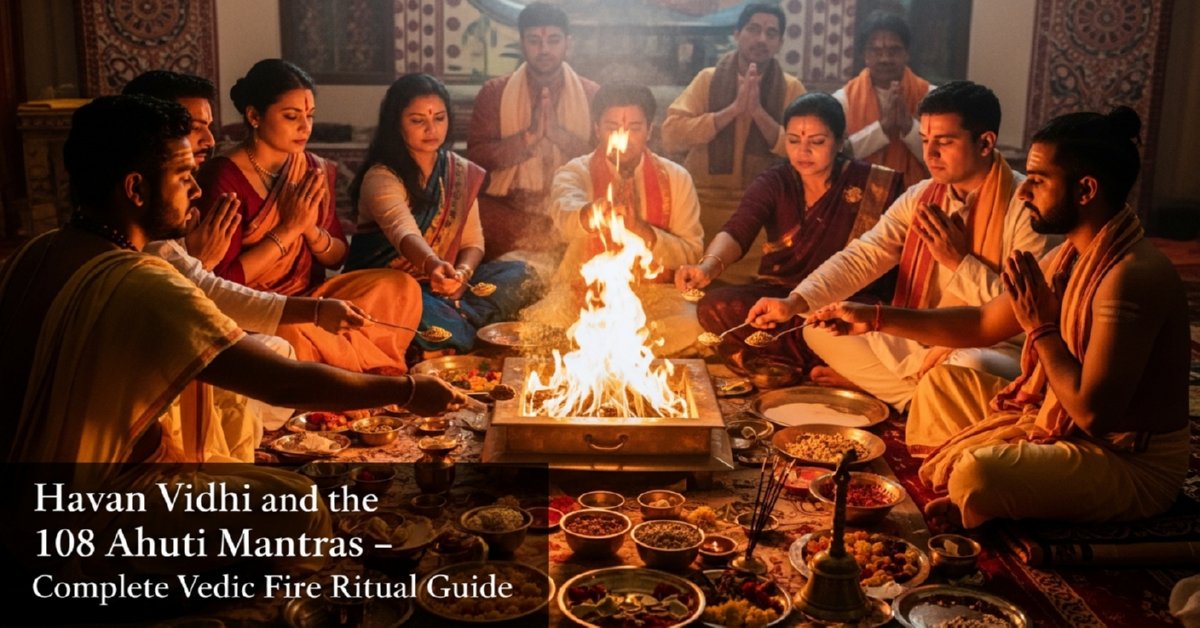
1. What is Havan? – Origin and Significance
Havan, derived from the Sanskrit root “hu” meaning “to offer into fire,” is a Vedic ritual that dates back thousands of years to the Rigvedic period. The sacred fire (Agni) serves as a messenger between humans and the divine. Whatever is offered into the fire is believed to reach the gods (Devas) in their celestial abode.
Why 108 Ahutis?
The number 108 holds profound significance in Hindu tradition. There are 108 Upanishads, 108 beads in a Japa Mala, 108 internal chakras, and 108 sacred points (Marma Sthanas) in the human body according to Ayurveda. The 27 Nakshatras multiplied by the 4 Padas give 108. Offering 108 ahutis symbolizes completeness and cosmic alignment. Each ahuti is accompanied by a specific mantra dedicated to a deity, natural force, or cosmic principle, making the ritual a comprehensive invocation of universal energies.
2. Havan Samagri – Complete List of Materials
The Havan Samagri consists of carefully selected herbs, woods, grains, and aromatic substances that, when burned, release medicinal and purifying compounds into the atmosphere. Below is the comprehensive list:
Primary Materials (Mukhya Samagri)
- Mango Wood (Aam ki Lakdi): The primary fuel wood, considered most auspicious for Havan
- Cow’s Ghee (Gau Ghrita): Pure clarified butter from cow’s milk — the main oblation material
- Camphor (Kapoor): Used for igniting the fire and purification
- Sandalwood (Chandan): Powder or small pieces for fragrance and sanctity
- Havan Samagri Mix: A prepared mixture of dried herbs and aromatic substances
Grains and Seeds
- Barley (Jau) – Whole unbroken grains
- Sesame Seeds (Til) – Black or white
- Rice (Akshat) – Unbroken, uncooked rice grains
- Wheat (Gehun) – Whole grains
Herbs and Aromatic Substances
- Guggul (Indian Bdellium)
- Loban (Benzoin resin)
- Javitri and Jaiphal (Mace and Nutmeg)
- Dried Rose Petals (Gulab Patti)
- Nagarmotha (Cyperus Rotundus)
- Tagar (Indian Valerian)
- Saffron (Kesar) – for special Havans
- Agar and Tagar
- Dried Coconut (Copra) pieces
- Sugar or Mishri (Rock Sugar)
3. Step-by-Step Havan Vidhi (Procedure)
Performing Havan correctly requires adherence to a specific sequence of rituals. Below is the authentic step-by-step procedure followed in traditional Vedic practice:
Step 1: Preparation (Pūrva Taiyārī)
- Clean the Havan Kund (fire altar) and the surrounding area thoroughly
- Place the Havan Kund facing East
- Arrange all samagri, ghee, a wooden ladle (sruvā/sruk), and a water vessel (Kalash)
- The performer should bathe, wear clean clothes, and sit on a clean Asana
Step 2: Sankalp (Sacred Resolve)
Take water in the right palm, state your name, gotra, the date (tithi), and the purpose of the Havan, then let the water flow onto the ground. This is a formal declaration of intent before the divine.
Step 3: Agni Sthāpanā (Establishing the Fire)
Arrange mango wood pieces in the Kund in a pyramid or grid pattern. Place camphor and cotton wicks soaked in ghee at the center. Light the fire while chanting:
Oṃ Bhūr Bhuvaḥ Svaḥ | Tat Savitur Vareṇyaṃ Bhargo Devasya Dhīmahi | Dhiyo Yo Naḥ Pracodayāt ||
Step 4: Ghee Offerings (Ghṛta Āhuti)
Pour ghee into the fire with the wooden ladle while chanting the initial mantras. The first offerings are made to Agni, Soma, Prajapati, Indra, Surya, and Vayu. Mantra: (ॐ अग्नये स्वाहा | इदं अग्नये न मम॥, ॐ सोमाय स्वाहा | इदं सोमाय न मम॥, ॐ प्रजापतये स्वाहा | इदं प्रजापतये न मम॥, ॐ इन्द्राय स्वाहा | इदं इन्द्राय न मम॥,ॐ वायवे स्वाहा | इदं वायवे न मम॥, ॐ सूर्याय स्वाहा | इदं सूर्याय न मम॥)
Step 5: Pradhān Homa (Main Offerings – 108 Ahutis)
This is the core of the ritual. Each of the 108 mantras is chanted, and a spoonful of ghee mixed with samagri is offered into the fire with each “Svāhā.” The word Svāhā is the key utterance that consecrates the offering — it means “well offered” and invokes Svāhā Devi, the wife of Agni.
Step 6: Pūrṇāhuti (Final Offering)
The last and most important offering is the Purnahuti — a whole coconut, draped in a red cloth and soaked in ghee, is placed into the fire. This symbolizes the complete surrender of the ego to the divine. Performed standing up. The total surrender of the fruit of the action.
| ॐ पूर्णमदः पूर्णमिदं पूर्णात् पूर्णमुदच्यते । पूर्णस्य पूर्णमादाय पूर्णमेवावशिष्यते ॥ स्वाहा ॥ | oṃ pūrṇamadaḥ pūrṇamidaṃ pūrṇāt pūrṇamudacyate । pūrṇasya pūrṇamādāya pūrṇamevāvaśiṣyate ॥ svāhā ॥ | The Invocation of Totality. Even after the ritual, the Divine remains Infinite. |
Step 7: Shānti Pāṭh (Peace Invocation)
The Havan concludes with the chanting of:
Om dyauh shantir antariksham shantihi Prithvi shantir apah shantih Oshadhayah shantihi || Vanaspatayah shantir vishvedevaah shantir brahma shantihi Sarvam shantihi, Shantireva shantihi Saa maa shantiredhi || Om shanti shanti shanti hi ||
Step 8: Bhasma Dhāraṇ and Prasād
After the fire cools, the sacred ash (Bhasma/Vibhuti) is collected and applied on the forehead. Prasad is distributed to all participants.
4. The 108 Ahuti Mantras – Complete Table
Below is the comprehensive table of all 108 Ahuti Mantras used in traditional Havan. Each mantra is an invocation to a specific deity or cosmic force, offered with a spoonful of ghee-mixed samagri into the sacred fire. The word “Svāhā” at the end of each mantra consecrates the offering. These mantras are primarily drawn from the Vedas, Upanishads, and traditional Arya Samaj Havan Paddhati.
This meticulously curated list comprises the universal Sarva-Devata (All-Deity) 108 Ahuti Mantras. It begins by honoring Lord Ganesha, moves through the cosmic deities (Navagraha, Dikpalas), the Hindu Trinity, the Divine Mother, and concludes with universal peace. Offer a pinch of Samagri into the fire every time you say “Swaha”.
| Sl No | Sanskrit Mantra | IAST (Transliteration) | Explanation / Purpose |
|---|---|---|---|
| 1 | ॐ गं गणपतये स्वाहा | Oṃ Gaṃ Gaṇapataye Svāhā | Invoking Lord Ganesha to remove all obstacles. |
| 2 | ॐ विघ्नेश्वराय स्वाहा | Oṃ Vighneśvarāya Svāhā | Offering to the Lord Ganesha, the remover of all obstacles. |
| 3 | ॐ शिवाय स्वाहा | Oṃ Śivāya Svāhā | Offering to Lord Shiva, the Auspicious One. |
| 4 | ॐ विष्णवे स्वाहा | Oṃ Viṣṇave Svāhā | Offering to Lord Vishnu, the Preserver. |
| 5 | ॐ ब्रह्मणे स्वाहा | Oṃ Brahmaṇe Svāhā | Offering to Lord Brahma, the Creator. |
| 6 | ॐ लक्ष्म्यै स्वाहा | Oṃ Lakṣmyai Svāhā | Offering to Goddess Lakshmi for wealth. |
| 7 | ॐ सरस्वत्यै स्वाहा | Oṃ Sarasvatyai Svāhā | Offering to Goddess Saraswati for wisdom. |
| 8 | ॐ दुर्गायै स्वाहा | Oṃ Durgāyai Svāhā | Offering to Goddess Durga for protection. |
| 9 | ॐ सूर्याय स्वाहा | Oṃ Sūryāya Svāhā | Offering to Sun God for health and vitality. |
| 10 | ॐ अग्नये स्वाहा | Oṃ Agnaye Svāhā | Offering to Agni, the Fire God and messenger. |
| 11 | ॐ सोमाय स्वाहा | Oṃ Somāya Svāhā | Offering to the Moon God for mental peace. |
| 12 | ॐ भौमाय स्वाहा | Oṃ Bhaumāya Svāhā | Offering to Mars for courage. |
| 13 | ॐ बुधाय स्वाहा | Oṃ Budhāya Svāhā | Offering to Mercury for intellect. |
| 14 | ॐ बृहस्पतये स्वाहा | Oṃ Bṛhaspataye Svāhā | Offering to Jupiter for spiritual growth. |
| 15 | ॐ शुक्राय स्वाहा | Oṃ Śukrāya Svāhā | Offering to Venus for harmony and joy. |
| 16 | ॐ शनैश्चराय स्वाहा | Oṃ Śanaiścarāya Svāhā | Offering to Saturn for discipline and justice. |
| 17 | ॐ राहवे स्वाहा | Oṃ Rāhave Svāhā | Offering to Rahu to pacify sudden adversities. |
| 18 | ॐ केतवे स्वाहा | Oṃ Ketave Svāhā | Offering to Ketu for spiritual liberation. |
| 19 | ॐ इन्द्राय स्वाहा | Oṃ Indrāya Svāhā | To Indra, Guardian of the East. |
| 20 | ॐ यमाय स्वाहा | Oṃ Yamāya Svāhā | To Yama, Guardian of the South. |
| 21 | ॐ नैऋतये स्वाहा | Oṃ Nairṛtaye Svāhā | To Nirriti, Guardian of the Southwest. |
| 22 | ॐ वरुणाय स्वाहा | Oṃ Varuṇāya Svāhā | To Varuna, Guardian of the West. |
| 23 | ॐ वायवे स्वाहा | Oṃ Vāyave Svāhā | To Vayu, Guardian of the Northwest. |
| 24 | ॐ कुबेराय स्वाहा | Oṃ Kuberāya Svāhā | To Kubera, Guardian of the North. |
| 25 | ॐ ईशानाय स्वाहा | Oṃ Īśānāya Svāhā | To Ishana, Guardian of the Northeast. |
| 26 | ॐ अनन्ताय स्वाहा | Oṃ Anantāya Svāhā | To Ananta, Guardian of the Nadir (Below). |
| 27 | ॐ पृथिव्यै स्वाहा | Oṃ Pṛthivyai Svāhā | Offering to Mother Earth. |
| 28 | ॐ अन्तरिक्षाय स्वाहा | Oṃ Antarikṣāya Svāhā | Offering to the Atmosphere. |
| 29 | ॐ दिवे स्वाहा | Oṃ Dive Svāhā | Offering to the Heavens. |
| 30 | ॐ दिग्भ्यः स्वाहा | Oṃ Digbhyaḥ Svāhā | Offering to all Spatial Directions. |
| 31 | ॐ अहोरात्रेभ्यः स्वाहा | Oṃ Ahorātrebhyaḥ Svāhā | Offering to Day and Night. |
| 32 | ॐ मासेभ्यः स्वाहा | Oṃ Māsebhyaḥ Svāhā | Offering to the Months. |
| 33 | ॐ ऋतुभ्यः स्वाहा | Oṃ Ṛtubhyaḥ Svāhā | Offering to the Seasons. |
| 34 | ॐ संवत्सराय स्वाहा | Oṃ Saṃvatsarāya Svāhā | Offering to the Year/Time. |
| 35 | ॐ रामाय स्वाहा | Oṃ Rāmāya Svāhā | Offering to Lord Rama for righteousness. |
| 36 | ॐ कृष्णाय स्वाहा | Oṃ Kṛṣṇāya Svāhā | Offering to Lord Krishna for divine love. |
| 37 | ॐ हनुमते स्वाहा | Oṃ Hanumate Svāhā | Offering to Lord Hanuman for strength. |
| 38 | ॐ कार्तिकेयाय स्वाहा | Oṃ Kārtikeyāya Svāhā | Offering to Lord Kartikeya for victory. |
| 39 | ॐ प्रजापतये स्वाहा | Oṃ Prajāpataye Svāhā | Offering to Prajapati, lord of beings. |
| 40 | ॐ नारायणाय स्वाहा | Oṃ Nārāyaṇāya Svāhā | Offering to Supreme Narayana. |
| 41 | ॐ वासुदेवाय स्वाहा | Oṃ Vāsudevāya Svāhā | Offering to the omnipresent Lord. |
| 42 | ॐ त्र्यम्बकाय स्वाहा | Oṃ Tryambakāya Svāhā | Offering to the Three-eyed Lord Shiva. |
| 43 | ॐ महादेवाय स्वाहा | Oṃ Mahādevāya Svāhā | Offering to the Great God. |
| 44 | ॐ गौर्यै स्वाहा | Oṃ Gauryai Svāhā | Offering to Goddess Gauri for marital bliss. |
| 45 | ॐ काल्यै स्वाहा | Oṃ Kālyai Svāhā | Offering to Goddess Kali for destroying ego. |
| 46 | ॐ पार्वत्यै स्वाहा | Oṃ Pārvatyai Svāhā | Offering to Goddess Parvati for devotion. |
| 47 | ॐ भूर्भुवः स्वः स्वाहा | Oṃ Bhūr Bhuvaḥ Svaḥ Svāhā | Offering to the three planes of existence. |
| 48 | ॐ श्रियै स्वाहा | Oṃ Śriyai Svāhā | Offering for prosperity and grace. |
| 49 | ॐ पुष्ट्यै स्वाहा | Oṃ Puṣṭyai Svāhā | Offering for nourishment. |
| 50 | ॐ तुष्ट्यै स्वाहा | Oṃ Tuṣṭyai Svāhā | Offering for contentment. |
| 51 | ॐ शान्त्यै स्वाहा | Oṃ Śāntyai Svāhā | Offering for absolute peace. |
| 52 | ॐ धृत्यै स्वाहा | Oṃ Dhṛtyai Svāhā | Offering for steadfastness. |
| 53 | ॐ मेधायै स्वाहा | Oṃ Medhāyai Svāhā | Offering for intelligence. |
| 54 | ॐ विद्यायै स्वाहा | Oṃ Vidyāyai Svāhā | Offering for true knowledge. |
| 55 | ॐ श्रद्धायै स्वाहा | Oṃ Śraddhāyai Svāhā | Offering for faith. |
| 56 | ॐ प्रज्ञायै स्वाहा | Oṃ Prajñāyai Svāhā | Offering for pure consciousness. |
| 57 | ॐ स्मृत्यै स्वाहा | Oṃ Smṛtyai Svāhā | Offering for good memory. |
| 58 | ॐ क्षमायै स्वाहा | Oṃ Kṣamāyai Svāhā | Offering for the virtue of forgiveness. |
| 59 | ॐ दयायै स्वाहा | Oṃ Dayāyai Svāhā | Offering for compassion. |
| 60 | ॐ धर्मयाय स्वाहा | Oṃ Dharmāya Svāhā | Offering to Righteousness. |
| 61 | ॐ अर्थाय स्वाहा | Oṃ Arthāya Svāhā | Offering for material well-being. |
| 62 | ॐ कामाय स्वाहा | Oṃ Kāmāya Svāhā | Offering for fulfilling noble desires. |
| 63 | ॐ मोक्षाय स्वाहा | Oṃ Mokṣāya Svāhā | Offering for spiritual liberation. |
| 64 | ॐ गङ्गायै स्वाहा | Oṃ Gaṅgāyai Svāhā | Offering to the sacred River Ganga. |
| 65 | ॐ यमुनायै स्वाहा | Oṃ Yamunāyai Svāhā | Offering to the sacred River Yamuna. |
| 66 | ॐ गोदावर्ये स्वाहा | Oṃ Godāvarye Svāhā | Offering to the sacred River Godavari. |
| 67 | ॐ सरस्वत्यै स्वाहा | Oṃ Sarasvatyai Svāhā | Offering to the hidden River Saraswati. |
| 68 | ॐ नर्मादायै स्वाहा | Oṃ Narmadāyai Svāhā | Offering to the sacred River Narmada. |
| 69 | ॐ सिन्धवे स्वाहा | Oṃ Sindhave Svāhā | Offering to the sacred River Sindhu. |
| 70 | ॐ कावेर्यै स्वाहा | Oṃ Kāveryai Svāhā | Offering to the sacred River Kaveri. |
| 71 | ॐ गुरुभ्यो स्वाहा | Oṃ Gurubhyo Svāhā | Offering to the lineage of Spiritual Masters. |
| 72 | ॐ ऋषिभ्यो स्वाहा | Oṃ Ṛṣibhyo Svāhā | Offering to the ancient Vedic Seers. |
| 73 | ॐ पितृभ्यो स्वाहा | Oṃ Pitṛbhyo Svāhā | Offering to honor the ancestors. |
| 74 | ॐ आरोग्याय स्वाहा | Oṃ Ārogyāya Svāhā | Offering for absolute health. |
| 75 | ॐ आयुष्ये स्वाहा | Oṃ Āyuṣye Svāhā | Offering for a long, fulfilling life. |
| 76 | ॐ बलाय स्वाहा | Oṃ Balāya Svāhā | Offering for physical and mental strength. |
| 77 | ॐ तेजसे स्वाहा | Oṃ Tejase Svāhā | Offering for radiant energy. |
| 78 | ॐ ओजसे स्वाहा | Oṃ Ojase Svāhā | Offering for spiritual vitality. |
| 79 | ॐ यशसे स्वाहा | Oṃ Yaśase Svāhā | Offering for fame and good reputation. |
| 80 | ॐ कीर्त्यै स्वाहा | Oṃ Kīrtyai Svāhā | Offering for glory. |
| 81 | ॐ मित्राय स्वाहा | Oṃ Mitrāya Svāhā | Offering to the solar deity Mitra (Friendship). |
| 82 | ॐ रवये स्वाहा | Oṃ Ravaye Svāhā | Offering to the Sun as the roarer/radiant one. |
| 83 | ॐ भानवे स्वाहा | Oṃ Bhānave Svāhā | Offering to the Sun as the illuminator. |
| 84 | ॐ खगाय स्वाहा | Oṃ Khagāya Svāhā | Offering to the Sun moving through the sky. |
| 85 | ॐ पूष्णे स्वाहा | Oṃ Pūṣṇe Svāhā | Offering to the nourisher of all. |
| 86 | ॐ हिरण्यगर्भाय स्वाहा | Oṃ Hiraṇyagarbhāya Svāhā | Offering to the cosmic golden womb. |
| 87 | ॐ मरीचये स्वाहा | Oṃ Marīcaye Svāhā | Offering to the rays of light. |
| 88 | ॐ आदित्याय स्वाहा | Oṃ Ādityāya Svāhā | Offering to the son of Aditi. |
| 89 | ॐ सवित्रे स्वाहा | Oṃ Savitre Svāhā | Offering to the quickening power of the Sun. |
| 90 | ॐ अर्काय स्वाहा | Oṃ Arkāya Svāhā | Offering to the one fit to be praised. |
| 91 | ॐ भास्कराय स्वाहा | Oṃ Bhāskarāya Svāhā | Offering to the creator of light. |
| 92 | ॐ विश्वेदेवेभ्यः स्वाहा | Oṃ Viśvedevebhyaḥ Svāhā | Offering to all the Universal Gods. |
| 93 | ॐ रुद्रेभ्यः स्वाहा | Oṃ Rudrebhyaḥ Svāhā | Offering to the fierce forms of Shiva (Rudras). |
| 94 | ॐ वसुभ्यः स्वाहा | Oṃ Vasubhyaḥ Svāhā | Offering to the elemental deities (Vasus). |
| 95 | ॐ अश्विभ्यां स्वाहा | Oṃ Aśvibhyāṃ Svāhā | Offering to the Ashwini Kumaras (divine physicians). |
| 96 | ॐ मरुद्भ्यः स्वाहा | Oṃ Marudbhyaḥ Svāhā | Offering to the wind deities. |
| 97 | ॐ सर्वदेवेभ्यः स्वाहा | Oṃ Sarvadevebhyaḥ Svāhā | Offering to absolutely all deities. |
| 98 | ॐ सर्वदेविभ्यः स्वाहा | Oṃ Sarvadevibhyaḥ Svāhā | Offering to absolutely all goddesses. |
| 99 | ॐ ग्रामदेवताभ्यः स्वाहा | Oṃ Grāmadevatābhyaḥ Svāhā | Offering to the village/local deities. |
| 100 | ॐ कुलदेवताभ्यः स्वाहा | Oṃ Kuladevatābhyaḥ Svāhā | Offering to the family deities. |
| 101 | ॐ इष्टदेवताभ्यः स्वाहा | Oṃ Iṣṭadevatābhyaḥ Svāhā | Offering to one’s personal beloved deity. |
| 102 | ॐ त्र्यम्बकं यजामहे सुगन्धिं पुष्टिवर्धनम्। उर्वारुकमिव बन्धनान् मृत्योर्मुक्षीय मामृतात् स्वाहा |
Oṃ Tryambakaṃ yajāmahe… Svāhā | Mahamrityunjaya Mantra for conquering untimely death. |
| 103 | ॐ भूर्भुवः स्वः तत्सवितुर्वरेण्यं भर्गो देवस्य धीमहि धियो यो नः प्रचोदयात् स्वाहा | Oṃ bhūr bhuvaḥ svaḥ tat savitur… Svāhā | The Gayatri Mantra for enlightenment and ultimate wisdom. |
| 104 | ॐ अन्नपूर्णायै स्वाहा | Oṃ Annapūrṇāyai Svāhā | Offering to Goddess Annapurna for abundance of food. |
| 105 | ॐ वास्तोष्पतये स्वाहा | Oṃ Vāstoṣpataye Svāhā | Offering to Vastu Purusha for the sanctity of the home. |
| 106 | ॐ सर्वेभ्यो भूतेभ्यो स्वाहा | Oṃ Sarvebhyo Bhūtebhyo Svāhā | Offering for the peace of all living beings. |
| 107 | ॐ शान्तिः शान्तिः शान्तिः स्वाहा | Oṃ Śāntiḥ Śāntiḥ Śāntiḥ Svāhā | Offering for physical, mental, and spiritual peace. |
| 108 | ॐ पूर्णमदः पूर्णमिदं पूर्णात्पूर्णमुदच्यते। पूर्णस्य पूर्णमादाय पूर्णमेवावशिष्यते स्वाहा॥ |
Oṃ Pūrṇamadaḥ Pūrṇamidaṃ… Svāhā | Purnahuti: The final offering to the infinite, whole, and perfect Supreme Reality. |
Note: If you are performing a specific deity Havan (e.g., Durga Havan), you can optionally chant the Gayatri Mantra 108 times, or the 108 names (Ashtottara Shatanamavali) of that specific deity, ending each name with “Swaha”.
5. Gayatri Mantra Ahuti – Special Significance
In many Havan traditions, especially those following the Arya Samaj and Gayatri Parivar practices, the Gayatri Mantra itself is chanted for all 108 ahutis or as a central part of the offering. The Gayatri is considered the “Mother of the Vedas” (Veda Mata) and is the most universally powerful mantra.
ॐ भूर्भुवः स्वः। तत्सवितुर्वरेण्यं भर्गो देवस्य धीमहि। धियो यो नः प्रचोदयात् स्वाहा॥
Oṃ Bhūr Bhuvaḥ Svaḥ | Tat Savitur Vareṇyaṃ Bhargo Devasya Dhīmahi | Dhiyo Yo Naḥ Pracodayāt Svāhā ||
Meaning: “We meditate upon the divine light (spiritual effulgence) of that adorable Supreme Creator (Savitr). May He stimulate and inspire our intellect and understanding. We offer this into the sacred fire.”
How Gayatri Ahuti is Performed
In a dedicated Gayatri Havan, the devotee chants the complete Gayatri Mantra with “Svāhā” at the end and pours one spoonful of ghee-mixed samagri into the fire. This is repeated 108 times, 1008 times, or even more in elaborate ceremonies. The Gayatri Havan is particularly recommended during:
- Sandhya times — dawn and dusk
- Navratri, Guru Purnima, and Vasant Panchami
- On one’s birthday (Janma Diwas Havan)
- During Upanayana (Sacred Thread Ceremony)
- New ventures — house warming, business inauguration
6. Scientific and Spiritual Benefits of Havan
Spiritual Benefits
- Purification of Karma: The fire is believed to burn away negative karmic impressions
- Divine Blessings: Direct invocation of deities through Agni as the divine postman
- Inner Peace: The rhythmic chanting and fire-gazing induce meditative states
- Vastu Correction: Havan is recommended to correct negative energies in living spaces
- Ancestral Satisfaction: Pitru-oriented ahutis bring peace to departed souls
Scientific Benefits (Research-Supported)
- Air Purification: Research conducted at the National Botanical Research Institute (NBRI), Lucknow, found that Havan smoke can reduce airborne bacteria by up to 94% in a closed room, with effects lasting up to 24 hours [1].
- Medicinal Fumes: The burning of herbs like Guggul, Agar, and Tagar releases compounds with antibacterial, antifungal, and antiviral properties [2]
- Stress Reduction: The combination of fire-gazing (Trataka), rhythmic chanting, and aromatic fumes activates the parasympathetic nervous system [3].
- Environmental Cleansing: Ghee combustion in the Havan fire is known to produce formaldehyde, ethylene oxide, and beta-propiolactone — all of which are known fumigants [4].
- Oxygen Enhancement: The photosynthesis-supporting compounds released may improve local air quality
7. Important Rules and Precautions
Do’s (Vidhi)
- Always face East or North while performing Havan
- Use only mango wood or Palash (Butea monosperma) wood as primary fuel
- Use pure cow’s ghee — avoid buffalo or mixed ghee
- Bathe and wear clean, preferably white or yellow clothes
- Maintain Brahmacharya (celibacy/self-restraint) on the day of Havan
- Pronounce mantras clearly with proper Svaras (intonations)
- Use the right hand for offering ahutis; use the thumb and middle finger together
- Add “Idam na mama” (This is not for me) mentally after each offering — signifying selflessness
Don’ts (Nishedh)
- Never use kerosene, petrol, or chemical fire starters
- Do not use broken or impure grains
- Avoid performing Havan during Sutak (birth/death pollution period) unless specifically prescribed
- Do not talk unnecessarily or leave the Havan midway
- Women during menstruation traditionally abstain, though this varies by tradition
- Never blow on the Havan fire with the mouth — use a fan or hand
- Do not perform Havan in an angry or agitated mental state
8. Types of Havan
Hindu tradition recognizes several types of Havan based on purpose, scale, and the specific deity invoked:
- Deva Yagna: Performed for invoking cosmic deities — the most common type of Havan
- Gayatri Havan: Focused entirely on the Gayatri Mantra — for intellectual and spiritual illumination
- Navgraha Havan: Performed to pacify the nine planets and reduce astrological afflictions
- Maha Mrityunjaya Havan: Chanting of the Mrityunjaya Mantra for health, longevity, and overcoming fear of death
- Rudra Havan: Dedicated to Lord Shiva/Rudra for removal of obstacles and negative energies
- Vastu Havan: Performed during house construction or to rectify Vastu defects
- Vivah Havan: The sacred fire ritual at the center of Hindu marriage ceremonies
- Pitru Havan: Performed for the peace of ancestors, especially during Pitru Paksha
- Shatachandi/Sahasrachandi: Large-scale havans involving hundreds or thousands of mantras and priests
9. Frequently Asked Questions (FAQs)
Q1: Can Havan be performed at home without a priest?
Yes, Havan can be performed at home by anyone who has learned the basic procedure. In the Hindu tradition, householders are encouraged to perform daily Havan (Agnihotra) at dawn and dusk. However, for elaborate rituals like Navgraha Havan or large-scale Yagnas, a trained priest (Purohit) is recommended to ensure correct Vedic procedure and pronunciation.
Q2: What is the best time to perform Havan?
The ideal times are during Brahma Muhurta (approximately 4:00–5:30 AM before sunrise) and at sunset (Sandhya Kaal). For daily Agnihotra, both morning and evening are prescribed. For special occasions, consult a Panchang (Hindu almanac) for auspicious Muhurta. Sundays, Tuesdays, and Saturdays are particularly favored for specific Havans. Full Moon (Purnima) and New Moon (Amavasya) days are also auspicious.
Q3: Why is mango wood preferred for Havan?
Mango wood (Aam ki Lakdi) is preferred because it burns slowly and steadily, produces minimal smoke compared to other woods, generates sustained heat, and is considered sattvic (pure) in nature. It is also abundantly available in the Indian subcontinent. Alternatives include Peepal wood, Palash (Dhak) wood, and Shami wood, all of which have Vedic sanction.
Q4: What is the significance of “Svāhā” at the end of each mantra?
Svāhā is a sacred invocation that literally means “well said” or “well offered.” It is the name of the wife of Agni Deva. Without uttering Svāhā, the offering is considered incomplete. Mythologically, Svāhā Devi transforms the physical offering into a subtle form that the gods can receive. The offering is poured into the fire only at the moment of saying Svāhā — not before or after.
Q5: Can women perform Havan?
Yes, absolutely. Vedic tradition supports women performing Havan. The Rigveda mentions women Rishis (Rishikas) like Gargi, Maitreyi, and Lopamudra who were accomplished in Vedic rituals. In many traditions, the wife sits beside the husband during Havan, and both make offerings together. The Arya Samaj has been a strong advocate of women’s equal participation in all Vedic rituals including Havan.
Q6: How long does a standard 108 Ahuti Havan take?
A standard Havan with 108 ahutis, including the preliminary preparations (Sankalp, Agni Sthapana) and concluding prayers (Purnahuti, Shanti Path), typically takes 45 minutes to 1.5 hours depending on the pace of chanting and the experience of the performer. A daily simplified Agnihotra can be completed in 15–20 minutes.
Q7: Is it necessary to offer exactly 108 ahutis?
While 108 is the traditional and most auspicious number, Havan can be performed with different counts based on purpose and tradition. Common counts include 28, 51, 108, 1008, and 10008 ahutis. For daily practice, even 5 to 21 ahutis with the Gayatri Mantra are considered highly beneficial. The intention and devotion matter more than the exact count.
Q8: What should be done with the Havan ash (Bhasma)?
Havan ash is considered sacred (Vibhuti). It can be applied on the forehead as a tilak, mixed with water and sprinkled around the house for purification, mixed into garden soil as a natural fertilizer (it is rich in potassium and calcium), or immersed in a flowing river. It should never be thrown in the garbage or treated disrespectfully.
Q9: Can Havan be performed during rain or in an apartment?
Havan should ideally be performed in an open or well-ventilated area. In apartments, a small Havan Kund can be used on a balcony or near a window with good ventilation. Portable copper Havan Kunds are available specifically for home use. During rain, Havan can be performed under a covered but ventilated area. Always ensure fire safety measures and keep a water bucket nearby.
Q10: What is “Idam Na Mama” and why is it important?
“Idam Na Mama” means “This is not for me” or “This does not belong to me.” It is a mental affirmation made with each offering, signifying that the devotee is not the owner of the offering or its fruits — everything belongs to the divine. This practice cultivates selflessness (Nishkama Karma), detachment, and surrender, which are central to Vedic spirituality.
10. Conclusion
The Havan Vidhi and the 108 Ahuti Mantras represent one of humanity’s oldest continuous spiritual traditions. Rooted in the wisdom of the Vedas and validated by modern science, this sacred fire ritual bridges the material and the divine, the individual and the universal, the human and the cosmic. Each of the 108 mantras is a carefully crafted invocation that addresses a specific aspect of existence — from the five pranas within the body to the welfare of the entire universe.
Whether you perform a simple daily Agnihotra with a few Gayatri Mantra offerings or a full 108-ahuti Havan on special occasions, the key elements remain the same: pure materials, correct pronunciation, sincere devotion, and selfless intention. The fire is not merely a chemical reaction — it is Agni Deva himself, the eternal witness and divine messenger who has been carrying human prayers to the heavens since the dawn of Vedic civilization.
सर्वे भद्राणि पश्यन्तु मा कश्चिद्दुःखभाग्भवेत्॥
ॐ शान्तिः शान्तिः शान्तिः॥
Oṃ Sarve Bhavantu Sukhinaḥ Sarve Santu Nirāmayāḥ |
Sarve Bhadrāṇi Paśyantu Mā Kaścid Duḥkhabhāg Bhavet ||
Oṃ Śāntiḥ Śāntiḥ Śāntiḥ ||
“May all be happy. May all be free from disease. May all see auspiciousness. May none suffer. Om Peace, Peace, Peace.”
Start your Havan practice today and invite divine fire into your life.
You can also read the 108 Ganesha Mantras and Meditation.
Disclaimer: While traditional beliefs promote the medicinal benefits of Havan smoke, it is important to note that inhaling excessive smoke, including that produced by Havan, can still cause respiratory irritation.