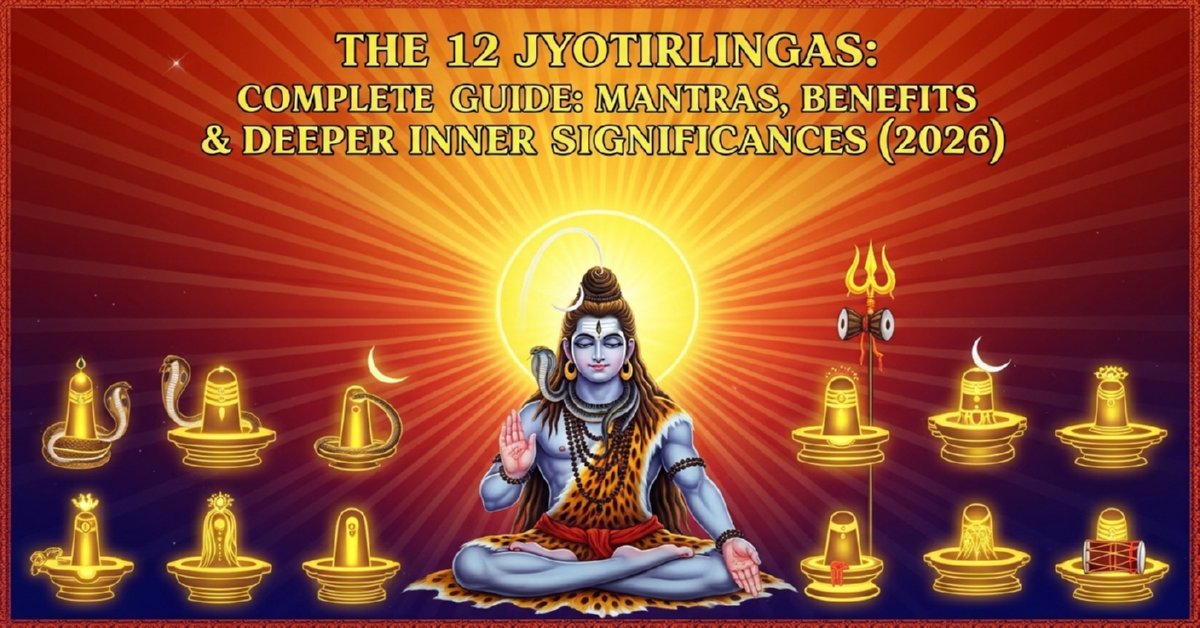
The 12 Jyotirlingas are not merely ancient temples scattered across India — they are living portals of cosmic light-consciousness, each representing a unique dimension of Lord Shiva’s infinite compassion and transformative power. The word Jyotirlinga (ज्योतिर्लिंग) means “Lingam of Light” — a self-manifested pillar of radiant divine energy where Shiva revealed Himself as an endless column of fire.

This comprehensive guide goes far beyond the standard temple-tourism approach. Drawing on the ancient Shiva Purana, Vedic wisdom, and the profound spiritual insights of Sri Amit Ray — renowned for his teachings on the 114 chakras, compassion meditation, and inner transformation — we explore each Jyotirlinga’s specific mantra, location, origin story, spiritual benefits, and deeper inner significance that most guides completely miss.
Whether you’re planning a physical pilgrimage, seeking the right mantra for your spiritual challenge, or yearning to understand what these sacred sites represent within your own consciousness, this is the definitive resource you need.
1. 🔱 What Is a Jyotirlinga? Origin & Cosmic Significance
Etymology: Breaking Down the Sacred Word
| Component | Sanskrit | Meaning |
|---|---|---|
| Jyoti | ज्योति | Light, radiance, cosmic fire — the self-luminous light of pure consciousness |
| Linga | लिंग | Sign, mark, symbol — the formless form; the cosmic egg; the primary symbol of Shiva representing the undifferentiated creative potential |
| Jyotirlinga | ज्योतिर्लिंग | “Pillar/Lingam of Radiant Light” — a site where Shiva manifested as an infinite column of light, piercing through earth and sky |
A Jyotirlinga is fundamentally different from an ordinary Shiva temple. While any temple may house a Shiva Lingam installed through human ritual (manava pratishtha), a Jyotirlinga is believed to be Swayambhu (self-manifested) — Shiva Himself chose to appear at that specific geographical location as a pillar of boundless light.
As Sri Amit Ray explains in his teachings on sacred energy and the 114 chakra system:
“Sacred spaces are not randomly located — they exist at points where the Earth’s energy field naturally supports the upward movement of human consciousness. The ancient sages could perceive these energy nodes and established temples to amplify and preserve these cosmic connections.”
— Inspired by Sri Amit Ray’s teachings on sacred geography and consciousness
How a Jyotirlinga Differs from a Regular Shiva Temple
- Self-Manifested: Jyotirlingas appeared through divine will, not human construction
- Geological Uniqueness: Each site has distinctive geological and electromagnetic properties
- Scriptural Authority: All 12 are specifically named in the Shiva Purana (Shatrudra Samhita)
- Unlimited Power: While all Shiva Lingams are sacred, Jyotirlingas are considered infinitely powerful — capable of granting any boon
- Cosmic Alignment: The 12 locations form a sacred geometric pattern across the Indian subcontinent
The Shiva Purana Verse Naming All 12
सौराष्ट्रे सोमनाथं च श्रीशैले मल्लिकार्जुनम् ।
उज्जयिन्यां महाकालमोंकारममलेश्वरम् ॥
परल्यां वैद्यनाथं च डाकिन्यां भीमशंकरम् ।
सेतुबन्धे तु रामेशं नागेशं दारुकावने ॥
वाराणस्यां तु विश्वेशं त्र्यम्बकं गौतमीतटे ।
हिमालये तु केदारं घृष्णेशं च शिवालये ॥
एतानि ज्योतिर्लिंगानि सायं प्रातः पठेन्नरः ।
सप्तजन्मकृतं पापं स्मरणेन विनश्यति ॥
Translation: “Somnath in Saurashtra, Mallikarjuna on Shrishailam, Mahakal in Ujjain, Omkareshwar on the Narmada, Vaidyanath in Paralya, Bhimashankar in Dakini, Rameshwaram at Setubandha, Nageshwar in Darukavana, Vishweshwar in Varanasi, Trimbakeshwar on the banks of Gautami, Kedarnath in the Himalayas, and Ghrishneshwar in the abode of Shiva. One who recites these twelve Jyotirlingas morning and evening destroys the sins of seven lifetimes through mere remembrance.“
2. 🔥 The Origin Story: The Infinite Pillar of Light (Lingodbhava)
The story of how the Jyotirlingas came to exist is one of the most profound narratives in Hindu cosmology — the Lingodbhava (Emergence of the Lingam).
The Cosmic Debate
At the beginning of a cosmic cycle, Brahma (Creator) and Vishnu (Preserver) began arguing about who was the supreme deity. Their debate escalated into a cosmic conflict that threatened the stability of creation itself.
The Infinite Pillar
To resolve their dispute, Lord Shiva manifested as an immeasurable column of blazing light — a Jyotirlinga — that pierced through all dimensions of existence, stretching infinitely upward and infinitely downward, with neither beginning nor end.
Shiva challenged both gods: “Whoever finds either end of this pillar of light shall be declared supreme.”
The Search
- Brahma transformed into a swan (Hamsa) and flew upward for thousands of years, searching for the top of the pillar. He could not find it.
- Vishnu transformed into a boar (Varaha) and dug downward for thousands of years, searching for the base. He could not find it.
The Revelation
Vishnu returned and humbly admitted that the pillar was infinite and that Shiva was indeed the Supreme Being. Brahma, however, lied — claiming he had found the top, citing a Ketaki flower as false witness.
Shiva, pleased with Vishnu’s honesty and angered by Brahma’s deception:
- Blessed Vishnu to be worshipped equally alongside Himself
- Cursed Brahma to have no dedicated temples (which remains true today — Brahma temples are extremely rare)
- Cursed the Ketaki flower to never be used in Shiva worship
The 12 Jyotirlingas are believed to be the earthly locations where fragments of this infinite pillar of light descended and anchored themselves — permanent gateways between the material world and the infinite light of Shiva consciousness.
“The Lingodbhava story is not just mythology — it is a profound teaching about the nature of consciousness. The infinite pillar of light represents the Atman (Self) — without beginning, without end, unknowable by the mind, accessible only through humble surrender.”
— Interpretation aligned with Sri Amit Ray’s teachings on walking the path of compassion
This origin story has a remarkable parallel in modern astrophysics. NASA’s exploration of the universe reveals that the cosmos itself may be infinite — with no observable edge or boundary. The cosmic microwave background radiation, detected by NASA’s WMAP and Planck missions, represents the oldest light in the universe — a “pillar of primordial light” that permeates all of space, strikingly similar to the Jyotirlinga concept.
3. 🔬 The Science of Sacred Geography & Electromagnetic Fields
Modern science offers fascinating insights into why the 12 Jyotirlinga locations may not be arbitrary. Several scientific principles support the ancient concept of “power spots” on Earth:
Earth’s Electromagnetic Field & Sacred Sites
Research published in Nature — Geophysics has documented that Earth possesses a complex electromagnetic field generated by its molten iron core. This field is not uniform — it has areas of higher and lower intensity, creating what geophysicists call magnetic anomalies.
Many of the world’s most ancient sacred sites — including several Jyotirlingas — are located at points of distinctive geological or electromagnetic significance:
- Somnath: Located on the western coast at a longitude where, according to tradition, there is no land mass directly south until Antarctica — creating unique oceanic energy patterns
- Kedarnath: Situated in the Himalayas at 3,583 meters, near the source of the Mandakini river, in a zone of active tectonic energy
- Omkareshwar: Built on a natural island in the Narmada River that is shaped like the sacred symbol Om (ॐ)
- Rameshwaram: Located at the tip of the Indian peninsula, surrounded by ocean on three sides, at a point of unique tidal and gravitational forces
Neuroscience of Sacred Spaces
Research in environmental neuroscience, documented in Nature Reviews Neuroscience, has shown that certain environments can significantly alter brain states. Factors like:
- Acoustic resonance (temple architecture creates specific sound frequencies)
- Negative ion concentration (higher near rivers, mountains, and waterfalls — common features of Jyotirlinga sites)
- Reduced electromagnetic interference (remote locations away from modern EMF pollution)
- Altitude and air pressure (affects cerebral blood flow and meditative states)
…all contribute to creating neurological conditions conducive to altered states of consciousness, meditation depth, and spiritual experience.
Sri Amit Ray’s research on the 114 chakras provides an additional framework for understanding how these external energy fields interact with the human subtle body. According to Ray, the 114 chakras function as energy transducers — converting environmental electromagnetic signals into subtle body energy. At Jyotirlinga sites, this transduction is amplified, explaining the heightened spiritual experiences reported by pilgrims.
The Sacred Geometric Pattern of the 12 Sites
When the 12 Jyotirlinga locations are plotted on a map of India, they form a remarkable pattern:
- They span the entire Indian subcontinent from Rameshwaram in the south to Kedarnath in the north
- They cover the coast-to-coast breadth from Somnath in the west to Vaidyanath in the east
- Several align along significant river systems (Narmada, Ganga, Godavari)
- The pattern suggests an intentional energy grid — a network of sacred sites that collectively “charge” the entire landmass
NASA’s Earth Science Division has documented similar grid-like patterns in Earth’s magnetic field and geological fault lines, suggesting that ancient civilizations may have possessed a sophisticated understanding of terrestrial energy patterns that modern science is only beginning to rediscover.
4. 🕉️ The 12 Jyotirlingas — Complete Individual Guides
Below is the definitive guide to each of the 12 Jyotirlingas, covering: location, specific mantra, origin story, unique benefits, darshan information, and deeper inner significance. Each section links to the consciousness dimension that Jyotirlinga represents.
① Somnath Jyotirlinga — The Eternal Beginning 🌙
“The First Among Twelve — Where Time Begins”
📍 Location
| Place | Prabhas Patan, Veraval, Gujarat |
| Coordinates | 20.8880° N, 70.4012° E |
| Nearest Airport | Diu Airport (85 km) / Rajkot Airport (164 km) |
| Nearest Railway | Veraval Junction (7 km) |
| Elevation | Sea level (coastal) |
| Darshan Timings | 6:00 AM – 9:30 PM (Aarti: 7:00 AM, 12:00 PM, 7:00 PM) |
| Famous Light & Sound Show | 8:00 PM – 9:00 PM daily (Story of Somnath) |
🕉️ Specific Mantra
ॐ नमः शिवाय सोमनाथाय नमः
“Om Namah Shivaya Somnathaya Namah”
Chant 108 times on Monday nights during waxing moon for maximum effect
📖 Origin Story
The Moon God (Chandra/Soma) had married the 27 daughters (Nakshatras) of Daksha Prajapati. However, Soma showed excessive favoritism toward one wife — Rohini — neglecting the others. Angered, Daksha cursed Soma to lose his light progressively — creating the waning moon cycle.
Devastated, Soma came to Prabhas Kshetra and performed intense penance to Lord Shiva, chanting the Maha Mrityunjaya Mantra ten million times. Shiva, moved by Soma’s devotion, partially lifted the curse — decreeing that the Moon would wax and wane in cycles, never permanently losing his light. Grateful, Soma installed a Shiva Lingam here, naming it Somnath (“Lord of Soma/Moon”).
✨ Specific Benefits
- Healing from mental health challenges — depression, anxiety, mood disorders (Moon governs the mind)
- Relief from Chandra Dosha and unfavorable Moon placement in horoscope
- Restoration of lost vitality, beauty, and radiance
- Blessing for cyclical renewal — ability to recover from setbacks
- Strengthening of emotional resilience
🧘 Deeper Inner Significance
Somnath represents the mind’s relationship with consciousness. The Moon symbolizes the mind (Manas), which waxes and wanes — sometimes brilliant, sometimes dark. The teaching is that even when the mind loses its light (depression, confusion, despair), Shiva’s grace ensures renewal. Light always returns. This is the first lesson of the Jyotirlinga path: no darkness is permanent when you turn to the inner light.
This connects directly to Sri Amit Ray’s teaching on meditation for peace of mind — that the mind’s fluctuations are natural, but the awareness behind the mind (Shiva consciousness) is eternally stable and luminous.
🏛️ Historical Significance
Somnath is renowned for its indomitable spirit of resurrection. The temple was destroyed and rebuilt at least 17 times through history — by Mahmud of Ghazni (1024 CE), Alauddin Khalji (1296 CE), and others — yet each time it rose again. The current temple, rebuilt in 1951 under Sardar Vallabhbhai Patel’s initiative, stands as a testament to the eternal resilience of faith — perfectly embodying Somnath’s core teaching of cyclical renewal.
② Mallikarjuna Jyotirlinga — The Sacred Mountain ⛰️
“Where Shiva and Shakti Unite on the Mountain of Light”
📍 Location
| Place | Srisailam, Kurnool District, Andhra Pradesh |
| Coordinates | 15.8505° N, 78.8688° E |
| Nearest Airport | Hyderabad (213 km) / Kurnool (185 km) |
| Nearest Railway | Markapur Road (90 km) |
| Elevation | 457 meters (Nallamala Hills) |
| Darshan Timings | 4:30 AM – 10:00 PM |
| Unique Feature | Both Jyotirlinga AND Shakti Peetha at same location |
🕉️ Specific Mantra
ॐ श्रीमल्लिकार्जुनाय नमः
“Om Shri Mallikarjunaya Namah”
Chant 108 times for unity in relationships and divine partnership
📖 Origin Story
When Lords Ganesha and Kartikeya competed to circumnavigate the universe first, Ganesha wisely circled his parents (Shiva and Parvati) — declaring them to be his universe — and won. Kartikeya, hurt and feeling cheated, left for the Krauncha mountain in anger.
Heartbroken, Shiva and Parvati followed their son. But Kartikeya kept moving away. Eventually, Shiva chose to remain at Srisailam as a Jyotirlinga — forever close to His son but respecting his space. Parvati settled beside Him as Bhramaramba (a form of Shakti). Together, they wait with eternal parental love — a Jyotirlinga born from the compassion of divine parenthood.
✨ Specific Benefits
- Family harmony and resolution of conflicts between parents and children
- Blessing for marriage and partnerships (Shiva-Shakti together)
- Balancing masculine and feminine energies within oneself
- Relief from Manglik Dosha and relationship obstacles
- Attainment of both material prosperity and spiritual wisdom (Mallika = jasmine = prosperity; Arjuna = white/pure = wisdom)
🧘 Deeper Inner Significance
Mallikarjuna represents the union of Shiva and Shakti — consciousness and energy, masculine and feminine, stillness and movement. It teaches that spiritual wholeness requires integrating both polarities. This aligns with Sri Amit Ray’s teaching on the 114 chakra system, where the balancing of Ida (lunar/feminine) and Pingala (solar/masculine) nadis is essential for awakening the central Sushumna channel — the inner Jyotirlinga.
③ Mahakaleshwar Jyotirlinga — The Lord of Time ⏳
“The One Who Devours Time Itself”
📍 Location
| Place | Ujjain, Madhya Pradesh |
| Coordinates | 23.1828° N, 75.7682° E |
| Nearest Airport | Indore (55 km) |
| Nearest Railway | Ujjain Junction (2 km) |
| Elevation | 494 meters |
| Darshan Timings | 4:00 AM – 11:00 PM |
| Famous Ritual | Bhasma Aarti at 4:00 AM (ash from funeral pyres applied to Lingam) |
| Unique Feature | Only Dakshinamurti (south-facing) Jyotirlinga; Lingam is Swayambhu |
🕉️ Specific Mantra
ॐ महाकालेश्वराय नमः
“Om Mahakaleshwaraya Namah”
Chant 108 times to overcome fear of death, aging, and impermanence
📖 Origin Story
The demon Dushana, having received a boon from Brahma, attacked the city of Avantika (Ujjain) and terrorized its devoted inhabitants. The pious king and citizens prayed intensely to Shiva. Responding with fury and compassion, Shiva emerged from the earth as Mahakal — the embodiment of Time and Death — and destroyed the demon army with a single roar. The devotees begged Him to remain, and Shiva agreed, establishing Himself as the Mahakaleshwar Jyotirlinga.
✨ Specific Benefits
- Overcoming fear of death and existential anxiety
- Time management and discipline — Mahakal governs time itself
- Protection from untimely death and serious accidents
- Karmic acceleration — rapid resolution of pending karmas
- Relief from Saturn (Shani) Dosha and Kaal Sarpa Dosha
- Attainment of Moksha — Ujjain is one of seven Moksha-giving cities
🧘 Deeper Inner Significance
Mahakaleshwar represents the mastery over time and mortality. The south-facing orientation (Dakshinamurti) signifies that Mahakal faces Death (Yama, who resides in the south) directly — conquering it. The famous Bhasma Aarti (where cremation ash is applied to the Lingam) teaches the ultimate truth: all forms return to ash, but consciousness (Shiva) is eternal.
This aligns with research published in Nature on the nature of time in physics — modern quantum mechanics increasingly suggests that time may not be as linear or absolute as we experience it, echoing the Shaivite teaching that Shiva (consciousness) exists beyond time.
Sri Amit Ray’s teaching on mindfulness meditation and living in the moment reflects the Mahakal principle — when consciousness is fully present in the now, it transcends the bondage of past and future. You become Mahakal — the lord of your own time.
④ Omkareshwar Jyotirlinga — The Shape of Om 🕉️
“Where the Cosmic Sound Took Form in Stone”
📍 Location
| Place | Mandhata Island, Narmada River, Khandwa District, Madhya Pradesh |
| Coordinates | 22.2444° N, 76.1512° E |
| Nearest Airport | Indore (77 km) |
| Nearest Railway | Omkareshwar Road (12 km) |
| Unique Feature | The island is naturally shaped like the Om (ॐ) symbol when viewed from above |
🕉️ Specific Mantra
ॐ ओंकारेश्वराय नमः
“Om Omkareshwaraya Namah”
Chant with deep focus on the vibration of Om — 108 times at dawn
📖 Origin Story
Once the Devas (gods) and Danavas (demons) were engaged in a great battle. The Devas, overpowered, meditated on Shiva at the confluence of the Narmada and Kaveri rivers. Pleased, Shiva appeared as the sacred syllable Om and defeated the demons. The Devas requested Shiva to permanently reside at this spot as Omkareshwar. Additionally, the sage Vindhya performed intense penance here, and Shiva blessed him, establishing a second Lingam called Amaleshwar (Mamleshwar) on the southern bank.
✨ Specific Benefits
- Deepening of meditation and mantra practice
- Awakening of Nada (inner cosmic sound)
- Enhanced vocal ability — for singers, teachers, speakers, and preachers
- Clarity of thought and enhanced communication skills
- Connection with the primordial vibration underlying all creation
- Relief from Vaani Dosha (speech-related afflictions)
🧘 Deeper Inner Significance
Omkareshwar is the Jyotirlinga of primordial sound (Nada Brahma). Om is not just a word — it is the vibrational frequency from which the entire universe emerged. Modern physics, as documented by NASA’s Universe research, confirms that the universe began from a singularity that expanded with a primordial vibration — the cosmic microwave background “hum” that still permeates all space.
Sri Amit Ray’s teaching on the breath as the bridge between form and formlessness connects here — the breath carries the subtle vibration of Om, and conscious breathing at Omkareshwar (or while chanting its mantra) attunes the practitioner to the cosmic frequency.
⑤ Kedarnath Jyotirlinga — The Lord of the Sacred Field 🏔️
“The Highest Jyotirlinga — Where Earth Touches Heaven”
📍 Location
| Place | Kedarnath, Rudraprayag District, Uttarakhand |
| Coordinates | 30.7352° N, 79.0669° E |
| Elevation | 3,583 meters (11,755 ft) — highest Jyotirlinga |
| Nearest Airport | Jolly Grant Airport, Dehradun (239 km) |
| Nearest Railway | Rishikesh (216 km) |
| Trek Distance | 16 km from Gaurikund (or helicopter from Phata/Sitapur) |
| Open Season | April/May – November (6 months only; closed in winter) |
| Darshan Timings | 4:00 AM – 9:00 PM (in season) |
🕉️ Specific Mantra
ॐ नमः शिवाय केदारनाथाय नमः
“Om Namah Shivaya Kedaranathaya Namah”
Also: ॐ केदारेश्वराय नमः (“Om Kedareshwaraya Namah”)
📖 Origin Story
After the Mahabharata war, the Pandavas — burdened with the sin of killing their own kinsmen — sought Shiva’s forgiveness. Shiva, avoiding them, disguised Himself as a bull and hid among a herd in the Himalayas. Bhima recognized the divine bull and grabbed its tail. The bull dove into the earth, and its body parts emerged at five different locations — forming the Panch Kedar. The hump (triangular back) emerged at Kedarnath, and Shiva, moved by the Pandavas’ persistent devotion and repentance, forgave their sins and granted them liberation.
✨ Specific Benefits
- Karmic cleansing — purification from the deepest sins and accumulated negative karma
- Forgiveness — ability to forgive self and others for grave wrongs
- Overcoming guilt, shame, and moral suffering
- Moksha — considered one of the most powerful sites for liberation
- Physical and mental endurance (the difficult pilgrimage itself is transformative)
- Connection with Himalayan spiritual energy
🧘 Deeper Inner Significance
Kedarnath teaches the power of sincere repentance and persistent seeking. Even after committing the worst possible act (killing family), the Pandavas were forgiven because their repentance was total. The difficult 16-km trek represents the inner journey — spiritual growth requires effort, sacrifice, and the willingness to climb.
The triangular shape of the Kedarnath Lingam (representing the bull’s hump) symbolizes the Manipura Chakra (solar plexus) — the center of willpower and transformation. According to Sri Amit Ray’s 114 chakra mapping, multiple energy centers exist within the solar plexus complex, all related to personal power, digestive fire (both physical and karmic), and the ability to transform negative experiences into wisdom.
⑥ Bhimashankar Jyotirlinga — The Fierce Protector 🛡️
“Where Divine Wrath Becomes Divine Protection”
📍 Location
| Place | Bhimashankar, Pune District, Maharashtra (Sahyadri Hills) |
| Coordinates | 19.0728° N, 73.5362° E |
| Nearest Airport | Pune Airport (110 km) |
| Nearest Railway | Pune Junction (110 km) |
| Elevation | 1,034 meters (Sahyadri range) |
| Unique Feature | Located in a wildlife sanctuary; home to the Indian Giant Squirrel (Shekru) |
🕉️ Specific Mantra
ॐ भीमशंकराय नमः
“Om Bhimashankaraya Namah”
Chant for protection, courage, and overcoming powerful enemies
📖 Origin Story
The demon Bhima, son of Kumbhakarna, grew up not knowing his father’s fate. Upon learning that Vishnu (as Rama) had slain Kumbhakarna, Bhima was filled with rage. He performed severe penance, gained immense power from Brahma, and began conquering the three worlds — even defeating Indra and imprisoning Kamakhya Devi.
He attacked the devotee Kamarupeshwar, who was engaged in Shiva worship. When Bhima tried to destroy the Shiva Lingam, Shiva emerged in His fierce Bhima form and reduced the demon to ashes with a single glance. The sweat from Shiva’s fierce battle formed the river Bhima. The gods requested Shiva to remain as Bhimashankar.
✨ Specific Benefits
- Protection from enemies and malicious forces
- Overcoming legal disputes and competitive challenges
- Courage and fearlessness in the face of adversity
- Breaking free from oppressive situations (jobs, relationships, addictions)
- Healing from skin diseases (traditional belief)
- Environmental blessing — the wildlife sanctuary setting amplifies natural healing
🧘 Deeper Inner Significance
Bhimashankar represents fierce compassion — the dimension of love that fights, protects, and destroys what threatens the vulnerable. It teaches that compassion is not passive; sometimes love must be fierce to be effective. Sri Amit Ray explores this principle in his teachings on compassion — true compassion includes the courage to confront injustice, to say no, to set boundaries, and to fight for those who cannot fight for themselves.
⑦ Kashi Vishwanath Jyotirlinga — The Lord of the Universe 🌌
“The Holiest of Holy — Where Death Itself Becomes Liberation”
📍 Location
| Place | Varanasi (Kashi/Banaras), Uttar Pradesh |
| Coordinates | 25.3109° N, 83.0107° E |
| Nearest Airport | Lal Bahadur Shastri Airport, Varanasi (26 km) |
| Nearest Railway | Varanasi Junction (2 km) |
| Darshan Timings | 2:30 AM – 11:00 PM (Multiple aarti timings) |
| New Feature | Kashi Vishwanath Corridor (opened 2021) — magnificent temple complex |
| Unique Significance | Oldest continuously inhabited city in the world; Shiva’s permanent abode on Earth |
🕉️ Specific Mantra
ॐ विश्वनाथाय नमः काशी विश्वेश्वराय नमः
“Om Vishwanathaya Namah Kashi Vishweshwaraya Namah”
Chant for Moksha (liberation), universal wisdom, and total spiritual fulfillment
📖 Origin Story
Kashi is not merely a city where Shiva chose to reside — according to the Skanda Purana, Kashi IS Shiva’s Trishul (trident), upon whose three prongs the entire city rests. When the universe is destroyed at the end of each cosmic cycle, Kashi alone remains — lifted upon Shiva’s trident above the waters of dissolution.
Shiva Himself declared: “Kashi is my body. The Ganga is my flowing compassion. Vishwanath is my heart. I never leave Kashi — even for a moment.” According to tradition, Shiva personally whispers the Taraka Mantra (the mantra of liberation) into the ear of everyone who dies in Kashi, guaranteeing their Moksha.
✨ Specific Benefits
- Moksha (Liberation) — considered the single most powerful place for spiritual liberation
- Destruction of all accumulated sins (Saptajanma Papa — sins of seven lifetimes)
- Complete spiritual fulfillment — worshipping at Kashi is said to equal worshipping at all other sacred sites combined
- Wisdom and learning — Kashi has been India’s greatest center of knowledge for millennia
- Blessings for scholars, teachers, and students
- Healing from chronic and incurable diseases
🧘 Deeper Inner Significance
Kashi Vishwanath represents the universe (Vishwa) within consciousness (Nath/Ishwara). It teaches that the entire cosmos exists within you — you don’t need to go anywhere to find the divine. The city’s name “Kashi” means “the luminous one” — it represents the inner light of awareness that illuminates all experience.
The tradition that dying in Kashi grants Moksha carries a profound inner meaning: when the ego “dies” in the light of pure awareness (Kashi = inner luminosity), liberation is automatic. You don’t need to physically die in Varanasi — you need the “Kashi” of heightened awareness to be present at the moment of ego-death (meditation).
This connects beautifully with Sri Amit Ray’s teaching on the power of thoughts — when awareness becomes so luminous that it sees through all thoughts (like Kashi’s light illuminating all darkness), the mind naturally dissolves into its source.
⑧ Trimbakeshwar Jyotirlinga — The Three-Eyed Lord 👁️👁️👁️
“Source of the Sacred Godavari — Where Three Eyes See Three Worlds”
📍 Location
| Place | Trimbak, Nashik District, Maharashtra |
| Coordinates | 19.9322° N, 73.5311° E |
| Nearest Airport | Nashik / Mumbai (180 km) |
| Nearest Railway | Nashik Road (28 km) |
| Unique Feature | Lingam has three faces representing Brahma, Vishnu, and Shiva; source of River Godavari |
🕉️ Specific Mantra
ॐ त्र्यम्बकेश्वराय नमः
“Om Tryambakeshwaraya Namah”
Also the source of the Maha Mrityunjaya Mantra: “Om Tryambakam Yajamahe…”
📖 Origin Story
The sage Gautam Rishi lived on Brahmagiri hill with his wife Ahilya. Other jealous sages conspired against him, using magic to place a dead cow at his ashram entrance. Falsely accused of cow-killing (Gohatya), Gautam was ostracized. He performed intense penance to Shiva, who appeared and directed Ganga to descend from His hair at this location as the River Godavari (also called Gautami Ganga) — purifying Gautam of the false sin and the entire region. Shiva remained as Trimbakeshwar.
✨ Specific Benefits
- Kaal Sarpa Dosha Puja — Trimbakeshwar is THE primary temple for this powerful astrological remedy
- Narayan Nagbali Puja — for liberation of ancestors’ souls (Pitru Dosha)
- Tripindi Shradh — ancestral healing rituals
- Cure for false accusations and clearing one’s name
- Purification from sins committed knowingly or unknowingly
- Third eye intuitive awakening
🧘 Deeper Inner Significance
Trimbakeshwar embodies the power of the three eyes — which represent three modes of perception: physical sight (left eye = Moon), intellectual sight (right eye = Sun), and spiritual sight (third eye = Fire/Agni). The three-faced Lingam teaches that to see reality completely, we must engage all three — perceiving the physical, understanding through intellect, and intuiting through wisdom.
This corresponds to research in Nature Reviews Neuroscience on multi-modal perception — the brain integrates visual, cognitive, and intuitive processing to construct our experience of reality. Sri Amit Ray’s work on the third eye chakra complex (which includes multiple subtle centers beyond the commonly known Ajna) provides the yogic framework for developing this integrated perception.
⑨ Vaidyanath Jyotirlinga — The Divine Healer 💊
“The Lord Who Cures All — Doctor of the Three Worlds”
📍 Location
| Place | Deoghar, Jharkhand (also called Baidyanath Dham) |
| Coordinates | 24.4921° N, 86.6945° E |
| Nearest Airport | Ranchi (250 km) / Patna (281 km) |
| Nearest Railway | Baidyanath Dham / Jasidih Junction (7 km) |
| Darshan Timings | 4:00 AM – 3:30 PM, 6:00 PM – 9:00 PM |
| Famous Festival | Shravan Mela (July-Aug) — one of India’s largest congregations |
🕉️ Specific Mantra
ॐ वैद्यनाथाय नमः
“Om Vaidyanathaya Namah”
Chant 108 times for healing from chronic illness and health restoration
📖 Origin Story
Ravana, the great devotee of Shiva, performed severe penance on Mount Kailash. He offered nine of his ten heads, one by one, to Shiva. Moved by this extreme devotion, Shiva appeared, healed all of Ravana’s heads, and granted him the boon of invincibility. The name Vaidyanath (Lord of Physicians/Healers) was given because Shiva acted as the divine physician who restored Ravana’s severed heads.
Ravana tried to carry the Shiva Lingam to Lanka, but Vishnu, using a trick, caused Ravana to set it down at this spot. Once placed on earth, the Lingam became immovable — establishing the Vaidyanath Jyotirlinga.
✨ Specific Benefits
- Healing from chronic diseases — physical, mental, and spiritual
- Cure for otherwise incurable conditions
- Blessing for doctors, healers, and medical professionals
- Longevity and vitality
- Protection from epidemics and pandemics
- Overcoming addiction and substance dependency
- Emotional and psychological healing from trauma
🧘 Deeper Inner Significance
Vaidyanath represents Shiva as the healer of all wounds — physical, emotional, karmic, and existential. The story of restoring Ravana’s heads (even though Ravana was an “enemy” of the gods) demonstrates that Shiva’s healing compassion is unconditional — He heals anyone who approaches with sincere devotion, regardless of their moral record.
Modern medical research, including studies published in Nature Medicine, increasingly recognizes the mind-body connection in healing. Sri Amit Ray’s approach to integrating yoga, meditation, and healing provides practical methods for activating the body’s innate healing intelligence — the inner Vaidyanath.
⑩ Nageshwar Jyotirlinga — The Lord of Serpents 🐍
“Protector from All Poisons — Internal and External”
📍 Location
| Place | Daarukavanam, Dwarka, Gujarat |
| Coordinates | 22.3327° N, 68.9600° E |
| Nearest Airport | Jamnagar (137 km) |
| Nearest Railway | Dwarka (17 km) |
| Unique Feature | Near the legendary Dwarkadhish Temple (Lord Krishna); massive 25m outdoor Shiva statue |
🕉️ Specific Mantra
ॐ नागेश्वराय नमः
“Om Nageshwaraya Namah”
Chant for protection from poisons (physical, emotional, karmic) and Kundalini awakening
📖 Origin Story
The demon Daaruka and his wife Daaruki had received a boon from Goddess Parvati that made them nearly invincible. They terrorized the world, capturing many people including a devout Shiva bhakt named Supriya. Even in captivity, Supriya continued chanting Om Namah Shivaya and inspired all the prisoners to join.
Enraged, Daaruka tried to kill Supriya. At that moment, Shiva manifested as Nageshwar — the Lord of Serpents — and destroyed the demon with His divine weapon, the Pashupatastra. The area became known as Daarukavanam (Daaruka’s forest), and Shiva remained as the Nageshwar Jyotirlinga.
✨ Specific Benefits
- Protection from all forms of poison — snake bites, toxic relationships, poisonous thoughts
- Kaal Sarpa Dosha remedy and Rahu-Ketu pacification
- Kundalini awakening — the serpent represents Kundalini energy
- Freedom from fears and phobias (especially related to serpents, darkness, and death)
- Protection from black magic and negative energies
- Detoxification — physical and emotional cleansing
🧘 Deeper Inner Significance
Nageshwar represents the mastery of Kundalini energy — the coiled serpent power at the base of the spine. In the 114 chakra framework described by Sri Amit Ray, the Kundalini passes through numerous energy centers as it ascends. Nageshwar teaches that this powerful energy must be approached with reverence — like approaching a serpent. When properly channeled through meditation, it illuminates all 114 chakras; when mishandled, it can cause harm.
The serpent symbolism also connects to modern neuroscience. The vagus nerve — often called the “wandering nerve” — winds through the body like a serpent and is the primary conduit of the parasympathetic nervous system. Research in Nature Reviews Neuroscience has shown that vagal stimulation promotes states of calm, compassion, and social bonding — strikingly similar to what yogic tradition describes as Kundalini’s effect when it flows through the body’s energy channels.
⑪ Rameshwaram Jyotirlinga — Rama’s Lord 🏹
“Where Even God Worships God — The Southernmost Light”
📍 Location
| Place | Rameshwaram Island, Ramanathapuram District, Tamil Nadu |
| Coordinates | 9.2882° N, 79.3174° E |
| Nearest Airport | Madurai Airport (174 km) |
| Nearest Railway | Rameshwaram (1 km) — connected by Pamban Bridge |
| Darshan Timings | 5:00 AM – 1:00 PM, 3:00 PM – 9:00 PM |
| Unique Feature | World’s longest temple corridor (1,220 meters); 22 sacred Theerthams (holy water tanks); Adam’s Bridge/Ram Setu visible nearby |
🕉️ Specific Mantra
ॐ रामेश्वराय नमः
“Om Rameshwaraya Namah”
Chant for dissolution of Brahmahatya dosha and ultimate devotion
📖 Origin Story
After defeating Ravana (a Brahmin) in the epic war, Lord Rama was afflicted by Brahmahatya Dosha — the sin of killing a Brahmin. The sages advised Him to worship Lord Shiva to absolve this sin. Rama sent Hanuman to Mount Kailash to bring a Shiva Lingam, but when Hanuman was delayed, Sita Devi created a Lingam from sand so Rama could worship at the auspicious time.
When Hanuman returned with a Kailash Lingam, Rama, to honor Hanuman’s devotion, installed both Lingams — decreeing that the Kailash Lingam (Vishwanath/Hanuman Lingam) should be worshipped first, and then the sand Lingam (Ramanathaswamy). This Jyotirlinga is unique because it was established by God Himself worshipping God — Vishnu’s avatar (Rama) worshipping Shiva.
✨ Specific Benefits
- Removal of Brahmahatya Dosha and all Pitru Dosha
- Bathing in the 22 Theerthams cures specific diseases (each tank has a unique healing property)
- Attainment of Moksha — one of the Char Dham (four divine abodes)
- Humility and devotion — even God worshipped God here
- Success in overcoming impossible challenges (as Rama overcame the ocean)
- Blessing for marriages and relationships (Rama-Sita’s devotion together)
🧘 Deeper Inner Significance
Rameshwaram teaches the most radical spiritual lesson: even the divine needs the divine. Rama, an avatar of Vishnu, worshipping Shiva demonstrates that no one is too great for humility, no one is beyond the need for grace. It dissolves the sectarian divide between Shaivism and Vaishnavism — revealing that Shiva and Vishnu are ultimately one consciousness expressed in different modes.
The Ram Setu (Adam’s Bridge) connecting India to Sri Lanka, visible from Rameshwaram and documented by NASA’s Earth observation satellites, remains one of the most fascinating intersections of mythology and geological science — a chain of limestone shoals that precisely matches the description in the Ramayana.
⑫ Grishneshwar Jyotirlinga — The Lord of Compassion 💛
“The Last Jyotirlinga — Where the Journey Culminates in Pure Compassion”
📍 Location
| Place | Ellora, Aurangabad District, Maharashtra (near Ellora Caves — UNESCO World Heritage Site) |
| Coordinates | 20.0235° N, 75.1793° E |
| Nearest Airport | Aurangabad Airport (30 km) |
| Nearest Railway | Aurangabad (30 km) |
| Darshan Timings | 5:30 AM – 9:30 PM |
| Must-Visit Nearby | Ellora Caves (1 km) — 34 rock-cut caves including the magnificent Kailasa Temple (Cave 16) |
🕉️ Specific Mantra
ॐ घृष्णेश्वराय नमः
“Om Ghrishneshwaraya Namah”
Also: ॐ कुसुमेश्वराय नमः (“Om Kusumeshwaraya Namah”)
Chant for compassion, renewal after loss, and new beginnings
📖 Origin Story
A devoted woman named Kusuma would create 101 Shiva Lingams daily from clay, worship them, and immerse them in a nearby lake. Her jealous co-wife, consumed by envy, murdered Kusuma’s son and threw his body into the same lake. When Kusuma came to immerse her Lingams and discovered her son’s body, she did not waver in her devotion — she continued her worship with unshaken faith.
Shiva, overwhelmed by her supreme devotion and compassion, appeared and restored her son to life. He offered to punish the co-wife, but Kusuma asked Shiva to forgive her instead. Moved by this extraordinary act of compassion — forgiving the murderer of her own child — Shiva remained at this spot as Grishneshwar (also called Ghushmeshwar/Kusumeshwar).
✨ Specific Benefits
- Overcoming grief and loss — especially the loss of children, loved ones
- Developing the capacity for radical forgiveness
- Fertility blessings and safe pregnancy
- New beginnings after devastating setbacks
- Cultivation of unconditional compassion
- Breaking cycles of jealousy, envy, and comparison
- Blessings for artistic and creative endeavors (near the magnificent Ellora Caves)
🧘 Deeper Inner Significance
Grishneshwar, the twelfth and final Jyotirlinga, represents the culmination of the spiritual journey in compassion. It is profoundly significant that the last Jyotirlinga is one born from a woman’s unbreakable devotion and her willingness to forgive the unforgivable.
This perfectly mirrors Sri Amit Ray’s teaching that compassion is the highest spiritual attainment — not intellectual knowledge, not yogic powers, not ritual perfection, but the capacity to hold love even in the face of the worst suffering. Kusuma embodies what Ray calls “transcendental compassion” — compassion that goes beyond logic, beyond justice, beyond the ego’s need for retribution.
That the Jyotirlinga journey begins with Somnath (the mind seeking healing) and ends with Grishneshwar (the heart achieving perfect compassion) tells us the deepest truth of Shaivism: the purpose of all spiritual practice is not power, not knowledge, not even liberation — it is the flowering of compassion.
5. 🧘 The Deeper Inner Significance: 12 Jyotirlingas as 12 Dimensions of Consciousness
Beyond their geographical and mythological significance, the 12 Jyotirlingas can be understood as a map of human spiritual evolution — twelve progressive stages of consciousness awakening. This interpretation is informed by Sri Amit Ray’s framework of integrated consciousness development.
| # | Jyotirlinga | Consciousness Dimension | Inner Journey |
|---|---|---|---|
| 1 | Somnath | Mind Healing | Accepting the mind’s cycles; finding stability amid fluctuation |
| 2 | Mallikarjuna | Sacred Union | Integrating masculine-feminine, logic-intuition, action-receptivity |
| 3 | Mahakaleshwar | Time Mastery | Transcending fear of death; living fully in the present moment |
| 4 | Omkareshwar | Primordial Sound | Accessing the cosmic vibration; deepening meditation through Nada |
| 5 | Kedarnath | Karmic Purification | Sincere repentance; transforming guilt into grace through persistent effort |
| 6 | Bhimashankar | Fierce Protection | Developing courage; learning when compassion requires strength |
| 7 | Kashi Vishwanath | Universal Vision | Seeing the universe within; the inner luminosity that illuminates all |
| 8 | Trimbakeshwar | Triple Perception | Integrating physical, intellectual, and intuitive knowing |
| 9 | Vaidyanath | Deep Healing | Healing all wounds — physical, emotional, ancestral, karmic |
| 10 | Nageshwar | Energy Mastery | Awakening and channeling Kundalini; transmuting poison into nectar |
| 11 | Rameshwaram | Sacred Humility | Even the divine bows to the divine; dissolving spiritual ego |
| 12 | Grishneshwar | Ultimate Compassion | Forgiving the unforgivable; compassion as the flower of all spiritual practice |
“The outer pilgrimage to twelve temples mirrors an inner pilgrimage through twelve dimensions of your own consciousness. You don’t need to travel thousands of kilometers — every Jyotirlinga exists within you, waiting to be illuminated by awareness and devotion.”
— Interpretation inspired by Sri Amit Ray’s integrated spiritual approach
6. 📿 Master Mantra Guide: All 12 Jyotirlinga Mantras at a Glance
Here is the complete collection of all 12 Jyotirlinga-specific mantras for quick reference and daily chanting:
| # | Jyotirlinga | Mantra (Sanskrit) | Best For |
|---|---|---|---|
| 1 | Somnath | ॐ सोमनाथाय नमः | Mental peace, emotional healing |
| 2 | Mallikarjuna | ॐ मल्लिकार्जुनाय नमः | Relationships, unity |
| 3 | Mahakaleshwar | ॐ महाकालेश्वराय नमः | Overcoming fear, time mastery |
| 4 | Omkareshwar | ॐ ओंकारेश्वराय नमः | Meditation depth, creativity |
| 5 | Kedarnath | ॐ केदारनाथाय नमः | Spiritual elevation, liberation |
| 6 | Bhimashankar | ॐ भीमाशंकराय नमः | Strength, overcoming enemies |
| 7 | Kashi Vishwanath | ॐ विश्वेश्वराय नमः | Moksha (liberation), wisdom |
| 8 | Trimbakeshwar | ॐ त्र्यम्बकेश्वराय नमः | Detoxification, health |
| 9 | Vaidyanath | ॐ वैद्यनाथाय नमः | Healing, medicine |
| 10 | Nageshwar | ॐ नागेश्वराय नमः | Protection from poison/negativity |
| 11 | Rameshwaram | ॐ रामेश्वराय नमः | Clearing karmic debts |
| 12 | Grishneshwar | ॐ गृष्णेश्वराय नमः | Fulfillment of desires |
Conclusion: The Eternal Light Within
As we complete this journey through the 12 Jyotirlingas of India, we recognize that these are not merely physical temples or geographic locations, but profound energetic gateways to consciousness itself. Each Jyotirlinga represents a unique facet of Shiva’s infinite nature, serving as a mirror to our own inner divine potential.
Key Insights to Carry Forward:
- Inner Pilgrimage: The true pilgrimage occurs within. Each mantra and spiritual practice brings you closer to recognizing the Jyotirlinga of consciousness that already exists in your own heart center.
- Daily Integration: You don’t need to travel thousands of miles to connect with these energies. Through regular chanting, meditation, and conscious living, you can invite these transformative frequencies into your daily life.
- Holistic Transformation: The Jyotirlingas address the complete human experience—from health and relationships (Vaidyanath, Mallikarjuna) to time mastery and liberation (Mahakaleshwar, Kashi Vishwanath).
- Timeless Relevance: In our modern world of 2026, these ancient spiritual technologies remain remarkably relevant, offering antidotes to stress, fragmentation, and spiritual seeking.
The journey through the twelve sacred sites—from the oceanic shores of Somnath to the Himalayan heights of Kedarnath, from the primordial sound of Omkareshwar to the liberating wisdom of Kashi Vishwanath—maps a complete spiritual evolution. This pilgrimage, whether undertaken physically or through dedicated practice, systematically awakens, purifies, and illuminates every layer of our being.
“The Jyotirlingas are not stones to be worshipped, but states of consciousness to be realized. When the outer light becomes an inner sight, the pilgrimage is complete.”
Your Personal Jyotirlinga Practice in 2026 and Beyond
As we move forward in this rapidly evolving world, consider integrating this wisdom practically:
📿 Daily Mantra Rotation
Choose one Jyotirlinga mantra each month, cycling through all twelve over the year. Notice how different energies support different phases of your life.
🌙 New Moon Contemplation
Each new moon, meditate on a different Jyotirlinga, reflecting on its qualities and how they manifest in your life. The twelve-month cycle creates a powerful spiritual rhythm.
✨ Virtual Pilgrimage
Use technology mindfully—virtual darshans, guided meditations, and online satsangs can support your practice between physical visits to the temples.
Remember that the ultimate purpose of engaging with the Jyotirlingas is self-realization—recognizing that the light you seek in these sacred sites already burns brightly within you. The mantras, pilgrimages, and practices are simply methods to remove the obstructions that prevent you from experiencing this truth directly.
The Journey Continues
May this guide serve as a living companion on your spiritual path. Return to it often, not as a fixed destination, but as a map that reveals new territories as you evolve. The Jyotirlingas have illuminated paths for thousands of years, and they continue to offer their timeless light to all sincere seekers in 2026 and beyond.
ॐ नमः शिवाय
Om Namah Shivaya
Article last updated: February 2026 | May your inner light shine brightly