
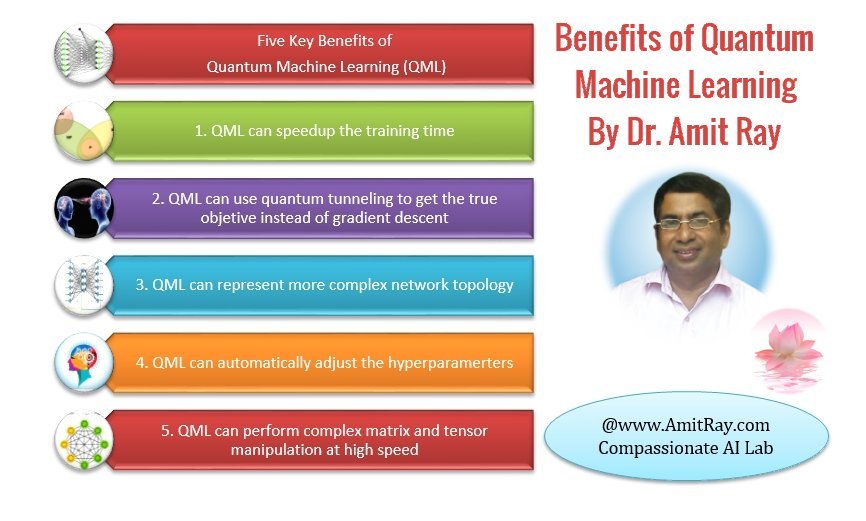
Five Key Benefits of Quantum Machine Learning
Five Key Benefits of Quantum Machine Learning Here, Dr. Amit Ray discusses the five key benefits of quantum machine learning. […]
Five Key Benefits of Quantum Machine Learning Here, Dr. Amit Ray discusses the five key benefits of quantum machine learning. […]
How many qubits are needed to outperform conventional computers? How to protect a quantum computer from the effects of decoherence? […]
The Many-Worlds Interpretation (MWI) of quantum mechanics posits that all possible outcomes of quantum measurements are realized, each in a […]
Upanishadic Meditation and Quantum Consciousness Online Class Upanishads are the most ancient literature of meditations. They are considered as the […]
Here we discussed the advantages and limitations of seven key qubit technologies for designing efficient quantum computing systems. The details of qubit types Superconducting qubits , Quantum dots qubits , Trapped Ion Qubits , Photonic qubits , Defect-based qubits , Topological Qubits , and Nuclear Magnetic Resonance (NMR) are discussed.
Here, we discussed seven key requirements for implementing efficient quantum computing systems. The seven key requirements are long coherence time, […]
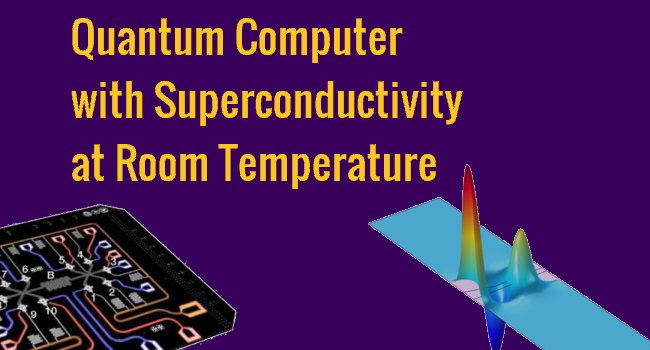
Quantum computer with superconductivity at room temperature is going to change the landscape of artificial intelligence. In this article we reviewed the implication of superconductivity at room temperature on quantum computation and its impact on artificial intelligence. Long coherence time (synchronized), low error rate and high scalability are the three prime requirements for quantum computing.
Quantum Computing Algorithms for Artificial Intelligence Dr. Amit Ray explains the quantum annealing, Quantum Monte Carlo Tree Search, Quantum algorithms for traveling […]
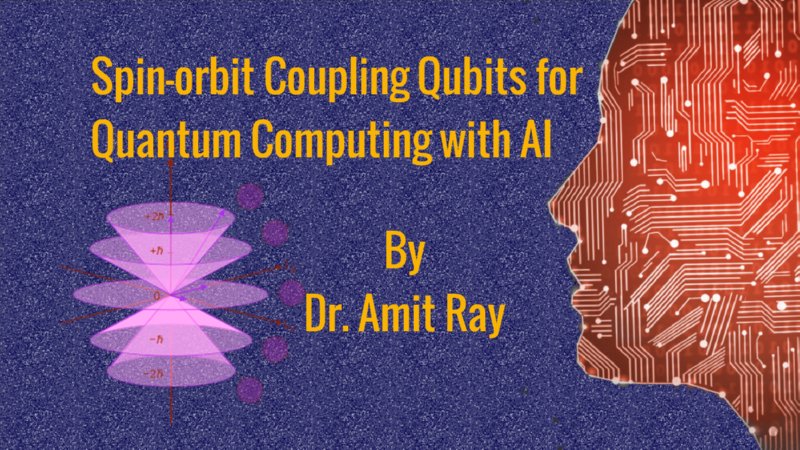
The Power of Spin-orbit Coupling Qubits for Quantum Computing Here, Dr. Amit Ray discusses the power, scope, and challenges of Spin-orbit […]
Quantum Computing and Artificial Intelligence Here, Sri Amit Ray discusses the power, scope, and challenges of Quantum Computing and Artificial […]